The big picture
The whole system in one view, before the eleven teardowns: who builds each piece, how data flows from the ball to your phone, and what is still unknown.
TL;DR
Calling the ball a computer is a slight stretch. It is closer to a sensor with a radio. But follow what it does, five hundred times a second, and "computer" stops feeling wrong.
The one-line answer. A moment on the pitch becomes data on a phone because two separate sensing systems watch every play and one shared clock welds them together. A sensor in the ball reports when. Sixteen cameras rebuild every player as a moving skeleton to report where and who. A clock accurate to about a millionth of a second stamps both, so software can ask what happened at the precise instant of a kick. Everything after that (the offside verdict, the broadcast graphics, the 2,000-plus stats, the team AI, the fan app) is built on those two streams and that one clock.
Five things worth knowing before the deep dives:
- It is a timing system first. The clever part is not any single sensor but the shared timeline they land on (PTP, the IEEE-1588 protocol), which lines up "boot strikes ball" with where every defender stood at that frame. Get the clock wrong and the offside line is wrong. It also holds the least public detail of anything here.
- The ball reports itself. Inside the Adidas Trionda, fixed behind one of the panels, sits a sensor module, not a computer, that times contact to about two milliseconds and broadcasts its position roughly a hundred times a second over ultra-wideband radio. The host chip reads straight off the FCC teardown photos (an Arm Cortex-M0+). What those photos cannot resolve, and the report's single biggest unknown, is which ultra-wideband chip the 2026 ball carries and whether it does cryptographic secure-ranging.
- Sony is the parent behind several of the vendors. The optical engine that draws the offside line (Hawk-Eye) and one of the two big wearable-vest vendors (STATSports) are both Sony. One company sits on both the officiating side and the training-data side of the same sport. This is a consolidation story worth knowing. The two tiers do not connect.
- The new AI is real, but its engine is unnamed. Football AI Pro is a working assistant: all 48 teams ask it questions in plain language and get back text, video, and 3-D answers drawn from 2,000-plus metrics. Teams reach it through a login-gated web portal, not a public app. Which foundation model sits underneath is not stated in any public source. The best-supported inference is a Lenovo-hosted, open-weight (Llama-class) model. No evidence points to ChatGPT, Claude, or Bedrock, and that read is labeled inference, not fact. inference
- The fan feed is wide open; the player feed is not. The same family of stats reaches the public fan app through an endpoint that, as far as the code shows, carries no key at all, and reaches the players' app from behind a per-user login. Same data, opposite front doors. That contrast is the cleanest answer to "how does the app get its data."

How to read this report
Two registers run in parallel: a narrative and visual layer (the map, the story, the figures) for the big picture, and eleven technical deep dives that follow one ball through the stack for the substance an engineer wants. Cross-links connect them. Three habits will help:
Every claim is labeled
Look for the badge after a claim:
Verified = primary or multi-source. Inference = a reasoned read, labeled as such. Unverifiable = non-public.
The map has seven lenses
The same entities carry seven relationship types. Toggle them on the map:
Highlight anything
All text, including diagram and table labels, is real, selectable text, so any phrase can be highlighted for dictionary lookup or translation. Dotted terms (like this) show a definition on hover; the full glossary defines them all.
The ecosystem, as one map
This is the whole stack as a single connected web (silicon, servers, clouds, identity providers, vendors, owners, boards and build responsibilities) over the four pipeline layers. Click any node for its full dossier (specs, owner, host/ASN, FCC teardown photo, sources). Toggle lenses to switch from "how data flows" to "who owns what" to "who built what." Use the confidence filter to reveal only verified facts, or to surface the disputed/inferred ones. The map is a navigable confidence ledger: every node and edge carries its label and sources.
Built from graph.json, the synthesis of the verified corpus. Hub nodes (the PTP clock, the fusion engine, the
Data Hub, the clouds, the IdPs, Sony) are single shared nodes, which is why focusing one entity lights up its role across every lens.
Who's who
The cast that designs, builds, operates and owns the stack. Full ownership chains, board interlocks and the "shell count" sit in the corporate section.
Governing body & its joint venture
FIFA
Owns the competition, the data, the FIFA Data Hub, the EFI metric space and the "Football Language Model." Departments: Football Technology & Innovation; Football Performance Analysis & Insights.
Football Technology Centre AG
The FIFA × Hawk-Eye joint venture that operates the optical / offside engine. A 3-director Zürich holding company (CHF/USD 120k capital), statute 31 Oct 2024.
IFAB
The lawmaker. Approves the SAOT protocol and the equipment laws (Law 4) that make the connected ball and automated alerts legal.
The technology vendors
Sony / Hawk-Eye
Hawk-Eye Innovations (100% Sony) builds the optical tracking + SAOT fusion + SkeleTRACK pose engine. Sony also owns STATSports (maj.), KinaTrax, Beyond Sports, Pulselive.
KINEXON
The in-ball sensor + UWB local-positioning system (anchors, tags, edge). FIFA Preferred Provider for live player & ball tracking (Jul 2022). Munich; backed by a $130M Series A led by THL.
Adidas
Official match ball (Trionda, 2026, and Al Rihla, 2022), housing the KINEXON module. FIFA partner through 2030.
Lenovo
Official Technology Partner (2024-10-15). AI (Football AI Pro), 3-D avatars, RefCam AI stabilization, broadcast IT (ThinkSystem servers @ Dallas IBC), the Miami command center. Runs on NVIDIA.
Catapult & STATSports
Training-tier wearables (GNSS/UWB/IMU vests). Catapult Vector; STATSports Apex (Sony-owned). FIFA-quality vendors, not central WC2026 official partners.
Riedel & Verizon
Riedel: the RefCam (14 g, 1080p50) + Easy5G private 5G + comms. Verizon: private 5G at all 16 venues plus the ~7 Tb/s contribution feed to the Dallas IBC.
Named public figures (professional role only)
| Person | Public role | Why they matter here |
|---|---|---|
| Johannes Holzmüller | FIFA Director of Football Technology & Innovation; President, FTC AG board | The regulator↔JV-board interlock: heads the FIFA function and chairs the joint venture it contracts. |
| Yuanqing Yang | Lenovo Chairman & CEO | On stage with FIFA's president to unveil the 2026 AI bundle. |
| Art Hu | Lenovo CIO | FIFA 2026 innovation briefing; the operational AI/IT owner on Lenovo's side. |
| Winston Cheng | Lenovo CFO | Stated the multi-LLM "orchestrator / we're not doing our own LLM" strategy, the spine of the foundation-model verdict (the AI section). |
Individuals appear only in their public professional capacity; no private information is compiled.
The story, start to finish
Follow one ball.
The kick
Late in a group-stage match, a midfielder clips a through-ball. Inside that ball, a KINEXON sensor module has been sampling its own motion 500 times a second. The boot's impact is a spike the accelerometer cannot miss, and the firmware marks that 2-millisecond sample as the instant of contact. At the same time the ball is broadcasting its position about a hundred times a second over ultra-wideband radio to a ring of receivers around the pitch. On its own, the ball has just answered when and roughly where. → §1, the connected ball.
Two ways of seeing
The ball only knows about itself. To place every player, sixteen dedicated cameras in the stadium roof watch the pitch and a Hawk-Eye model called SkeleTRACK rebuilds each player as a 29-point skeleton about 50 times a second, on the order of 150 million tracking points in one match. Separately, before the tournament, all 1,248 players were 3-D scanned in roughly a second each into accurate avatars. Skeletons for the geometry, avatars for the picture. → §2, optical tracking; §3, the parallel wearable tier.
One clock
Here is the hard part. The ball's radio stream and the camera skeletons are two different machines seeing two different things. They are only useful together if you know they are describing the same instant. A shared clock, Precision Time Protocol, stamps both onto one timeline good to about a millionth of a second. This is the quiet linchpin of the whole system, and also the thing FIFA says least about. → §4, transport and timing.
The verdict
With the contact instant and every player's position on one clock, offside becomes arithmetic. A fusion engine, owned by a FIFA-Hawk-Eye joint venture, picks the frame of the pass, finds the second-to-last defender, draws the line, and tests whether the attacker is beyond it. New for 2026, a clear call sends an automated audio alert straight to the assistant referee's earpiece. If it is tight, a human still reviews it. The same skeletons get dressed in the avatar to make the on-screen graphic. → §5, fusion and the verdict.
The firehose and its gate
The tracking data that settles offside also feeds a far bigger machine. FIFA's Data Hub turns it into more than 2,000 metrics, from line breaks, pressing, phases of play, a power index. Pitch to screen runs in under 30 seconds, but the last step is human: two analysts decide when each stat is allowed to appear, which is as much editorial control as engineering. → §6, the data format; §7, redistribution and EFI.
The new brain
On top of all that data sits Football AI Pro. A coach asks, in plain language, "show me their build-up under pressure," and gets back video, charts, and 3-D scenes drawn from 2,000-plus metrics. All 48 teams get equal access, through a login-gated web portal, before and after matches but never live. What powers it underneath is the report's headline AI question, and the honest answer is that no public source names it. → §8, the AI layer.
How it moves
None of this works without shifting enormous amounts of data off the pitch fast. Verizon runs private 5G at all 16 venues and the contribution network back to a central broadcast hub in Dallas. The referee's body-camera rides its own private 5G. And FIFA's blessed path for live tracking data is, by its own test document, a RabbitMQ queue into Google Cloud. → §4, transport and timing.
Onto your phone
Finally, the part you can hold. The public fan app pulls near-live stats from an endpoint that, as far as the code shows, carries no authentication at all. The players' app pulls the same family of data from behind a per-user login. Same data, two opposite designs, and that contrast is the real answer to how the app gets what it gets. → §9, how the app gets its data.
Two bookends frame the journey: who owns and builds each piece, and what is not publicly disclosed; and how this report itself was put together from public records. → §10, infrastructure; §11, corporate; and the colophon.
The spine: ball → processing → app
This is the whole chain at a glance, before the deep dives take it apart hop by hop. The full per-hop detail (band, rate, processing, auth, host) lives in each hop's deep dive and the endpoint table; the parallel optical, wearable and app traces are detailed there too.

The chain runs thirteen hops, from the sensor inside the ball to the app in a pocket, and each gets its own deep dive below. Three of those hops hold the report's most consequential unknowns: the ball's radio, where it is still unclear whether the transceiver supports secure ranging; the master clock, whose authentication is undisclosed; and the link that carries the offside cue to the assistant referee's earpiece. One hop runs the other way and is unusually open: the near-live fan-stats feed answers without asking for a token, a fact read from public responses and deliberately never probed on a live server.

Notable facts
The "huh, that's interesting" details: the structural facts that reframe how you see the ecosystem once you have traced how it works.
- Sony plays both sides of the tracking market. The same corporate group owns the optical engine and a body-worn EPTS vendor, a quiet consolidation of "the eyes" of football. The two tiers do not connect. verified
- The two FIFA data feeds have opposite front doors. The near-live fan-stats feed (
fdh-api) is served without a client token; the per-user player feed (fdp) requires a Bearer. The split tracks how sensitive each side is: public match stats open, a player's personal telemetry locked. verified - A regulator chairs the vendor joint venture. FIFA's technology director is also the president of the FIFA-Hawk-Eye joint venture's board, the body that owns the offside algorithm. verified
- The AI you cannot see is the real one. The downloadable apps contain no LLM; the only client-side generative feature is a ServiceNow support chatbot in the ticketing app, while the actual football AI lives entirely server-side, reached through a login-gated web portal. verified
- The foundation model is a deliberate blank. Neither FIFA nor Lenovo names the model behind Football AI Pro, and Lenovo's own CFO says they run an "orchestrator," swapping models by region. inference
- National teams bought their own AI, separately. Argentina and France procured Google Gemini for tactical and injury analysis, parallel to and outside FIFA's tool. verified
Open questions
The things that could not be pinned down from open sources, and what it would take to resolve each. The full catalog of open, disputed and non-public items is in the ledger.
- Name the foundation model. This is the report's single biggest AI edge. FIFA and Lenovo name no model behind Football AI Pro; the best-supported inference is a Lenovo-hosted, open-weight (Llama-class) model served via NVIDIA NIM, with no evidence it is ChatGPT, Claude, or Bedrock. A Lenovo solution brief, a FIFA technical-regulation annex, or an NIM model string in a future artifact would settle it. inference
- The AI portal's identity provider and tenancy. The delivery channel is now resolved: a login-gated web portal at
aipro.fifa.org/fbai.fifa.org, Akamai-fronted, reached from Lenovo devices at team base camps. What stays open is which identity provider gates it and how the 48 teams are kept apart as tenants. An OIDC discovery document or a base-camp account of the login would close it. open - Settle the ball's radio. Decap or X-ray the Trionda UWB die to resolve whether it supports secure ranging (STS). It is the one teardown that would close the headline RF question. open
- The PTP profile. Whether the master-clock sync uses IEEE-1588-2019 Annex-P authenticated PTP is undisclosed, a detail that would complete the picture of how the timing layer is configured. open
- Resolve the FTC AG equity split. Swiss filings do not publish shareholders; a Gesellschafterliste-style pull would reveal the FIFA-Hawk-Eye stake. unverifiable
- The
fdh-apifeed design. Confirm whether the near-live stats feed is actually token-free by design, or whether a global client plugin adds auth the static read did not surface, and exactly which fields it returns. med/open
Follow the ball
Eleven pieces, from the silicon in the ball up to the cloud and the app.
The connected ball and its radio

The short version
A small sensor behind one panel of the match ball reads its own motion 500 times a second, so it can mark the instant of a kick to about two milliseconds, and it broadcasts short radio pulses on ultra-wideband. A ring of pitch-side receivers times those pulses, and an edge computer turns them into the ball's position roughly a hundred times a second.
The match ball is the first sensor in the chain, and it reports on itself. Behind one panel of the 2026 Adidas Trionda sits a small board, roughly 15 grams, that times a kick to about two milliseconds and broadcasts where it is around a hundred times a second over ultra-wideband radio. No camera in the stadium can pin the instant of contact the way that board can. The signal runs outward from the board to the radio to the first position fix on the pitch.

What is on the board
The sensor is one small PCB, built by KINEXON GmbH in Munich and
carried inside an Adidas ball. It holds a microcontroller, a motion sensor, a battery, a charging
coil, and a UWB transceiver. The processing happens off the ball, at the pitch edge. The processor on
both the 2026 Trionda and the 2022 Al Rihla is a
Microchip ATSAMD21E18A, a low-power Arm Cortex-M0+ chip read straight off the silkscreen
(Atmel / ATSAMD21 / E18A-U) in the
FCC internal photos
verified. A Texas Instruments analog companion (a B0510508-class
part) sits beside it.
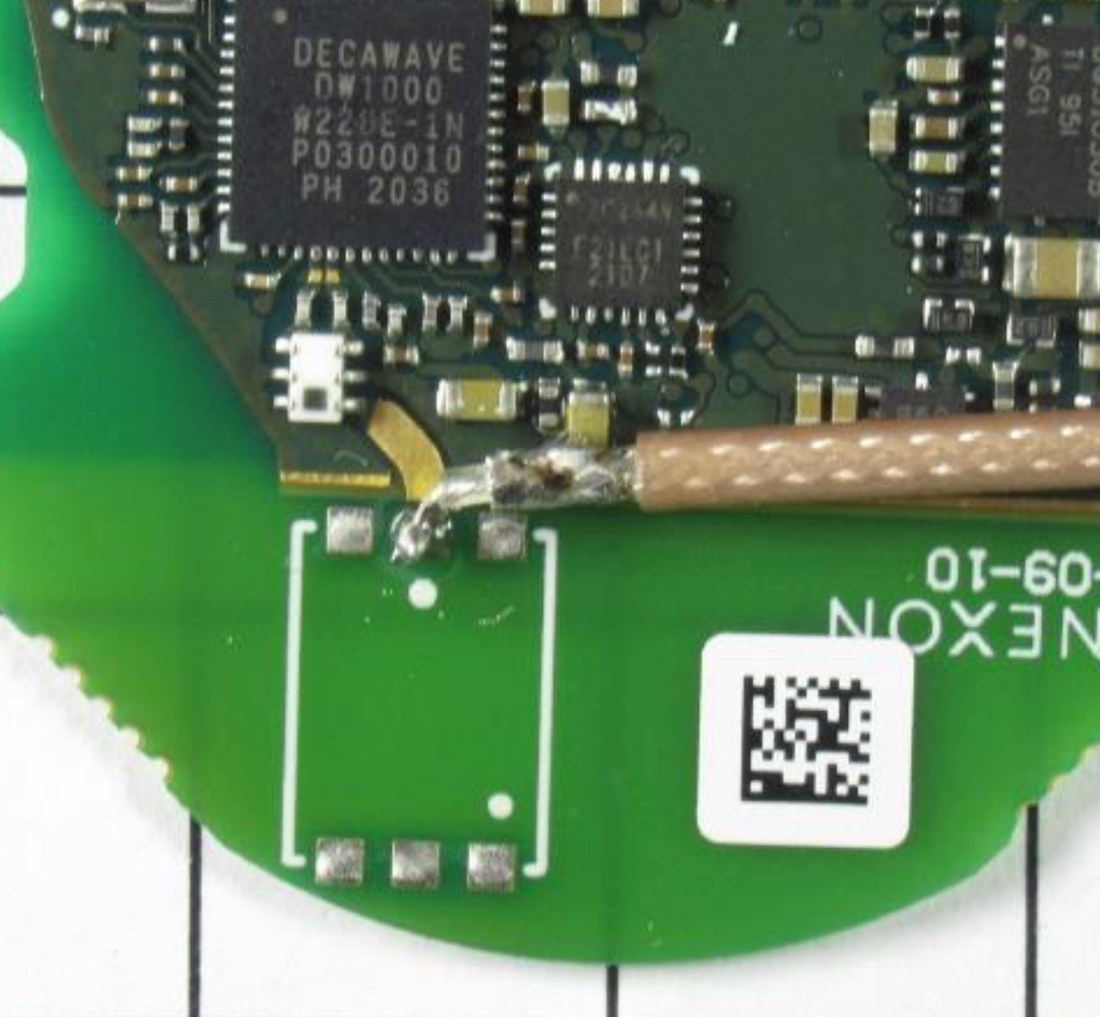
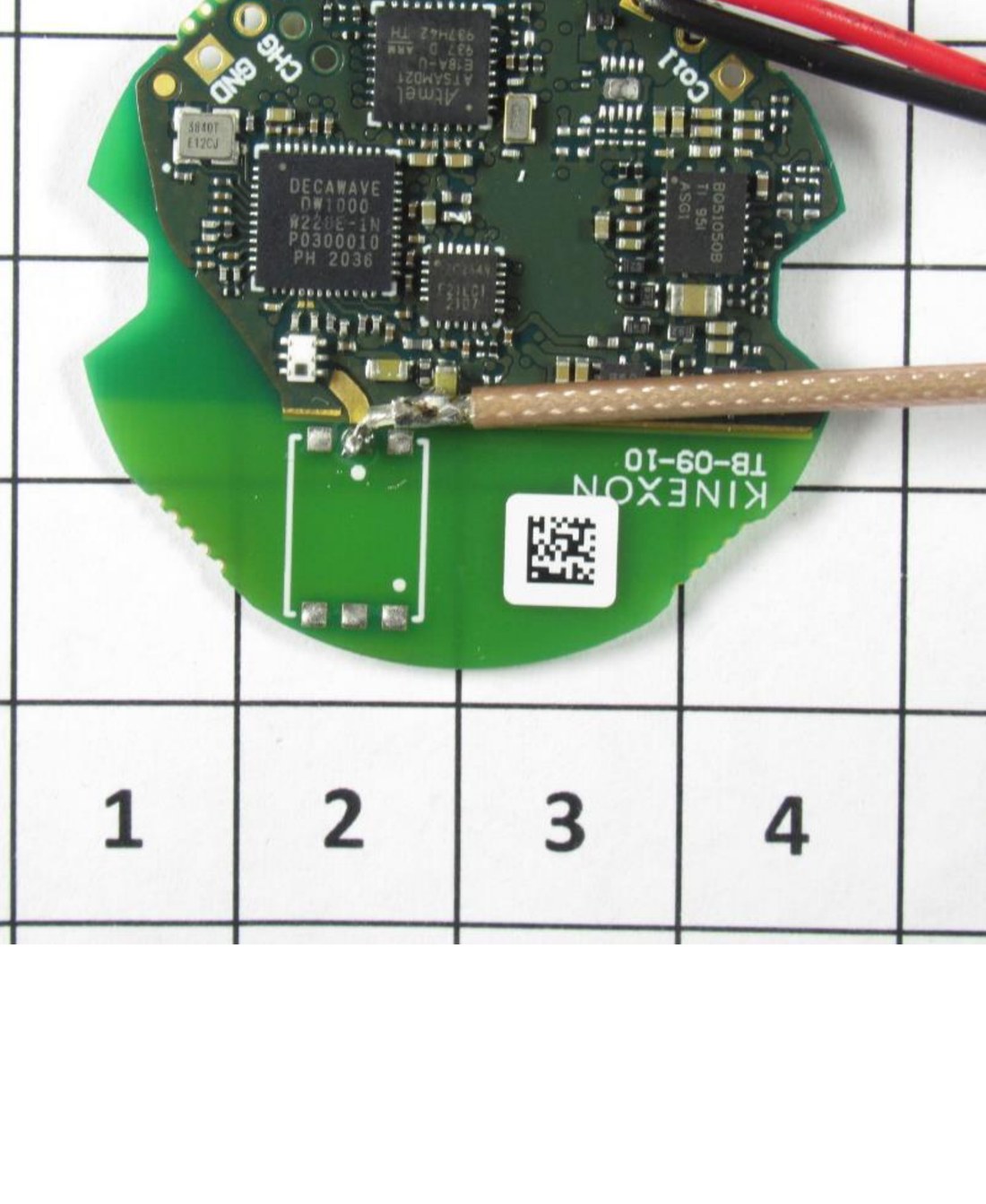
The two boards differ in shape and mount. The Al Rihla module is a round disc about 4 cm
across, silkscreened KINEXON TB-09-10; the Trionda module is roughly 28 × 15 mm,
silkscreened KINEXON TB-07-06, and bonded to the bladder with a latex patch behind one panel
instead of slung in the center.
The motion sensor does the timing. The IMU samples at 500 Hz, one reading every two milliseconds, across a three-axis accelerometer, a gyroscope, and a magnetometer verified. That stream, not the radio, is what catches a touch. When a boot strikes the ball the accelerometer sees a sharp spike, and the firmware flags the two-millisecond sample where that spike crosses threshold as the moment of contact. Adidas describes this trigger in its own ball patent as "a sensed impulse acceleration exceeding a threshold."
A hard impact can saturate the accelerometer, so derived numbers like launch angle are computed 100 to 150 milliseconds after the spike, once the signal recovers (US 12,533,561 B2). A single reading taken right at contact would be unreliable, which is why the ball samples so fast around it.
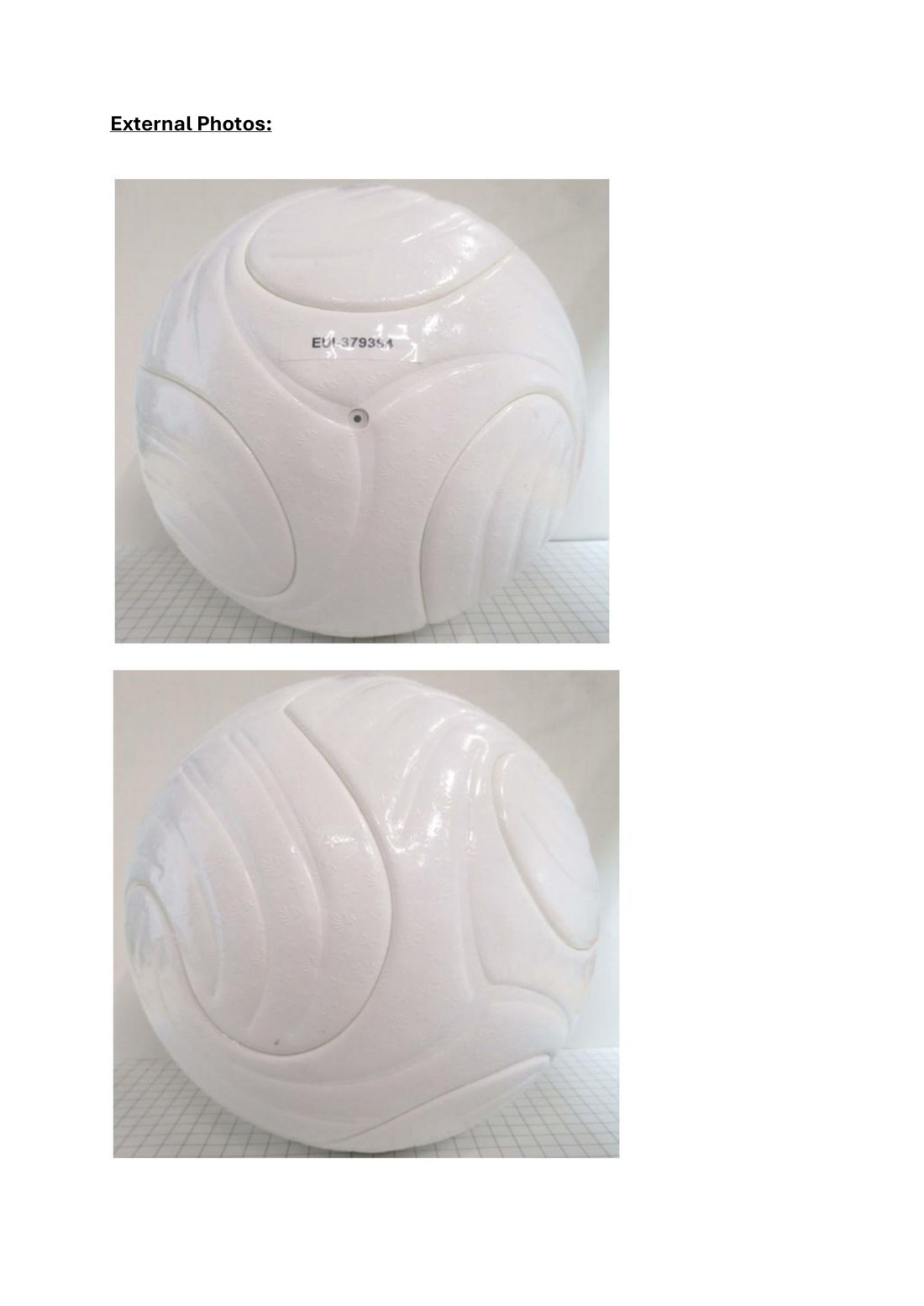
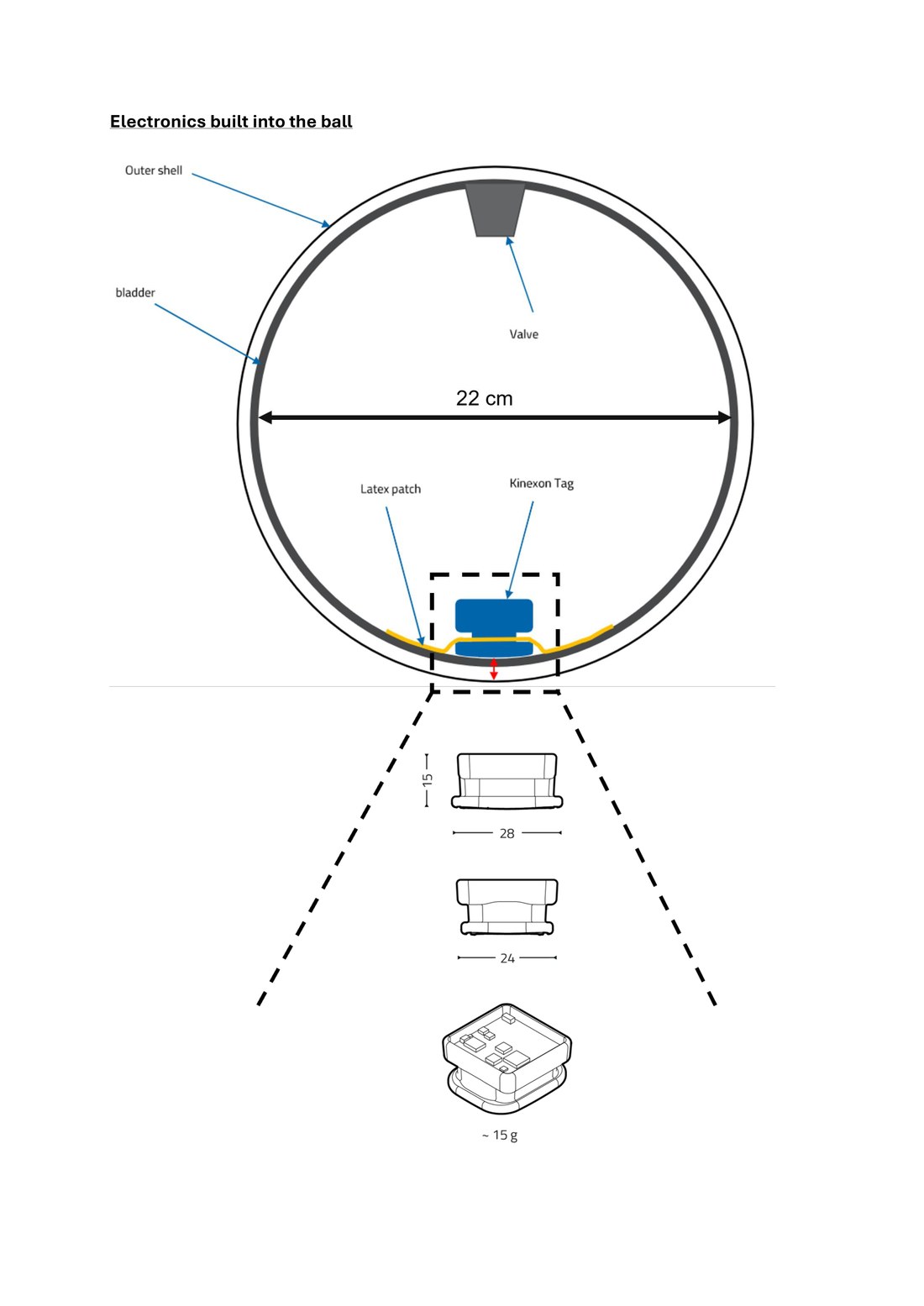
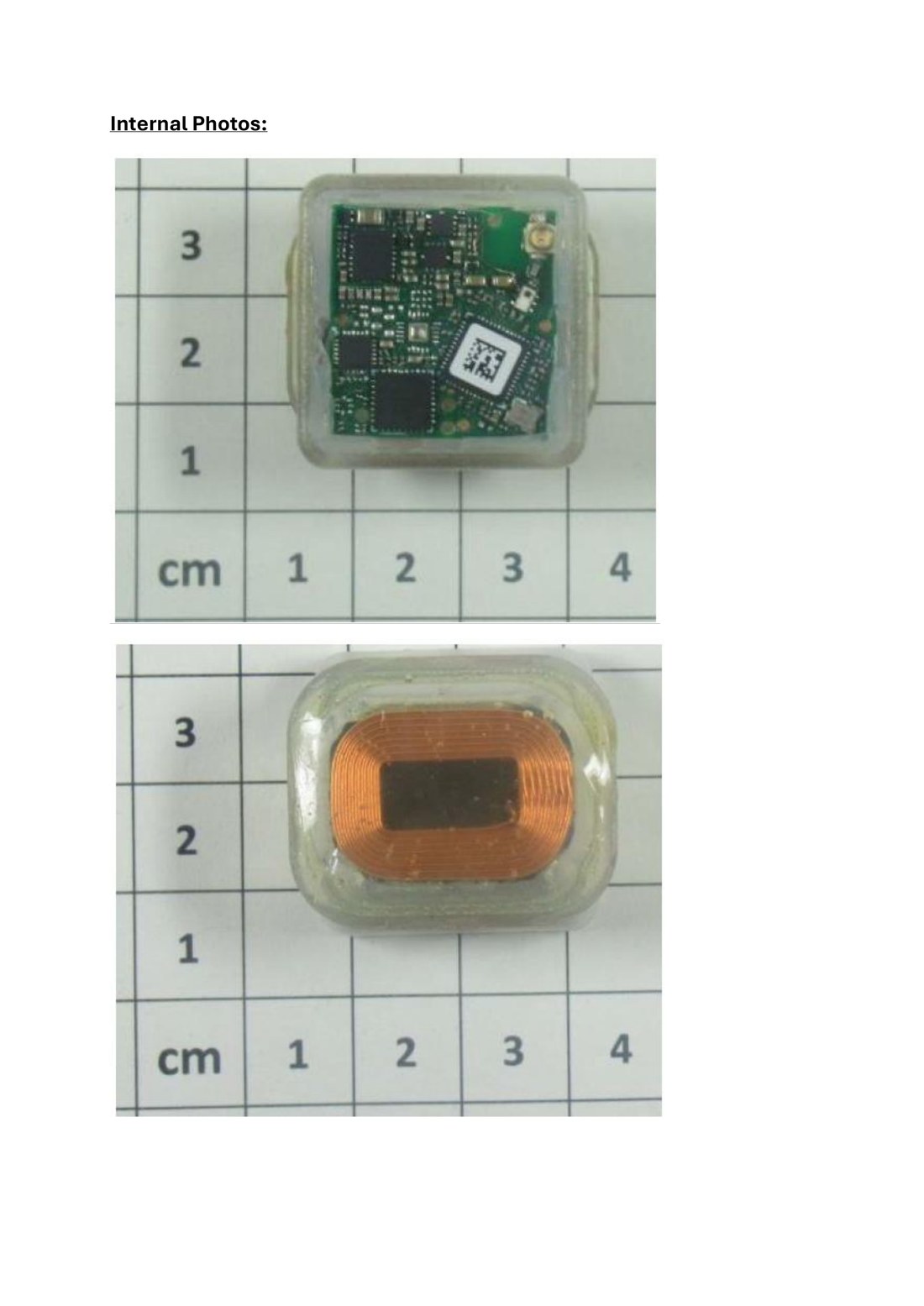
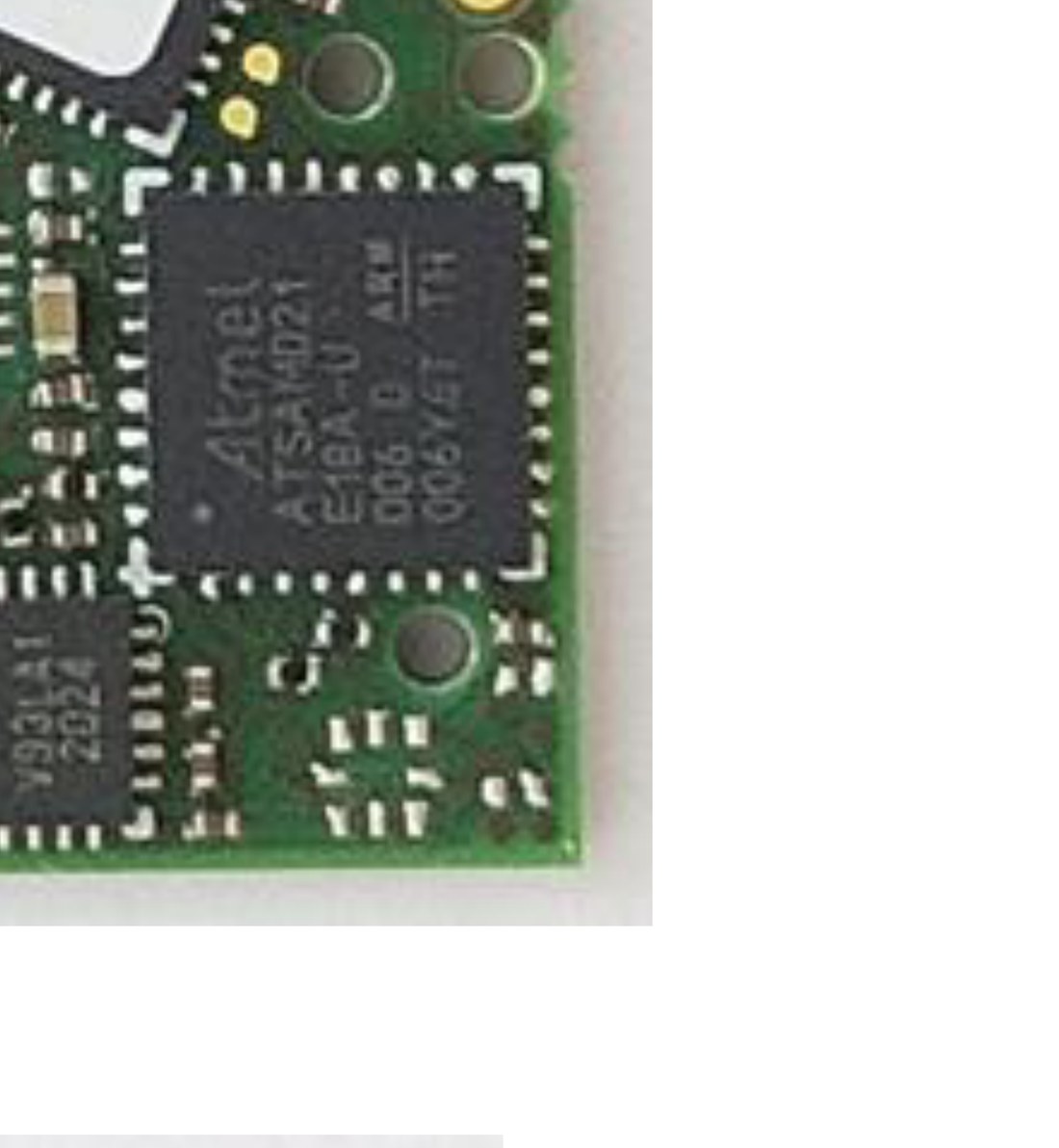
ATSAMD21 E18A-U silkscreen and the latex-patch mount are legible; the UWB transceiver is potted under
a glob-top, covered below. Source: FCC OET / fcc.report. verifiedThe UWB radio chip: a confirmed DW1000 in 2022, a sealed unknown in 2026
On the
2022 Al Rihla, the UWB transceiver is exposed and silkscreened. Read at high resolution off the FCC internal
photo, it says DECAWAVE DW1000 W220?E-1N P0300010 PH 2036, a Qorvo/DecaWave
DW1000 dated to week 36 of 2020
(internal photos, FCC ZLG-ALRIHLAPRO)
verified. The same chip turns up in the STATSports APX300 training pod of the same era,
which made it the default sports-tracking UWB transceiver of its generation.
The 2026 Trionda is a different story: its UWB chip cannot be read. The main
component on the sealed module is a black blob of potting compound about a centimeter across, and the radio chip
beside it is house-marked V93LA1 2024, not a DecaWave or Qorvo catalog number. Nothing on
the Trionda board says "DW" anything
(internal photos V2).
A chip change happened between 2022 and 2026: the mark is different, and the firmware jumped from version 5.5.4
to 4.11.13. But the exact part is not recoverable from the public photos, and the block diagram,
schematics, and parts list are permanently confidential. So whether the Trionda's radio supports the
Scrambled Timestamp Sequence (STS, the cryptographic secure-ranging feature
the DW1000 lacks) is, in mid-2026, open. Neither outcome is asserted here.
KINEXON TB-09-10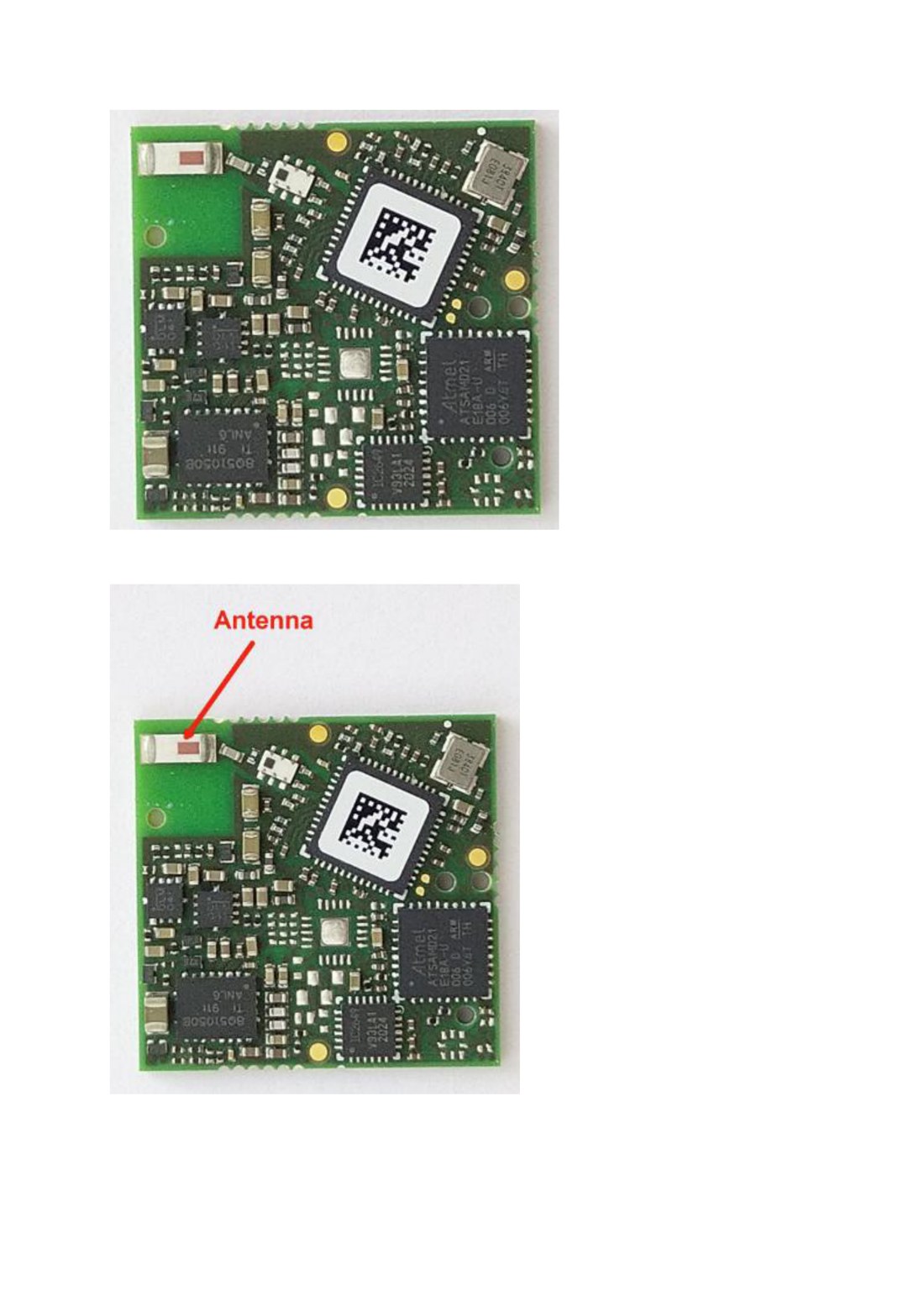
V93LA1 2024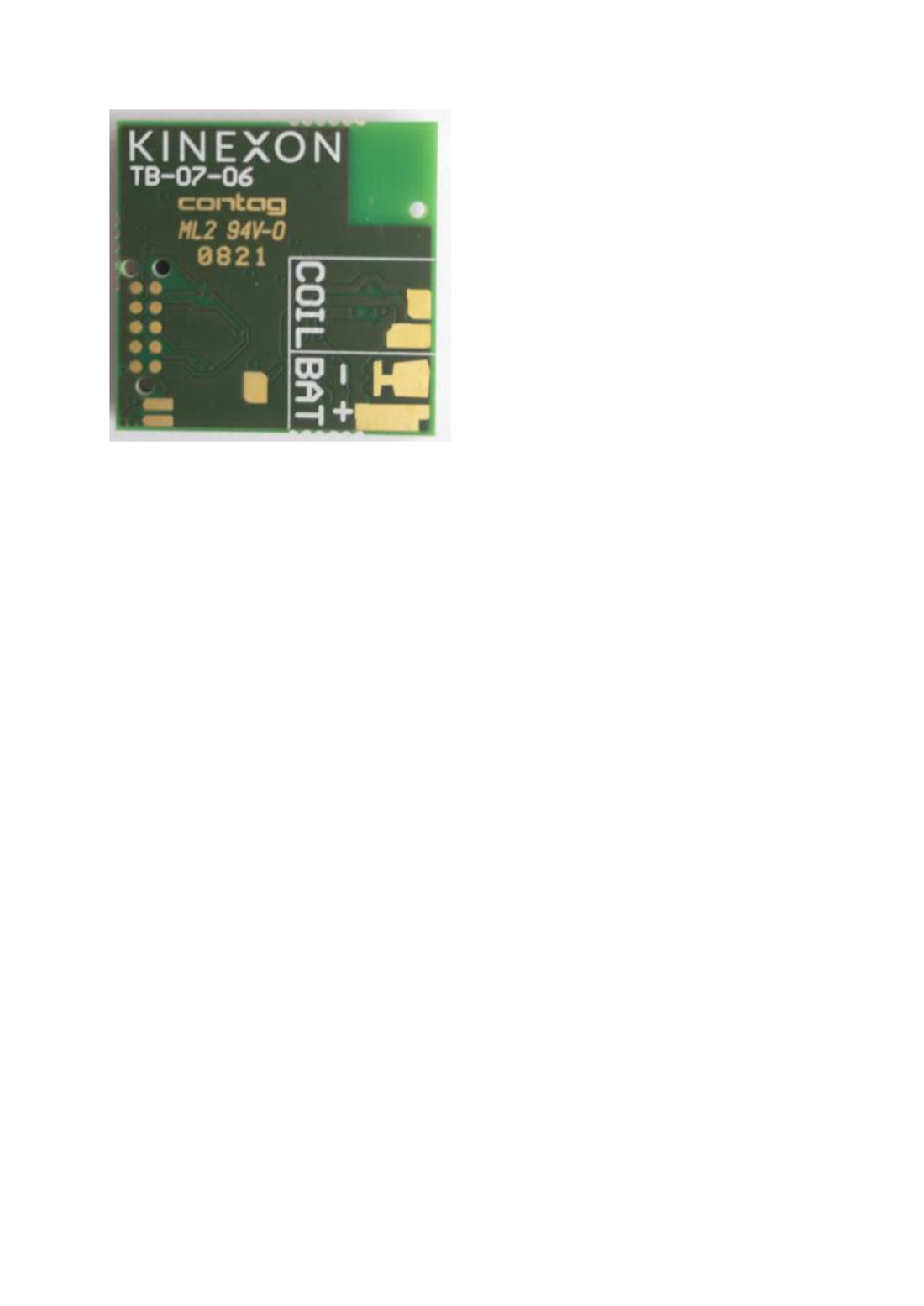
KINEXON TB-07-06 / contagThe radio it speaks
Both balls broadcast on the same two ultra-wideband channels, one near 4.5 GHz and one near 6.5 GHz, at a 6.8 Mbit/s data rate in the high-rate pulse (HRP) mode, using a modulation called BPM-BPSK (in Canada, regulators authorize the upper channel only) verified. The transmit power is tiny, well under a milliwatt, near the regulatory ceiling for a hand-held device of this class. That is by design: the range comes from the dense ring of receivers around the pitch, not from shouting.
The CSA Group Bayern test reports print the firmware versions in plain text, Trionda v4.11.13 and Al Rihla 5.5.4.
| Parameter | Al Rihla 2022 (ZLG-ALRIHLAPRO) | Trionda 2026 (ZLG-SMCOMB) |
|---|---|---|
| Channels | Ch3 4492.8 + Ch5 6489.6 MHz | Ch3 4492.8 + Ch5 6489.6 MHz |
| Modulation / rate | BPM-BPSK (HRP) · 6.8 Mbit/s | BPM-BPSK (HRP) · 6.8 Mbit/s |
| Peak EIRP, worst case | Ch5 −2.54 dBm · Ch3 −3.96 dBm | Ch5 −2.60 dBm · Ch3 −5.58 dBm |
| UWB transceiver | DecaWave DW1000 (confirmed) | glob-top, house-marked (open) |
| Firmware | 5.5.4 | v4.11.13 |
The Trionda differs from the Al Rihla in two radio details. It spreads its energy a little wider than the channel minimum. And it uses a single Johanson 7000AT18A1600E-AEC chip antenna, tuned for the upper band, to serve both channels, so it transmits the lower channel off its best frequency. That shows up in the power table as a weaker peak on Channel 3 than on Channel 5. The Al Rihla's antenna covered both channels more evenly. Across four years the power budget barely moved.
How a position gets computed
The ball transmits, and the receivers do the arithmetic. KINEXON's positioning blends several techniques. Claim 4 of its own patent (US 11,150,321 B2) names "Two-Way Ranging, TWR, Three-Way Ranging, 3WR, Time-Difference of Arrival, TDoA, Angle-of-Arrival, AoA, Phase Difference of Arrival, PDoA, and radio signal strength indicator, RSSI" verified. Two carry the load:
- TDoA, time-difference of arrival. The ball emits one short blink; every receiver timestamps when it arrives, and none reply. The tiny differences in arrival time across the ring pin down where the ball is. One transmission locates it, so this is the low-energy, high-volume method. The price is that every receiver has to share one clock, synchronized to the nanosecond.
- TWR, two-way ranging. The ball and one receiver trade timestamped packets, and the round-trip flight time gives the distance directly. The round trip cancels out any clock offset between the two, so it is the most accurate method, but it costs several packets per receiver and does not scale to a pitch full of fast-moving tags.
The blended fix is computed at the edge, not on the ball; the ball only ranges. The rates land at about 100 Hz for the ball's position and about 20 Hz for player tags, riding on top of that 500 Hz motion stream, and KINEXON's Officiate page states the split verbatim verified. A peer-reviewed validation of a 26-antenna pitch deployment measured player position error around 8 to 9 cm and ball error around 15 cm in 2D (17 cm for shots, 21 cm for throws) verified.
One patent recovers the ball's orientation and spin from the radio alone, with no motion sensor: US 11,150,321 B2 (inventor Martin Lawitzky). Because the ball radiates unevenly in different directions, the system rotates that known pattern until it matches what the receiver ring sees, pinning down spin at the exact moment the motion sensor saturates on impact.
Where the signal first lands: anchors, switch, and a mini-PC
The receive chain is named, word for word, in the Al Rihla FCC test report's companion-device list: "UWB transceiver: Kinexon Anchor; PoE Switch: Netgear GS108LP; Mini-PC: Intel NUC; LAN cables" (test report, doc 7716482) verified. The air link ends at a pitch-side KINEXON anchor; the anchor backhauls over a Netgear GS108LP Power-over-Ethernet switch to an edge box that runs the position engine, turning blinks into ball coordinates. These are the companions Adidas declared for the lab keep-alive test, not a confirmed match-day rack (the Intel NUC, for one, is a test-bench mini-PC). The stadium build is presumably more hardened, and its exact hardware is not public.
The newer KINEXON anchor test (the KNX-A9-1) shows the same anchor-to-PoE-to-edge-box pattern, so two independent filings four years apart point at the same edge tier inference for the production box.
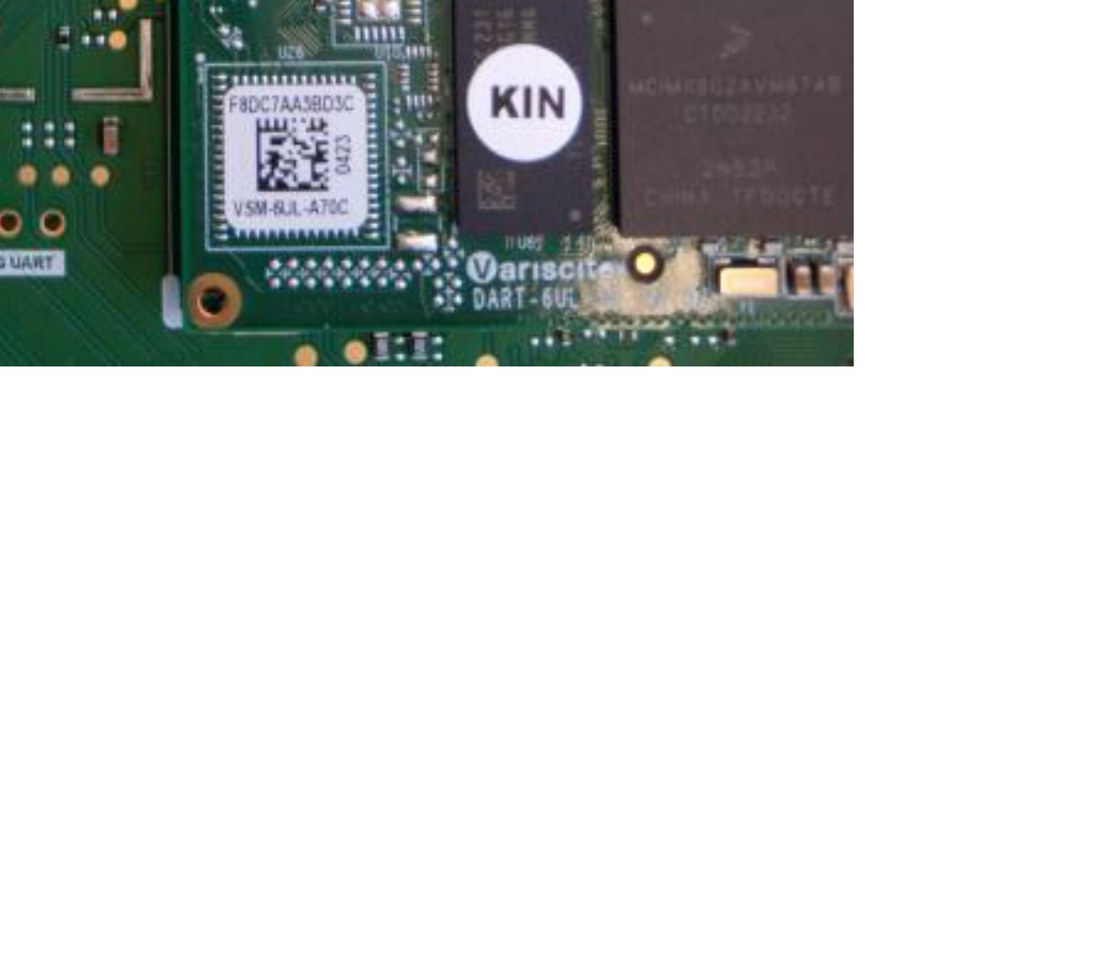
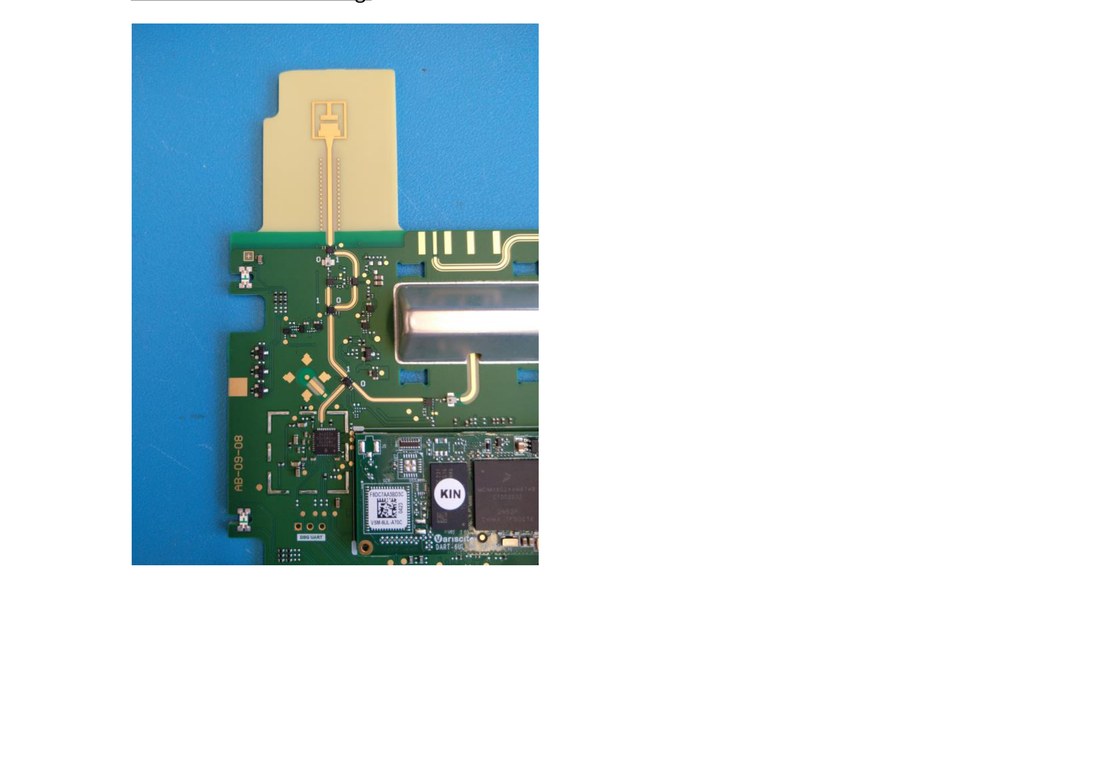
The current anchor, the KNX-A9-1 (FCC-granted 2025-03-11), is more computer than radio. The
de-shielded photo shows it runs embedded Linux on an NXP i.MX 6UltraLite (Arm Cortex-A7) processor on a Variscite
module, alongside a house-marked "KIN" UWB module and a populated debug header silkscreened DBG UART
(FCC 2ALC5-KNX-A9-1 internal photos)
verified. It covers a third channel as well as the ball's two,
and is filed for indoor use only.
How many anchors ring an actual pitch is not published. The citable figure is the 26 antennas and two base stations across three height levels from the peer-reviewed study, a research topology, not a FIFA install spec inference. From the edge box onward, the ball's stream joins the venue network and the shared clock that binds it to the cameras, the next leg of the journey.
Trionda  IMU 500 Hz  +  UWB blinks (Ch3 4492.8 / Ch5 6489.6, BPM-BPSK 6.8 Mbit/s)
   -> KINEXON Anchor (KNX-A9-1, tri-band, i.MX6UL / Variscite DART-6UL)
   -> Netgear GS108LP PoE switch
   -> edge box                  (position engine: TDoA + TWR -> ball xyz ~100 Hz)
   -> venue network / shared PTP clock  ->  optical fusion  (see the transport section)
The only way in: a Qi dock
The ball has no data ports; the test report says so in those words (Trionda UWB test report) verified. Its only non-radio connection is wireless charging: the KINEXON Ball Charger, KNX-WCHA1, described in its own FCC filing as a "long-distance (8 to 18 mm) Qi charger encased in a shell that is tuned to charge the Qi receivers in soccer and hand balls" (FCC 2ALC5-KNX-WCHA1) verified. It runs at a much lower frequency than the tap-to-pay NFC chips in a phone, and it pairs with the charging coil photographed on both boards. A ball charges on the dock before a match and runs for hours.
The dock also explains how the ball wakes and sleeps. By regulation, a hand-held UWB device of this class must stop transmitting within ten seconds unless it keeps hearing an acknowledgement from its receiver. The lab showed this directly: with the KINEXON anchor as the companion, "at the time M1 = 8s the companion device was powered off. The EUT immediately stopped transmissions" (Al Rihla test report), and the Trionda report records the same stop. Start-up is the mirror image: the ball "starts automatically transmission when taken away from a WPC station," so it begins broadcasting the moment it leaves the dock.
So a ball is on air only inside that handshake. One that rolls into the stands or waits in a spares bag loses the acknowledgements and goes quiet within seconds. None of this is a football feature; it is the power and interference behavior the regulator requires of this class of radio. The side effect is that only the ball in play transmits, which keeps the air clear and spares the battery.
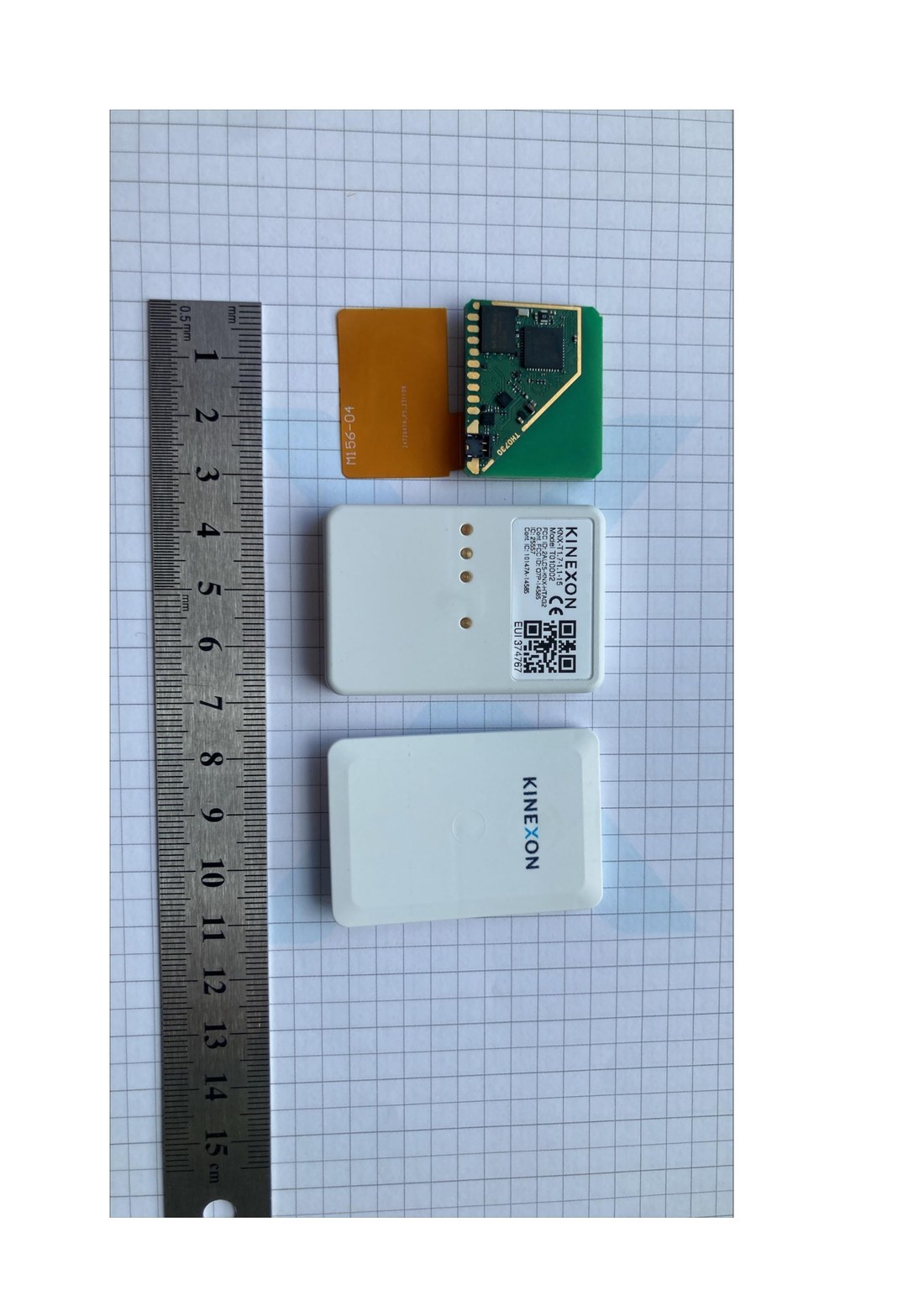
The player and equipment tag (product context, not the World Cup method)
The ball is not the only UWB device KINEXON sells. The product line also includes a worn player and equipment tag,
the KNX-HTAG2 ("TAG for UWB localization system," FCC-granted 2024-08-19), which uses the same two channels and
hand-held profile as the ball. Its internal photo shows the label
KINEXON / Model T010002, a flex antenna marked M156-04, a lithium-polymer cell, and
a PCB silkscreened TH0730. Its main chip, like the ball's and the anchor's, is house-marked and not
legible, the same across KINEXON's whole current UWB line.
The worn tag is product context, not the tournament's player-tracking method. At the World Cup the players are tracked optically by the stadium cameras, and the ball is the only officiating UWB device on the pitch. The training-tier vests that clubs run on their own, from Catapult and STATSports, are a separate world covered later.
Model T010002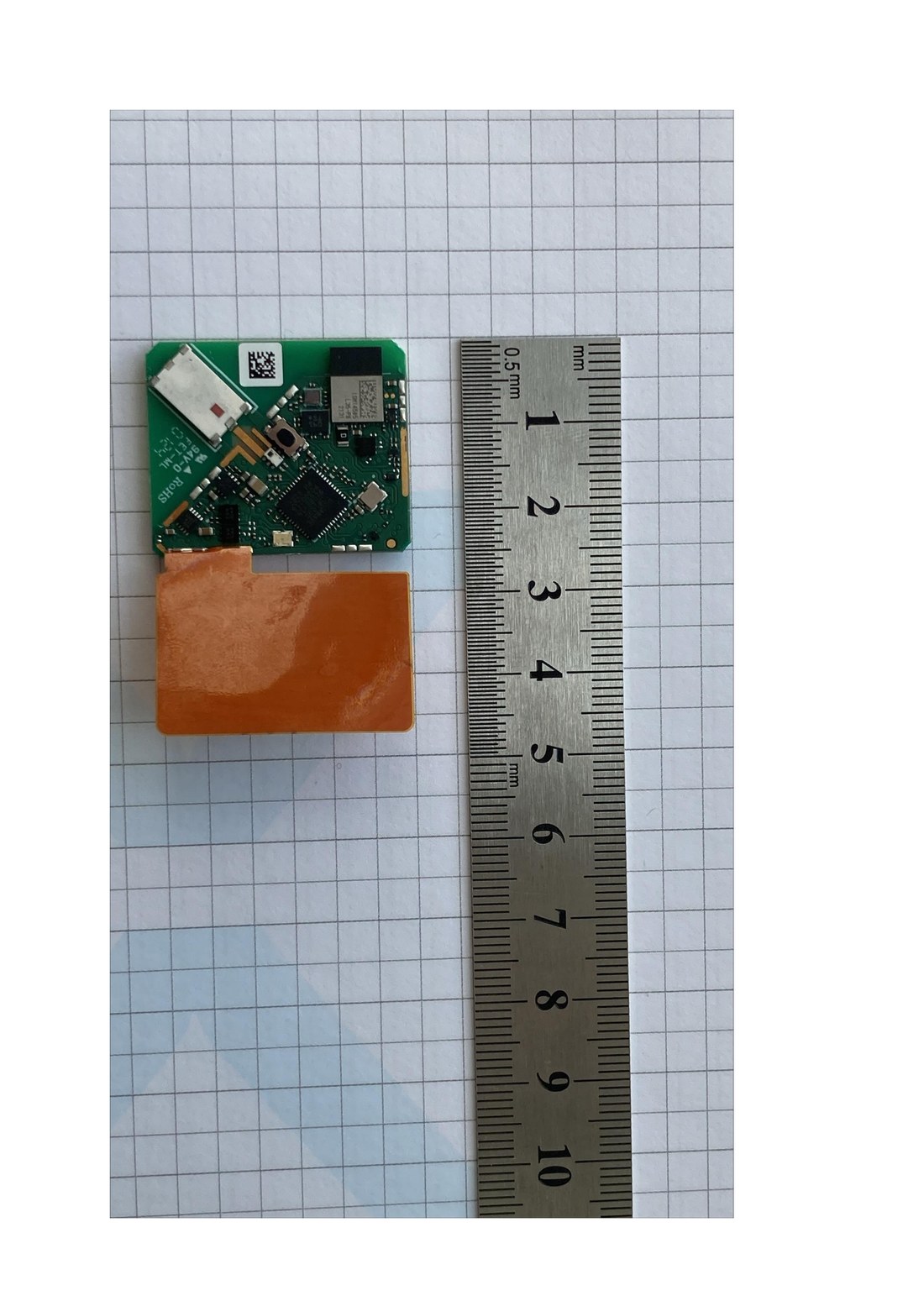
DBG UARTDBG UART header; tag
and anchor both use house-marked UWB silicon. Sources: FCC 2ALC5-KNX-HTAG2 and 2ALC5-KNX-A9-1 internal photos /
fcc.report. verifiedWhat the patents actually claim
Four ball-and-UWB patents get cited around this system, and their granted claims are narrower, and often different, than the loose summaries in circulation (several of which trace to a law-firm blog that does not match the granted text). The table reads each one verbatim.
| Patent | Assignee | What it actually claims |
|---|---|---|
| US 11,150,321 B2 | KINEXON GmbH (Lawitzky) | Recover ball orientation from the anisotropic radiation/absorption pattern of the in-ball transmitter as seen across the anchor grid, with no IMU; claim 4 lists TWR/3WR/TDoA/AoA/PDoA/RSSI for position. |
| US 12,533,561 B2 | Adidas AG (Coza, DiBenedetto) | Display an instantaneous motion characteristic (speed, spin, spin axis) time-synced to the individual video frame; impulse-acceleration trigger; launch angle computed 100 to 150 ms post-impact. Priority 2014. |
| US 12,070,655 B2 | Adidas AG (Coza, DiBenedetto, Allen) | Ball distance from free-flight detection plus a drag-profile speed model, with accelerometer-to-magnetometer redundancy for rotation when one stream is unreliable. |
| US 12,121,776 B2 | Adidas AG (+ Foundry Collaborative) | A sports ball with a pit suspended in the shell by a plurality of cords (5 to 90° between cord axes), the pit holding the electronics, battery, and transmitter: the cord-suspension mount. |
The cord-suspension patent US 12,121,776 B2 is the literal "Adidas Suspension System" of the Al Rihla. Goal-line and offside appear only as motivating applications in the description, never as a claimed algorithm. Adidas describes the Trionda as moving away from a center-slung pit toward a sensor layer behind one panel, so that cord-suspension claim reads on the Al Rihla-class concept, and whether the Trionda uses it or the latex-patch mount is an open question open.
None of the four patents claims an end-to-end "ball sensor to optical kick-frame to offside" fusion. The closest is US 12,533,561 B2's alignment of a motion reading to an individual video frame, and that is framed as a broadcast display method rather than an officiating one.
One patent often pinned to KINEXON, EP 4,305,444 A1 ("UWB anchor having a double antenna"), is in fact assigned to Trumpf Tracking Technologies and Zigpos. Its "double antenna" works by splitting frequencies across two bands rather than the direction-finding people assume corrected.
- The Trionda's UWB transceiver generation. The 2026 part is house-marked
(
V93LA1 2024); a chip change from the DW1000 is evident, but the exact part is not resolvable from the public photos, and the block diagram, schematics, and parts list are permanently confidential. Whether the 2026 ball does STS secure ranging is therefore open; the DW1000 confirmed on the 2022 Al Rihla does not. - Whether the radio payload is encrypted. No FCC exhibit or vendor document mentions it. open
- The exact motion-sensor part. The patents name an accelerometer, gyroscope, and magnetometer; the specific chip is not legible in the photos. open
- How ball firmware is updated. The dock is the only non-radio path to the board; no vendor document describes the update mechanism. open
- The real per-pitch anchor count and geometry across the 16 stadiums. The 26-antenna figure is from a peer-reviewed study, not a published FIFA deployment. inference
The ball has now answered the first two questions in the chain: when contact happened, to about two milliseconds, and roughly where it was, to within a handful of centimeters. It has handed that radio stream to a pitch-side anchor, a PoE switch, and a mini-PC. But the ball knows nothing about the 21 other players moving around it. That takes an entirely different way of seeing, and it lives in the stadium roof.
Optical tracking and the 3-D avatars

The short version
Sixteen cameras under the stadium roof watch every player and rebuild each one as a 29-point skeleton about fifty times a second. That is how the system places limbs the ball cannot see. On top sits a scanned 3-D body double of all 1,248 players, so a replay shows a recognizable figure instead of a stick drawing.
The ball reports on itself and nothing else. To place every other body on the pitch, the stadium watches. Sixteen cameras in the roof feed a model that turns each player into a 29-point skeleton about fifty times a second, more than 150 million tracking points across one match FIFA, World Cup 2026 innovation page. That is the geometry layer. On top of it sits a scanned 3-D double of every one of the 1,248 players, so a replay can show a recognizable body instead of a stick figure.
Sixteen cameras, and they run faster than the broadcast
Each of the 16 stadiums holds 16 optical tracking cameras, mounted under the roof, watching the ball and every player FIFA, 2026. That is up from 12 at Qatar 2022, and that jump is the whole upgrade on the capture side corrected.
Press counts of "30 cameras" or "10 to 14 cameras" measure something else. The 10-to-14 figure is the generic range Hawk-Eye quotes for its product across sports. The 30 lumps the tracking cameras together with a venue's separate replay, goal-line and VAR cameras.
These officiating cameras are separate from the broadcast cameras, and deliberately faster. A Lenovo engineer on a BBC panel said the World Cup tracking cameras "are going to have more frames per second per camera than a broadcast camera" BBC, "Will AI crown the World Cup winners?", 4 Jun 2026. The higher frame rate gives the offside machinery a tighter window around the instant the ball is struck. The cited rate is about 50 frames a second, phrased by FIFA in 2022 as "50 times per second" and in 2026 as "more than 50 times" verified.
FIFA's 2026 page does not print "29 points" or "50 fps." That detail comes from Hawk-Eye's product pages plus the 2022 FIFA spec, corroborated across the 2026 trade press.
SkeleTRACK: 29 joints per player, rebuilt in 3-D
The pose engine is Hawk-Eye's, called SkeleTRACK. Hawk-Eye describes it as a real-time, 3-D, skeletal-tracking system "built from the ground up using machine learning," tracking 29 key points per player, the joints that matter for an offside call: knees, ankles, hips, shoulders, elbows, wrists, head Hawk-Eye, SkeleTRACK.
The phrase "from the ground up using machine learning" is verbatim, though it comes from a Cambridge engineering talk by a Hawk-Eye ML engineer rather than the product page Machine Learning @ CUED, Hawk-Eye, 14 Nov 2022.
A single center-of-mass dot shows roughly where a player is, but not where a striker's trailing shoulder or front foot was at the frame of the pass. Twenty-nine points in 3-D can.
How the cameras become a skeleton is not spelled out. The standard approach for a ring of fixed, calibrated cameras triangulates the same points across overlapping views. Hawk-Eye has never published that it works this way, so this mechanism is an inference from the standard literature, not a disclosure inference. The output, whatever the internal route, is a 3-D skeleton per player at the camera frame rate.
Two figures circulate for different deployments. For the World Cup's 16-camera setup, FIFA quotes "over 150 million tracking data points per match" FIFA, 2026. Hawk-Eye's SkeleTRACK product literature quotes "172 million" across its general 10-to-14-camera range Hawk-Eye, SkeleTRACK. Either figure is a step change. The older center-of-mass tracking produced only about 600,000 points per team, so the skeletal feed carries roughly two orders of magnitude more.
How accurate it is, and what still breaks it
Independent evidence backs the accuracy, not just vendor marketing. A peer-reviewed study at ICSTPA 2025 analyzed the official offside data from the top European leagues (2020 to 2024) and the 2022 World Cup. It found that camera density correlates positively and significantly with centimeter-level offside precision (p < 0.01) Yan, ACM ICSTPA '25, doi:10.1145/3796028.3796045. That turns "more cameras means more precise" from a sensible guess into a measured result, the strongest justification for going from 12 cameras to 16 verified.
The same study names what still defeats the system. High player speed hurts: above about 30 km/h the misjudgment rate rises. Body-posture ambiguity and camera blind spots are the other two named limits. FIFA's own framing of the 2026 system agrees: it cannot resolve the very tightest offsides, and it struggles when players are grounded or clustered together Inside World Football, 3 Jun 2026. Below that floor, a skeleton built from images cannot be trusted to the centimeter. A tight margin still hands the call to a human. The offside section picks up that story.
The model is a deliberate blank (and one famous patent is the wrong one)
Hawk-Eye will say SkeleTRACK is machine learning and nothing more. The neural network architecture, the training framework, and the training set are undisclosed, and the Cambridge talk on the system holds back every architectural detail open.
No public patent fills the gap either. The patent most often cited as the SkeleTRACK pose network, US 10,970,849 ("Pose estimation and body tracking using an artificial neural network"), is not Hawk-Eye's at all. It is assigned to ETH Zürich and Walt Disney, works on a single image rather than many views, and was demonstrated on 21 hand landmarks, not a 29-point body US 10,970,849, Google Patents. It is background prior art and should not be attributed to FIFA or Hawk-Eye corrected.
The actual Sony and Hawk-Eye optical IP is a different patent, US 11,514,678, assigned to Sony Europe BV (UK Branch), Hawk-Eye Innovations Ltd and Sony Group Corp, with a 2019 priority date US 11,514,678, Google Patents. It covers how cameras are fused rather than the pose network: take a 3-D position fixed by the calibrated cameras, work out where it should appear in the picture of a moving broadcast camera, and pick the placement that best matches what that camera sees. Its method for lining cameras up in time is "timestamp association," tagging each image with the moment it was captured so frames from different cameras can be matched. That is consistent with the shared clock the timing section covers, though the patent never names it.
Hawk-Eye builds its own computer vision and machine learning rather than buying someone else's large language model for the job, a point that matters for the AI question later in this report. Its public technical signals are a Databricks data platform, Autodesk for 3-D, and Wiz for cloud-security monitoring. Its domain carries no Anthropic or OpenAI verification token, unlike several of the data distributors further down the chain inference.
The 3-D avatars: a one-second scan of all 1,248 players
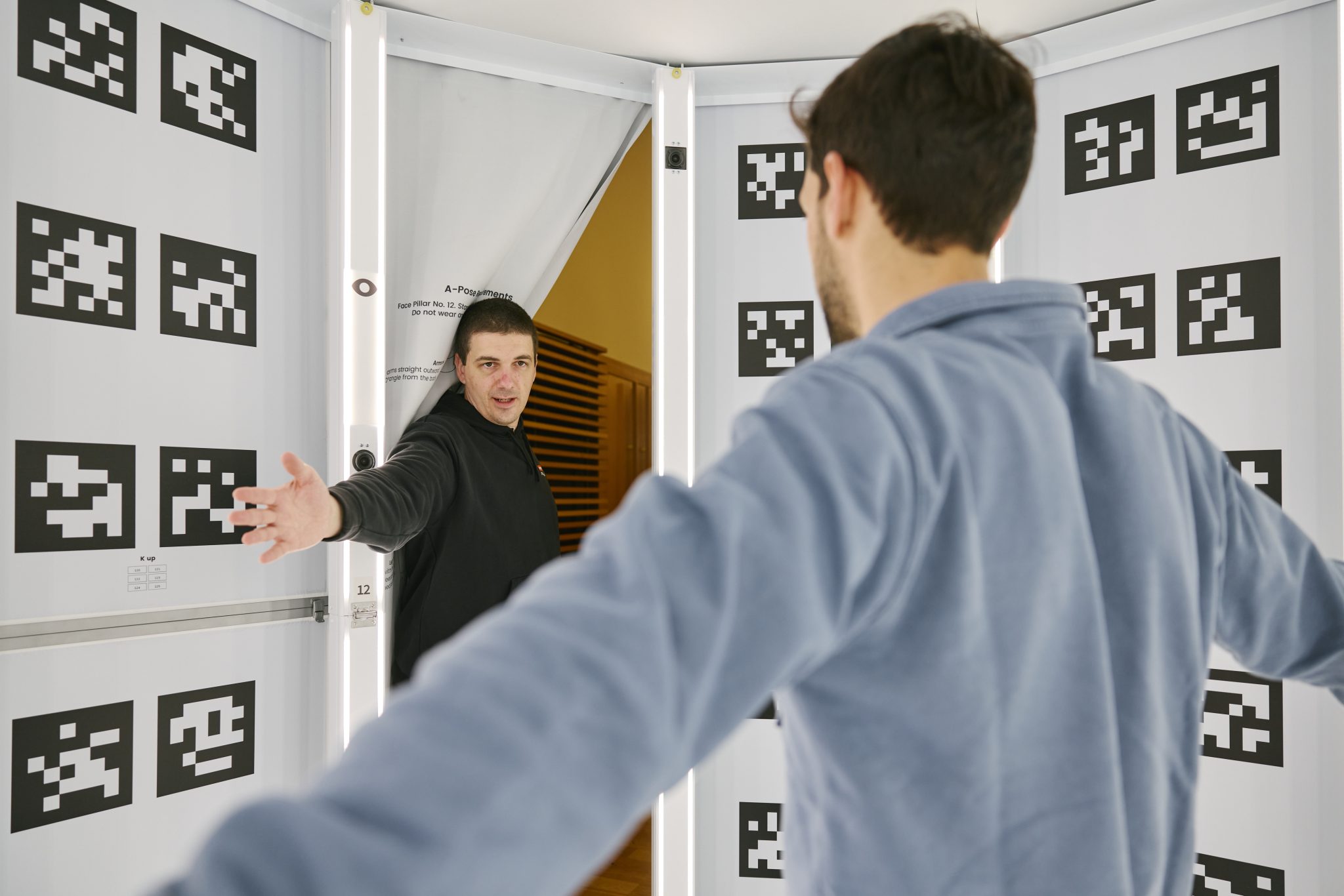
The newest piece of the seeing layer is the part you watch on a replay. Every one of the 1,248 players, all 48 squads of 26, was 3-D scanned during the pre-tournament photo shoot, and the avatars feed both the offside review and the broadcast graphic Inside World Football, 3 Jun 2026.
The scan itself is fast. Lenovo owns these assets from scan to quality check to lifecycle, and describes the player stepping into a scanner for about 30 seconds including setup, the capture under one second, then reconstruction into one avatar per player Lenovo StoryHub, "Building 3-D player avatars", 5 May 2026. The roughly one-second capture is the cited figure. A widely repeated "28 scanning stations, three-hour render" detail is poorly sourced and has been left out disputed.
The mesh is dense. A Lenovo engineer described scanning a body to "about 10,000 data points," with the points "a millimeter or 2 millimeters apart," so the avatar resolves a shoulder or a knee as a real surface rather than a generic limb BBC, 4 Jun 2026. Treat the 1-to-2 mm figure as the vendor's, not a lab measurement. It is a scan resolution, not an offside tolerance.
The avatar's role is "a further data source for player tracking and officiating decisions," an extra input to FIFA's existing VAR, and Lenovo is explicit that it "is not running VAR" Lenovo StoryHub, 5 May 2026. The combination was trialled at the FIFA Intercontinental Cup 2025 in Doha before its World Cup debut.


- The SkeleTRACK neural network. Architecture, framework and training set are all undisclosed; only "machine-learning pose estimation, built from the ground up" is public. No patent discloses the net. open
- The cameras-to-3-D reconstruction method. Multi-view triangulation is the standard and obvious approach, but no Hawk-Eye, Sony or FIFA source states the actual algorithm. inference
- "29 points" and "50 fps" for 2026 specifically. FIFA's 2026 page prints neither; the provenance is Hawk-Eye's product pages plus the 2022 FIFA spec carried forward, corroborated by 2026 trade press. verified, with that provenance
- The avatar scan logistics. The roughly one-second capture is cited; the "28 stations, three-hour render" detail is not well sourced and is left out. disputed
The system now holds two pictures of the same instant: the ball's radio stream from the last section, and a stadium full of skeletons and avatars from this one. Before either is put to use, there is a second, entirely separate tracking world that never touches officiating: the vests clubs and national teams put on players in training. That tier comes next.
Team wearables, the parallel training tier

The short version
Separate from the officiating gear, clubs and national teams put tracking pods in the vests their players wear in training. Catapult and STATSports make most of them. The pods blend satellite positioning, motion sensors, and short-range radio, and the readings flow to each company's own cloud, never to the offside system.
A second tracking world runs next to the officiating pipeline. The vests clubs and national teams pull over their players in training belong to the teams and their vendors, not to FIFA. The readings go to a vendor cloud, not the offside engine. The sensors sit on a moving body, the same idea, but the stack is separate, with its own silicon and radios.
Two companies dominate the worn-pod market: Catapult with its Vector line and STATSports with Apex. Both are flat plastic pods about the size of a bar of soap, slotted into a pocket sewn between the shoulder blades of a compression vest.
One ownership detail matters here. STATSports is now majority-owned by Sony, the same group behind Hawk-Eye, the optical engine for the offside line. Sony's Companies House filing for STATSports Group (NI641589) records Sony Europe Limited as the controlling shareholder from 7 October 2025, confirmed by Sony's own acquisition release, which frames it as a "comprehensive optical and wearable tracking solution." One company now sits on both sides of the sport, officiating and training. The corporate section covers that; here it is context for who builds the pods.
What is inside the pods
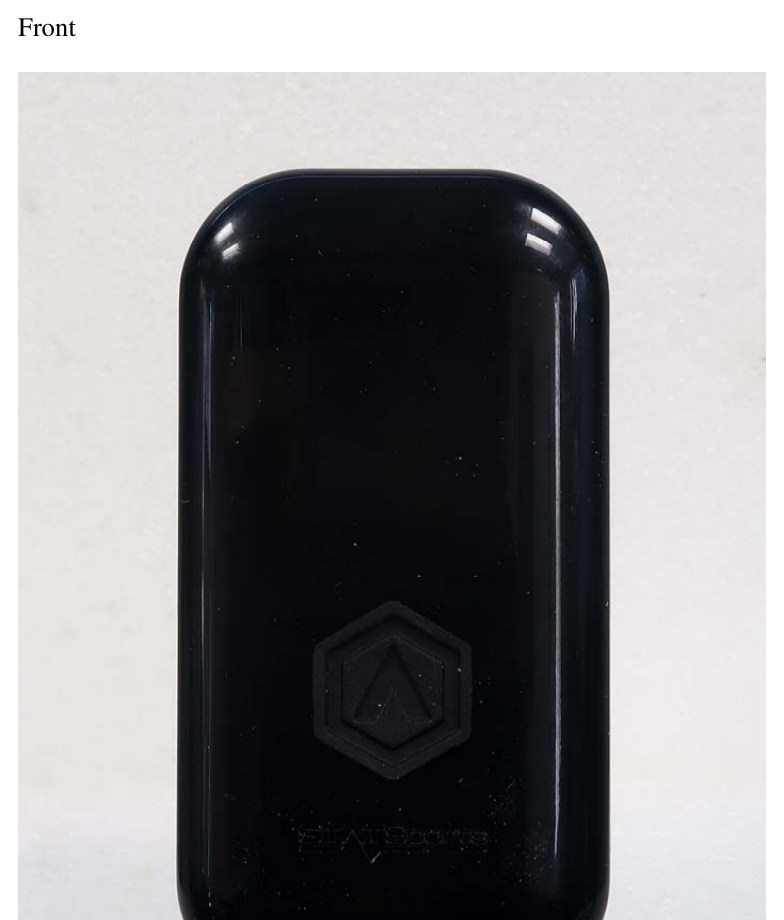
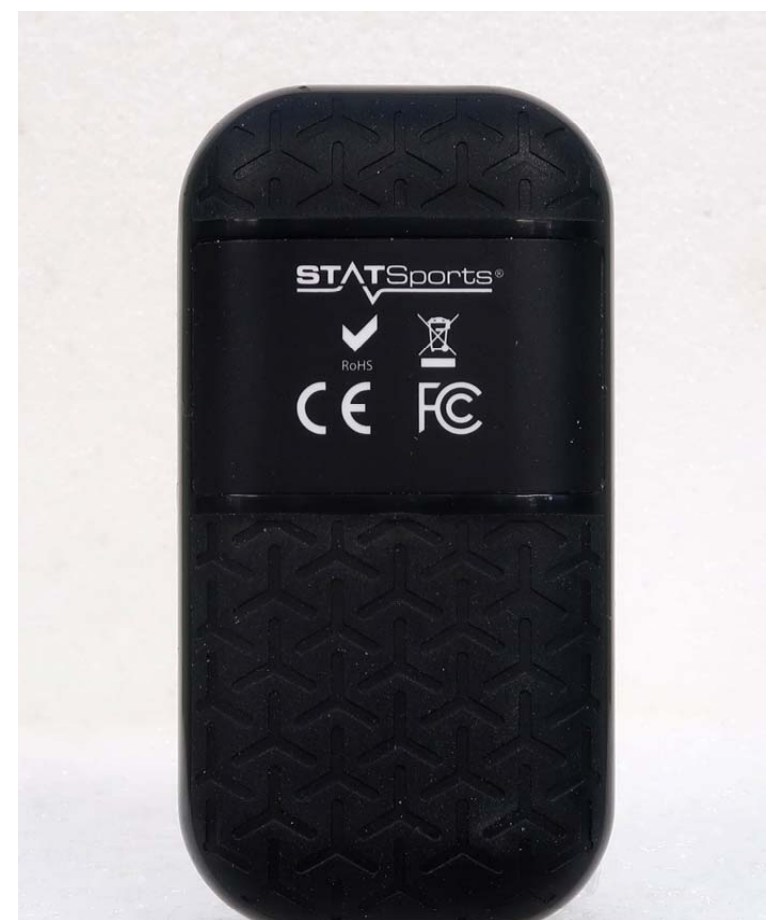
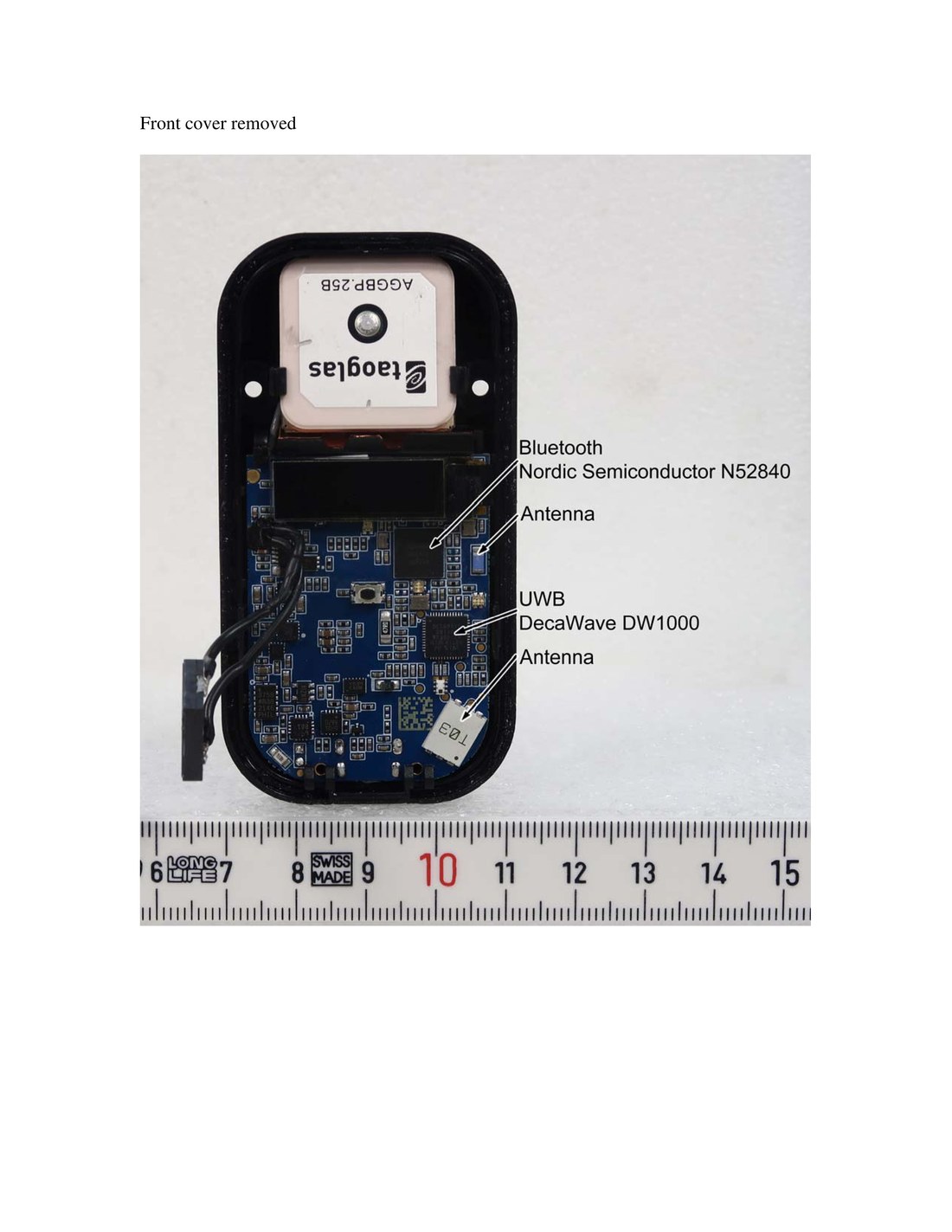
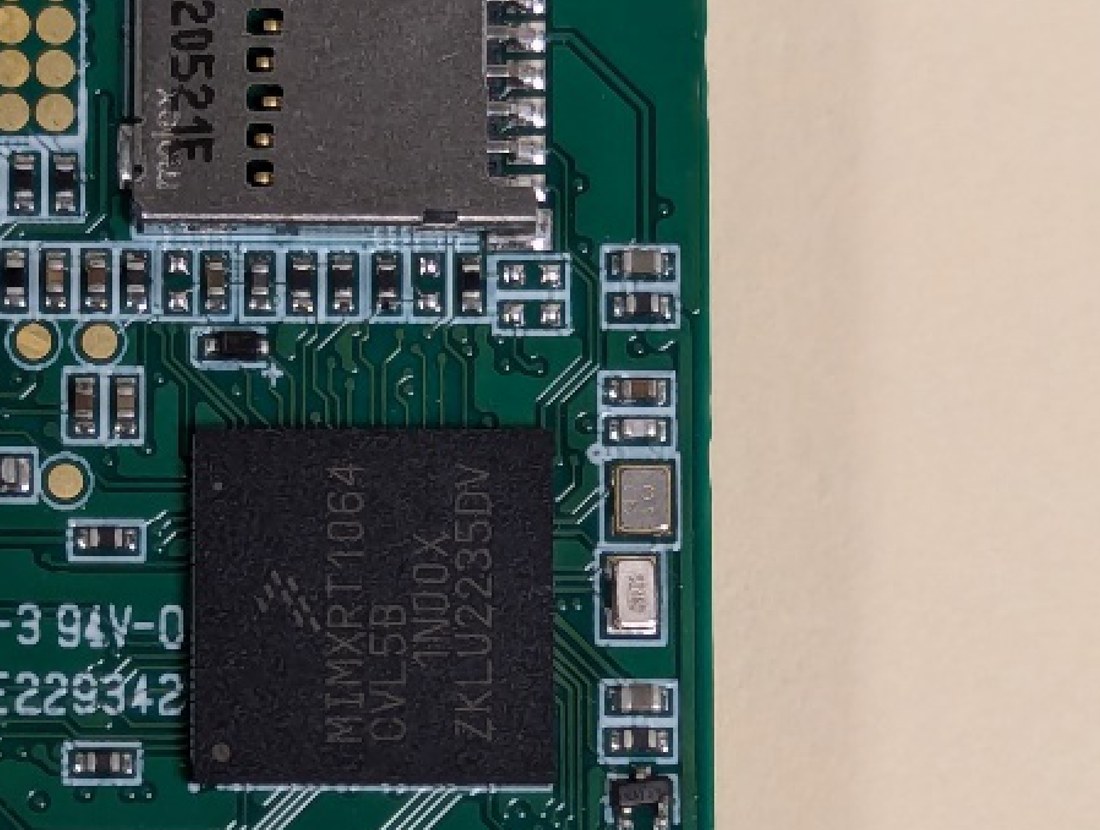
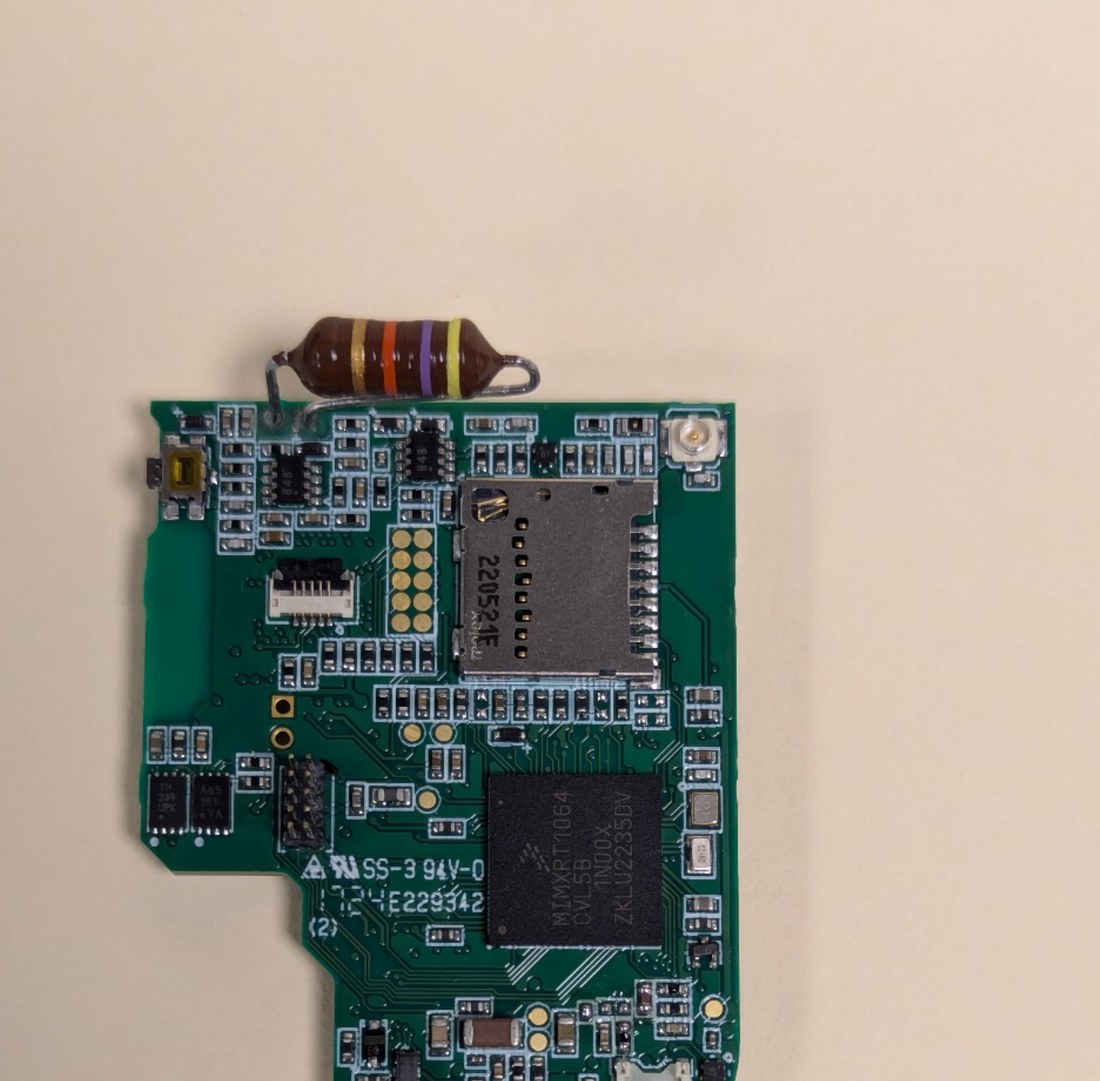
The 2025-era STATSports flagship is the easiest device to read. Both of its FCC test reports carry a parts table that names every chip. The Apex 2.0 pod (internal name "ApexNXT," FCC ID 2APHS-APX400) is built around an NXP i.MX RT1064, an Arm Cortex-M7 processor clocked to 600 MHz, paired with a microSD card for raw session logging. That chip backs STATSports' "on-edge AI, 70-plus metrics on-board" marketing.
The processor also marks a generational jump. The prior APX300 pod ran on a Nordic nRF52840. The APX400 demotes that same Nordic part to a Bluetooth coprocessor and lets the new processor run the show. The parts tables in both APX400 filings list the full radio set, including the ultra-wideband ranging chip, a Qorvo/DecaWave DW1000, alongside the Bluetooth radio and a u-blox GNSS module. verified
The APX400 test report names a DecaWave DW1000. That part has no built-in way to confirm a range measurement was not spoofed, a feature the spec calls Secure Ranging (STS). It is the same chip STATSports labeled in its own APX300 photo, and the same family that sat in the 2022 Al Rihla ball. Both pod generations therefore run on a non-secure-ranging radio, a property of the silicon rather than a judgment about the deployment. corrected
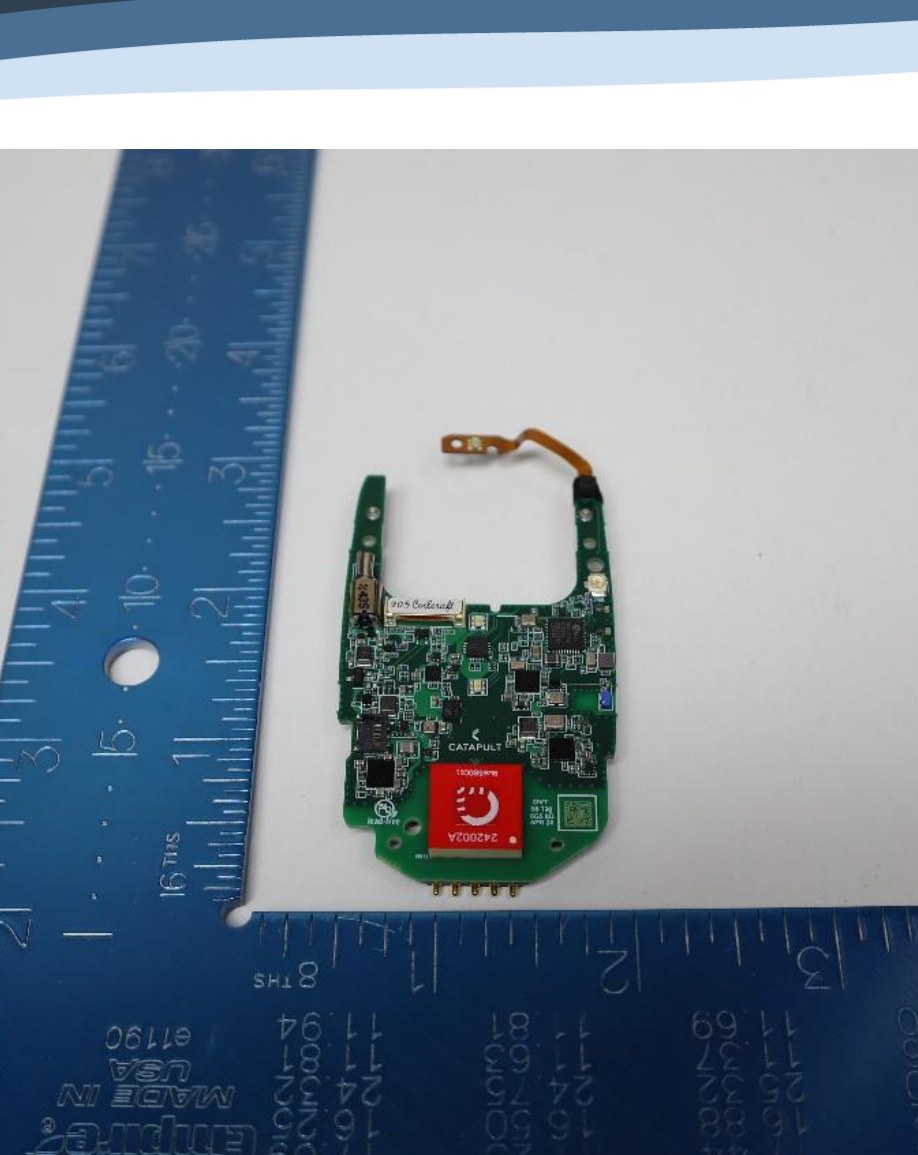
Catapult's current Vector S8 reverses that. Its radio plan is readable, its parts list is not. The two S8 test reports describe the spectrum cleanly, dual-band ultra-wideband on two channels at the regulatory power cap (FCC 2ADAL-WD-S8-08-V1). But neither report carries a chip table, and the one internal photo is a low-resolution shot against a ruler. The processor and radio part numbers cannot be recovered from the public exhibits. verified (RF) · unrecoverable (S8 chips)
| Pod | Main processor | UWB transceiver |
|---|---|---|
| STATSports APX400 (2025) | NXP i.MX RT1064, Cortex-M7 | DecaWave DW1000 |
| STATSports APX300 (2019) | Nordic nRF52840, Cortex-M4F | DecaWave DW1000 |
| Catapult Vector S8 (2025) | not in public filing | not in public filing |
What they measure, and where it goes
A worn pod fuses three sensing streams. The primary one is satellite positioning, GNSS, which the pod runs outdoors at roughly 10 Hz across GPS, GLONASS, and Galileo. The second is an inertial unit: accelerometer, gyroscope, and magnetometer. Independent validation puts the accuracy at meter class. A peer-reviewed study of Catapult's S8 GNSS reported about 57 satellites acquired and a sub-meter distance error against a fixed point, the result expected from this class of receiver (Ellens et al., PLOS One 2025). verified
The third stream is the pod's UWB transceiver, the same ultra-wideband ranging the officiating system uses, measuring pod to fixed receiver. Outdoors the satellite fix carries the position. Indoors or under a closed roof, where the satellite signal is weak, the pod falls back to UWB local positioning. Several 2026 World Cup venues are roofed, so in those buildings the UWB fix would carry the player's position.
Bluetooth handles a separate job. It pairs the pod to a coach's tablet or watch and streams a live view, up to twenty devices at once.
Off the body, each vendor routes the data its own way. On Catapult, telemetry lands at a field receiver, which backhauls over Wi-Fi to a Windows desktop called OpenField Console. That console syncs to OpenField Cloud, which RDAP places on Amazon Web Services.
On STATSports, the pod talks to a Smart Beacon, which relays over Wi-Fi to the Sonra software. STATSports states its Sonra cloud runs on Microsoft Azure. That claim is readable on the product page but not confirmable at the infrastructure level: the public web tier sits behind Cloudflare and masks the origin vendor claim, infrastructure unconfirmed. Either way, the worn-pod data ends up in a vendor's analytics cloud, never on FIFA's officiating plane.
Where the marketing outruns the silicon
STATSports markets the Apex 2.0 as carrying "Differential and Dual-Band RTK GNSS" with "centimeter-level" accuracy. The filed silicon does not deliver that. The GNSS module named in both APX400 test reports is a u-blox NEO-M9N, which u-blox documents as a standard-precision part with a typical 2-meter position error and no real-time kinematic mode at all. Centimeter RTK needs a more capable receiver from a different u-blox line. disputed
The "Dual-Band RTK GNSS" phrase attaches to the ground-based Smart Beacon, not the worn pod, and a base station can only feed a player's receiver the corrections that receiver can use. The NEO-M9N accepts differential corrections that can pull open-sky accuracy toward sub-meter, but that is differential GNSS, not centimeter RTK.
KINEXON publishes two tag weights for its own line, an in-jersey tag around 9 grams and a heavier indoor Perform tag near 15 grams. They are separate products for separate jobs, and they belong to KINEXON's tracking system, not the Catapult or STATSports vests here. verified (KINEXON-published figures)
The training tier is widely worn and runs on its own silicon and clouds. It and the officiating tier are both useless until two independent sensors can be proven to describe the same instant. That is a clock problem, and the clock comes next.
Transport and timing: the clock and the network

The short version
Two things move the data. One shared timing signal lines up the ball and the cameras to the same instant, accurate to about a millionth of a second, so the system can tell which frame a kick fell on. A private high-capacity network then carries the flood of match video off the pitch to a hub in Dallas.
Two streams now exist. The ball's radio reports when a kick happened to about two milliseconds. A stadium full of cameras reports where every limb was, fifty times a second. They are worthless together until you can prove they describe the same instant. That is a clock problem first. Solve the clock, then move the bits.
One clock, because two sensors are useless without it
A shared clock welds the two streams together, and it gets the least public attention. The ball's inertial sensor samples its own motion 500 times a second, one reading every 2 milliseconds. The optical cameras run at 50 frames a second, one frame every 20 milliseconds. To ask "which camera frame was the ball kicked on," both streams have to carry timestamps on the same timeline.
The 2026 stack supplies that timeline with Precision Time Protocol, the IEEE-1588 standard. The published precision is one millionth of a second between the in-ball data and the optical pipeline. KINEXON states on its product page that connected-ball data is "integrated seamlessly with VAR and SAOT systems via Precision Time Protocol" KINEXON Officiate, and a named FIFA innovation lead, Nicolas Evans, put a number on it: "the use of a PTP master clock allows synchronization between KINEXON and Hawk-Eye data that's precise down to one-millionth of a second" The Lowdown. verified (vendor and named-FIFA-source)
One caveat: no FIFA primary page states PTP. That it binds the two systems is vendor-stated and journalist-confirmed, strong but not from FIFA itself.

How PTP actually keeps the epoch
One device on the
network is elected the grandmaster (by the Best Master Clock Algorithm), and the assumption inside that election matters later. The grandmaster sends a timestamped Sync
message; in a two-step clock a Follow_Up carries the precise send time t1. The follower records
arrival t2, then sends a Delay_Req at t3 and gets back a Delay_Resp with the
master's receive time t4. From those four numbers it solves:
mean path delay       = [ (t2 - t1) + (t4 - t3) ] / 2
offset (follower-master) = [ (t2 - t1) - (t4 - t3) ] / 2

-> the follower steers its clock to drive offset toward zero
-> sub-microsecond accuracy comes from HARDWARE timestamping at the PHY
   (the packet is stamped as it crosses the wire, before OS jitter creeps in)
The Sony and Hawk-Eye fusion patent
(US11514678B2)
never says PTP. It names only "timestamp association": images are "timestamped with their capture
time to enable images captured by different cameras at the same time to be associated with each other." That is what a
shared PTP clock would give you, frame by frame, but the patent stops at the word "timestamp."
verified
The ball's time reaches that clock the long way around, because the 2026 match ball is not a node on the
PTP network. Its FCC test report states plainly that it "has no data ports," and its only non-radio interface is the inductive
charging dock
(FCC ZLG-SMCOMB).
PTP runs over Ethernet, so a device with no IP interface cannot be a PTP clock. The kick instant is an ultra-wideband radio event. The pitch-side anchors timestamp
its arrival in their own radio timebase, and the wired edge server, which holds the PTP-disciplined clock,
re-stamps the kick into the shared epoch with the cameras. The link from ball time to optical time is a two-hop
translation, not a direct one. verified (no data ports) inference (the bridging step)
The part that is undisclosed
Everything above is confirmable. The configuration is not. A PTP deployment is defined by a profile, a grandmaster topology (how many clocks, redundant or not), and whether authentication is switched on. IEEE-1588-2019 added a security framework in its Annex P that can append an integrity check to each PTP message (IEEE 1588-2019). No public FIFA, Hawk-Eye, or KINEXON document names any of these for the officiating clock. The right word is undisclosed rather than unprotected. The presence of a control cannot be read off a standard, only off a deployment's own documents, and those are not public. open
One adjacent domain is knowable by industry standard rather than by FIFA. The broadcast video plant at the venues almost certainly synchronizes on SMPTE ST 2059-2, the professional-media PTP profile. The venue vendor (Riedel) publishes deployment guidance for it, and that profile is near-universal for IP broadcast plants (Riedel ST 2110 guide). A walkthrough of a modern broadcast truck at an NHL game shows in plain language how a live sports broadcast is built around a PTP master clock (Geerling, 2026).
Whether the officiating cross-clock shares that domain or runs an isolated profile is not established. inference (broadcast) open (officiating)
Moving the bits: the network off the pitch
With the clock settled, the second problem is volume, and one carrier handles almost all of it. Verizon, the official telecommunications sponsor, plays two distinct roles: inside the stadiums it runs a private 5G network, and between the venues and the hub it operates the wired contribution network. verified
Verizon's own release states that "private 5G networks will be deployed in host stadiums" to enable the Lenovo Referee View body cameras, and that network upgrades boost public-5G capacity "by an estimated three to five times" in the host stadiums, where fans are expected to use more than 50 TB of data inside a stadium per match (Verizon, 16 Apr 2026). The band, core, and RAN vendor of the private slice are not disclosed. verified
The contribution pipe, and the number that does not add up
The contribution network is the firehose that carries every venue's output to the International Broadcast Centre in Dallas. The well-sourced figure is the aggregate: 64 wave circuits of 100 gigabits each, about 6.4 Tb/s, which Verizon and the trade press round to roughly 7 Tb/s. That figure is Verizon-attributed, from the same Gorney interview, and internally consistent (64 times 100 is 6,400) (RCR Wireless; RedShark). verified
A widely repeated per-venue breakdown, about 600 Gbit/s a venue structured as two 100G paths over three redundant routes, does not survive the arithmetic and should not be trusted. It comes from a single non-Verizon outlet (Capacity), and no reading reconciles it with the aggregate. Three checks fail. Multiply 600 Gbit/s by 16 venues and the total is 9.6 Tb/s, not 6.4. Divide the 64 circuits across 16 venues instead and each gets 400 Gbit/s, not 600. And "two 100G paths" is only 200 Gbit/s of usable capacity. The figure reaches 600 only by summing three redundant routes, which is not how redundant capacity works. Treat the aggregate as the accurate figure and the per-venue split as single-source and unreconciled. disputed
| Contribution figure | Value | Provenance |
|---|---|---|
| Aggregate to the Dallas IBC | 64 × 100G ≈ 6.4 Tb/s | Verizon-attributed (Gorney); rounds to ~7 Tb/s |
| Per-venue contribution | ≈600 Gbit/s disputed | Single non-Verizon source; 600×16 = 9.6 Tb/s does not reconcile |
What travels to Dallas is host-broadcast video and the centralized data for the verdict. The UWB tracking link never rides the 5G; it terminates on the venue edge box and stays local.
The production has been deliberately decentralized. The premium plan runs 45 cameras per match across all 104 matches, handled by 16 venue-based production teams, one per stadium. That is up from around eight teams in past tournaments, and it avoids hauling crews across three countries.
Every feed lands at the IBC, replays are cut centrally, and the feeds go out to media partners over everything from SRT to satellite, with a secondary post-production hub in London. A FIFA broadcast lead, on the record at the SVGEurope Football Summit, named the carrier in one breath: "a broadcast contribution network through Verizon, which is our partner. All cameras come to the IBC" (SVGEurope Football Summit 2026). verified
The referee camera's own private 5G
One more radio runs alongside Verizon's. The referee body camera, RefCam, rides a dedicated private-5G slice from Riedel, branded Easy5G, carrying a referee point-of-view feed. Whether that slice is fully separate from Verizon's venue 5G is not settled, since Verizon's own release ties its network to the Referee View cameras open. The camera, the head mount, and what Lenovo's AI does to that feed belong to the officiating story in the next section.
The feed format is reported as 1080i in World Cup coverage (USA TODAY) but 1080p50 in Riedel's earlier Bundesliga demos, so the exact 2026 format remains open. verified format open

The live data path FIFA actually blesses
The most concrete transport finding sits in a FIFA certification document: KINEXON's FIFA EPTS Performance Test Report for the GPS PRO
wearable system. The report describes FIFA's own live-latency test method in
plain language: "This test method uses an open-source message broker software called Rabbit MQ. Tracking providers upload
their live data to the platform, Google/MIT then act as a client and publish the messages to the Google Cloud Platform
with a timestamp"
(KINEXON FIFA EPTS Test Report). FIFA's blessed path for live tracking data is therefore a
RabbitMQ queue into Google Cloud, which corroborates the KINEXON ingest hostnames the rest of this report mapped
(an incoming host feeding a rabbitmq host feeding the FIFA-facing endpoint).
verified
The document carries weight because it is an independent test. The report logs the setup: test date 19 May 2024, run at the Municipal Stadium of Leiria, Portugal, by an external test institute (Victoria University), with ground truth from a 38-camera Vicon optical motion-capture rig that tracks markers to sub-millimeter accuracy and serves as the "truth" the tested system is graded against.
The product under test is logged as a "Wearable System - GNSS," GNSS being satellite positioning (GPS and its peers), and it earns the four-year FIFA Quality stamp (valid 28 Nov 2024 to 27 Nov 2028) (KINEXON FIFA EPTS Test Report). verified
The same report tabulates the end-to-end latency of that live path for the GPS PRO wearable: a median of 378 ms from pitch to reception, with a 99th-percentile tail of 1,122 ms. Read that as roughly a third of a second typical and just over a second at the tail. verified
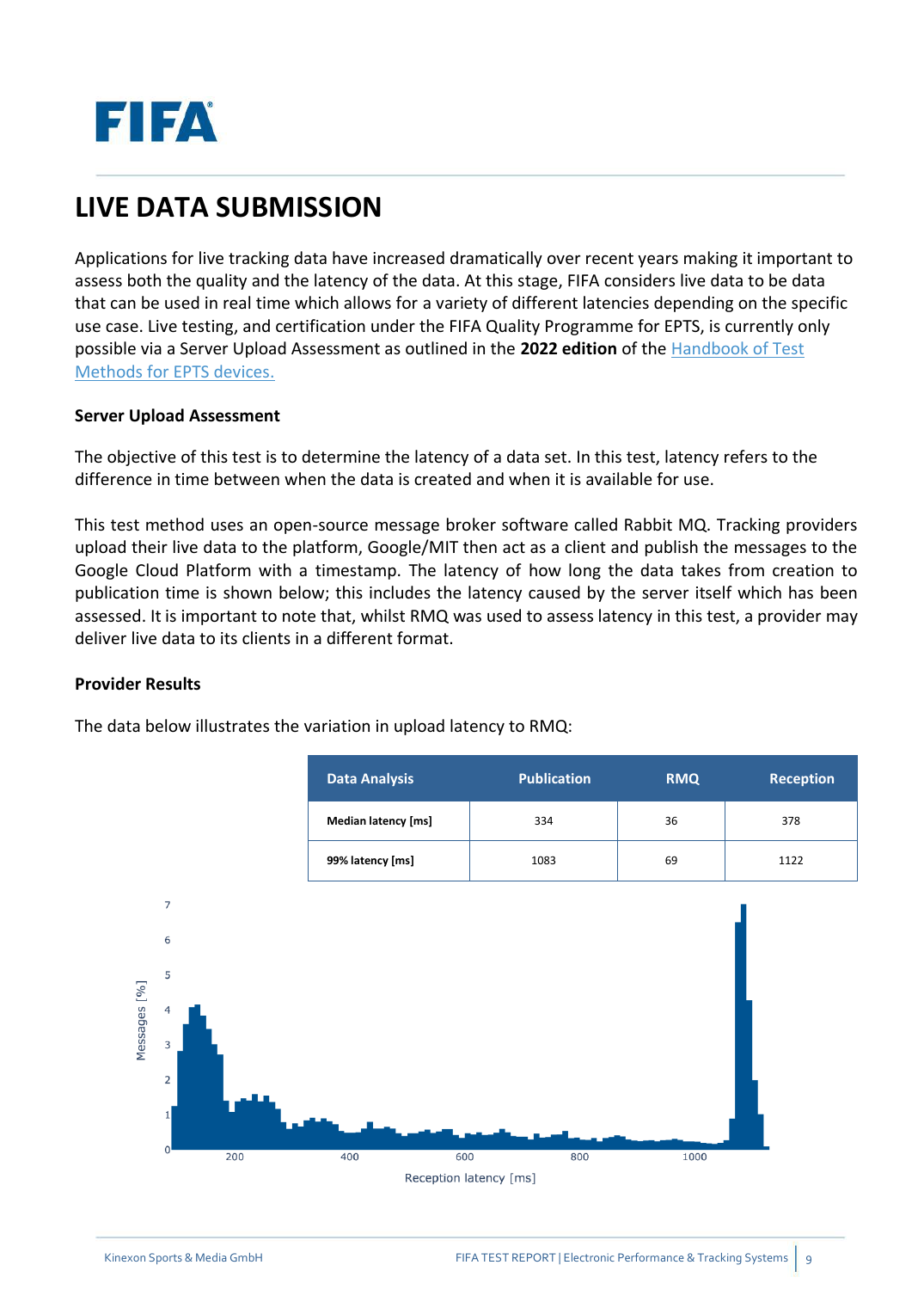
That is the wire-level layer end to end: one clock that makes two sensors comparable, a single carrier moving the broadcast firehose to a hub in Dallas, and a message queue carrying live tracking data into the cloud. A machine can finally ask the question this whole chain exists to answer: at the frame the ball was kicked, was the attacker beyond the second-to-last defender?
Fusion and the verdict

The short version
With the kick instant and every limb on one clock, an offside call becomes arithmetic: pick the frame the ball was struck, find the second-to-last defender, draw the line, and check the attacker against it. New for 2026 is that a clear call sends an audio alert straight to the assistant referee, while tight calls still go to a human reviewer.
With the kick instant and every limb on one clock, the offside question turns from a judgment call into arithmetic. Pick the frame the ball was struck. Find the second-to-last defender. Draw a line through them across the pitch. Test whether the attacker sat beyond it. New for 2026 is what happens next. When the answer is obvious, a machine speaks into the assistant referee's ear.
The verdict is geometry once you have the clock
The four sections before this feed one step. The ball's inertial sensor hands the fusion engine a kick timestamp good to about 2 milliseconds. The sixteen optical cameras hand it a 3-D skeleton of every player, fifty times a second, fitted to that player's scanned avatar so the relevant body point is a real knee or shoulder, not a stick-figure dot. Precision Time Protocol stamps both onto the same microsecond timeline. The engine then does five things, in order, for every kick:
1.  ball IMU 500 Hz  -> impulse spike marks the kick, t_kick (+/- 2 ms)
2.  PTP epoch        -> t_kick selects the nearest 50 fps optical frame  (kills the 20 ms blur)
3.  3-D avatars      -> read the 2nd-last defender's rearmost relevant point
                     -> project the offside line across the pitch
4.  3-D avatars      -> read the attacker's frontmost legal limb
5.  tolerance test   -> is the attacker beyond the line by more than the margin?
       clear  ->  automated AUDIO ALERT straight to the assistant referee's earpiece
       tight  ->  "delay"  ->  a human VAR reviews, can set the kick point and line by hand
Step 2 is the trick the whole chain is built around. The cameras see the world in 20-millisecond frames, so on their own "the moment the ball was played" is ambiguous to within one frame. A sprinting attacker moves several centimeters in 20 ms. The 500 Hz kick timestamp, dropped onto the shared clock, picks the exact frame the foot met the ball, so the line is drawn at the right instant. KINEXON's product page calls the 500 Hz signal "the key asset for officiating" KINEXON Officiate. verified
The engine that runs all of this is owned by Football Technology Centre AG, the FIFA and Hawk-Eye joint venture set up in 2024 to hold the automated-offside and event-detection algorithms. Who owns that JV, and how its board president also runs FIFA's own technology department, is a thread the report picks up at the end (§11). FIFA's own Club World Cup 2025 page names it, crediting "algorithms developed by Football Technology Centre AG, its joint venture with Hawk-Eye Innovations Ltd, to automatically collect the majority of live event data based on the available tracking data" FIFA, Club World Cup 2025. verified
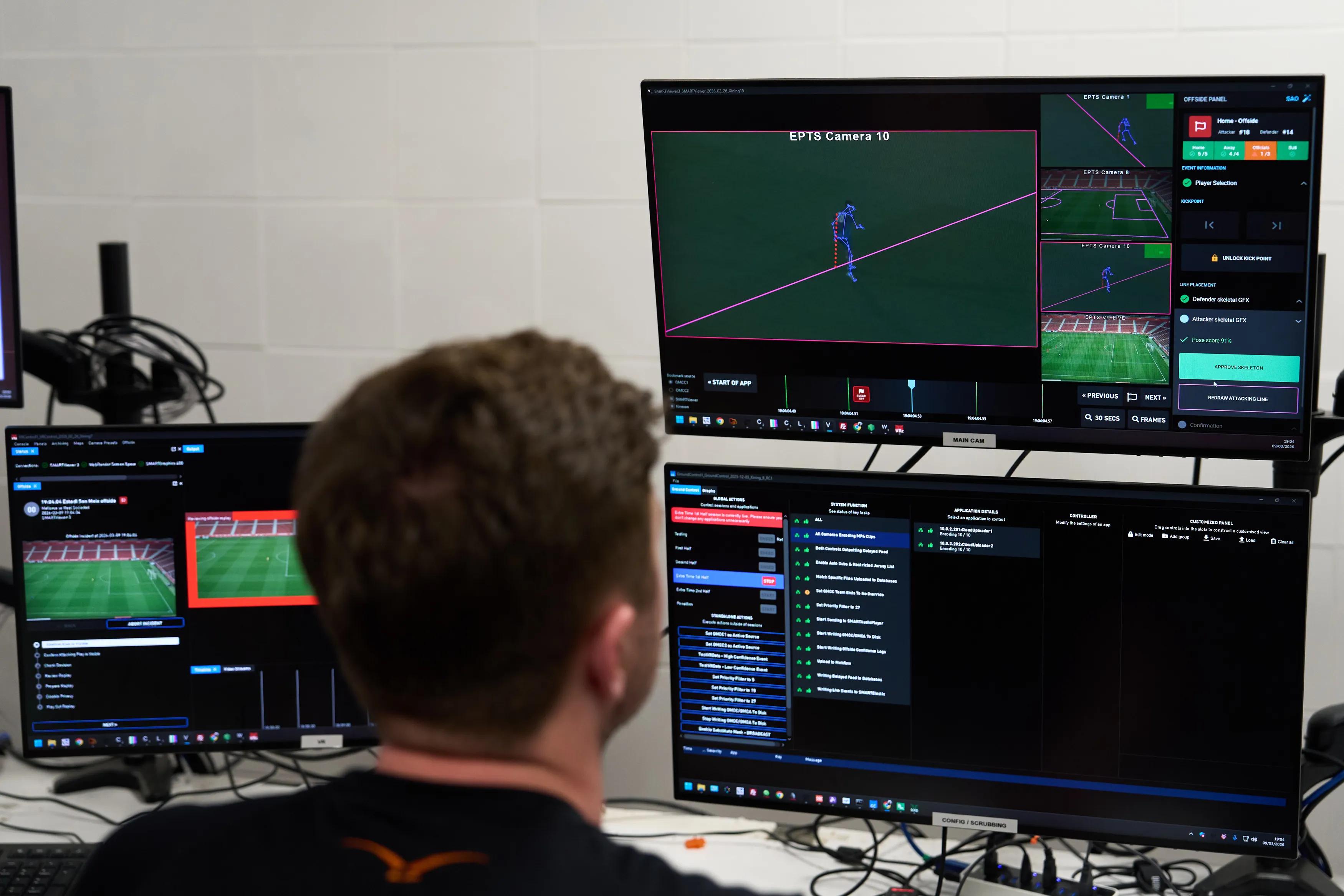

The tolerance, and why the number is not FIFA's
The line is not a hairline. The engine fires automatically only when the attacker is clear by more than a built-in tolerance, the margin that marks a call safe to make without a human. The figure carried across the June-2026 coverage is 10 centimeters. Clear by more than that and the system flags it; inside it, the system defers. Inside World Football, reporting FIFA's pre-tournament briefing, says a real-time audio alert notifies the assistant referee "if a player is more than 10 cm offside," down from the 50 cm threshold trialed at the Club World Cup and the Intercontinental Cup Inside World Football, 3 Jun 2026. verified (strong-secondary)
FIFA's own 2026 offside page does not print that number. The page describes the routing change and the avatars in full but states no centimeter figure FIFA, 2026 offside briefing. So the 10 cm is press consensus, agreed across at least four independent outlets, but never a FIFA primary. The 50 cm baseline it replaced was the Club World Cup 2025 trial figure, not a 2022 World Cup number. Both sit inside the JV's tenure. disputed-as-primary
Another number gets confused with the 10 cm alert and should be kept separate. FIFA's 2019 Handbook of Test Methods for Virtual Offside Line Assessment is the certification protocol a virtual-offside-line system has to pass. It sets placement tolerances of plus or minus 250 mm in the 2-D full-width test and plus or minus 200 mm in the tighter 3-D match scenario FIFA VOL Handbook, 2019 (via Wayback). Those are the accuracy bands a system must hit in a 2019 lab certification, not the live detection sensitivity at which the 2026 engine fires an alert.
The test measures placement error against a surveyed ground truth. A crew places markers on the pitch at known coordinates, the system draws its line on a broadcast still of that scene, and the offset is scored against the tolerance across ten pitch positions, graded pass or fail. verified (FIFA-primary, 2019 protocol)
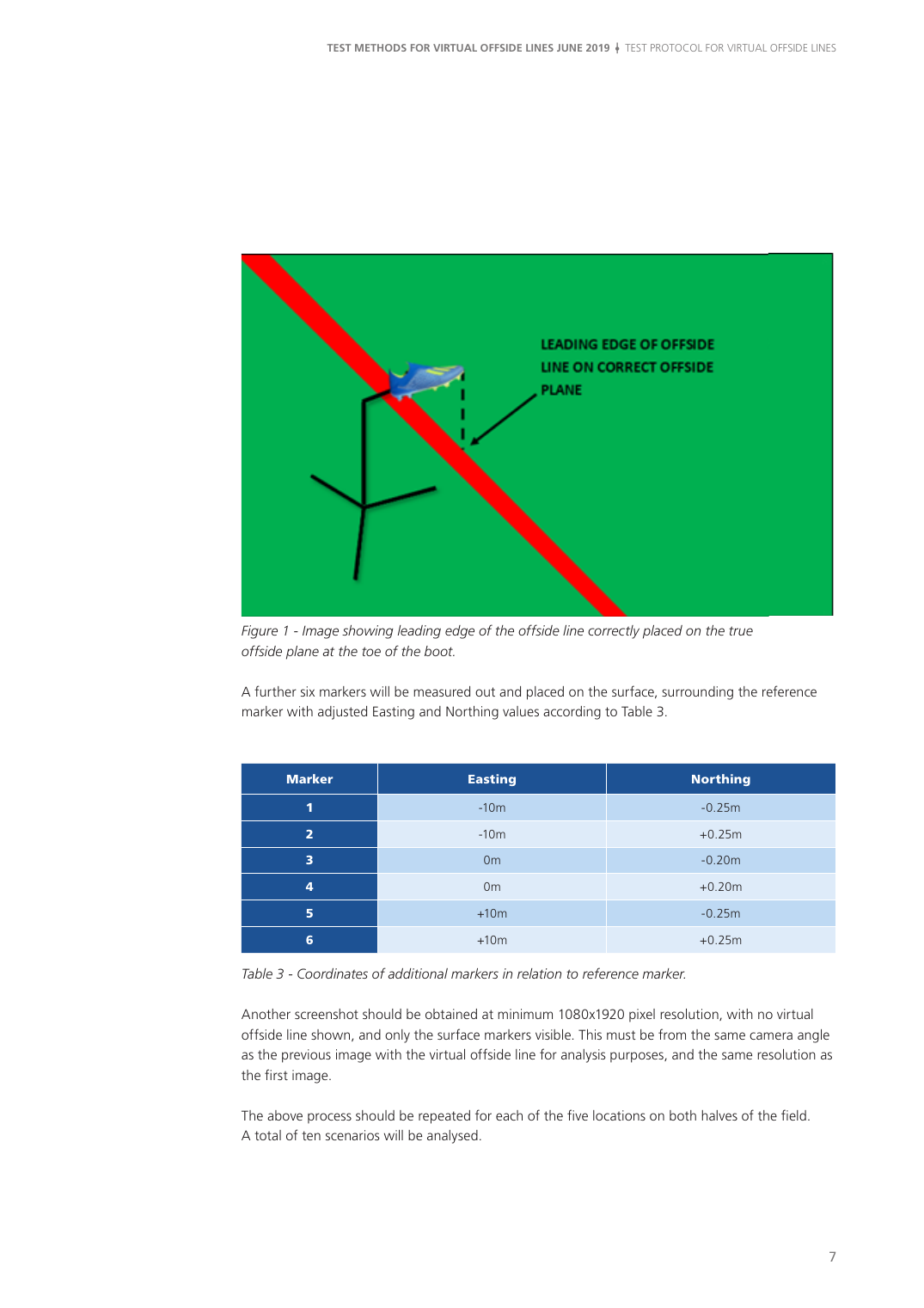
What is new in 2026: the alert goes to the linesman, not the booth
The 2026 change is in who hears the verdict first, not in what gets decided. In 2022 the automated offside alert went to the video officials, who validated it by hand and relayed it to the referee on the field. For 2026, when the call is clear, the alert is routed directly to the on-field officials as an audio cue, so the assistant referee can raise the flag almost at once. FIFA states the routing change across all three of its innovation pages; the Intercontinental Cup 2025 page puts it most plainly, that the system "provides assistant referees with immediate audio alerts when a positional offside occurs on the pitch, greatly speeding up the offside decision-making process" FIFA, Intercontinental Cup 2025. verified (FIFA-primary)
Two qualifications keep this precise. First, the word "earpiece" is not FIFA's. FIFA says "audio alerts" and "sent directly to the match officials"; that the audio lands in the assistant referee's ear is press consensus, well corroborated across TechTimes, the BBC, Al Jazeera and others, but layered onto FIFA's "audio alert" TechTimes, 7 Jun 2026. The cue does not go to a watch or a phone; it reaches the officials over the referee communication system, the Riedel-based headset comms they already wear. Whether it is a spoken phrase or a plain tone is not confirmed. "Synthesized" is loose press wording, so the alert is not called speech here. The comms product, and whether the channel is authenticated or encrypted, are not disclosed.
Second, only the clear, positional call takes the fast path. A tight margin is a "delay" that still goes to a human VAR, who can manually set the kick point and the offside line. Interfering with play stays a human judgment, and under the IFAB protocol the referee is the final arbiter; the assistant referee can even hold the flag down if a malfunction is suspected. verified (FIFA + IFAB) open (tone vs speech)
The ball does more than time the kick
The same in-ball sensor that pins the kick instant feeds two other officiating tricks new for 2026. The first is a goal-line-style 3-D animation for the byline: ball-tracking now reconstructs whether the whole ball crossed the touchline or goal line before a goal, the kind of call that decided a disallowed Aston Villa effort against Brentford in February. The second is sharper. The sensor identifies the last player to touch the ball, which lets the VAR settle corner-kick awards and similar decisions under expanded powers.
A "line-of-sight" extension also reaches offside review: virtual feeds that recreate both goalkeepers' viewpoints, shown to the VAR and to TV viewers Inside World Football, 3 Jun 2026. verified (strong-secondary)
Where the verdict physically runs
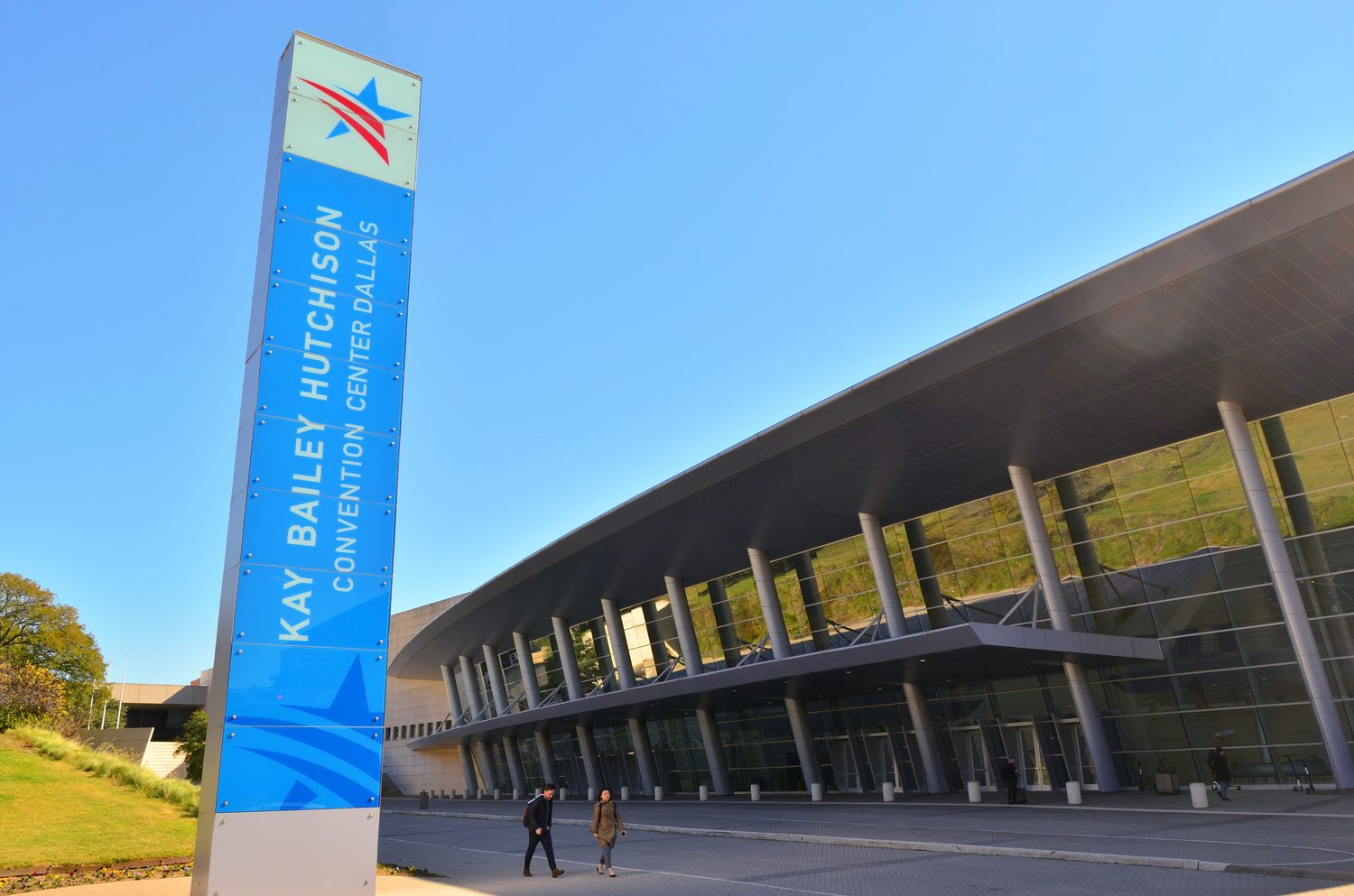
Ownership of the algorithm sits in Zürich; the compute that runs it does not. The video assistant referee operation for 2026 is run centrally from the Dallas International Broadcast Centre, the Kay Bailey Hutchison Convention Center. FIFA's IBC-opening release says the building houses "the video assistant referee (VAR) room" FIFA, IBC opening, and the broadcast-tech press is explicit that the SAOT cameras "feed directly into the VAR operation, which is being run centrally from the International Broadcast Centre in Dallas" RedShark. verified
Two precisions matter here. First, a central VAR operation does not mean the offside math runs on a specific server in Dallas. Hawk-Eye runs its own cloud infrastructure, the per-camera AWS environment the rest of this report mapped. So the first-pass triangulation and fusion may run at the venue edge, in that cloud, or at Dallas. The decision, the replay and the avatar render are surfaced centrally. Where the fusion computation physically happens, venue versus IBC versus cloud, no public source states. inference (fusion-compute location)
Second, the Lenovo ThinkSystem SR635 V3 servers are repeatedly described as running SAOT or VAR fusion. They are not. Every primary source ties them to the live-video and IPTV plane: FIFA's own Chief Business Officer, Romy Gai, says those servers "manage massive volumes of live video data from stadiums," powering the IPTV feed of ten channels to over a thousand screens Lenovo / Businesswire, 2 Jun 2026. The SR635 V3 ingests video; it does not render graphics. Lenovo's offside-related contribution is the GenAI 3-D avatars and the Referee View stabilization, and it names no server model for those, so the offside fusion server is unnamed. corrected
The host-broadcast reporting also describes a per-venue Video-Operations-Room failsafe, on-site replay operators kept at each stadium in case a venue loses its link to Dallas. The named sources confirm those crews as a "connectivity failsafe" SVGEurope, Football Summit 2026, but whether that backup covers the offside-adjudication function specifically, and exactly how failover works, is not spelled out. The per-venue VOR offside failsafe is treated here as inference. inference
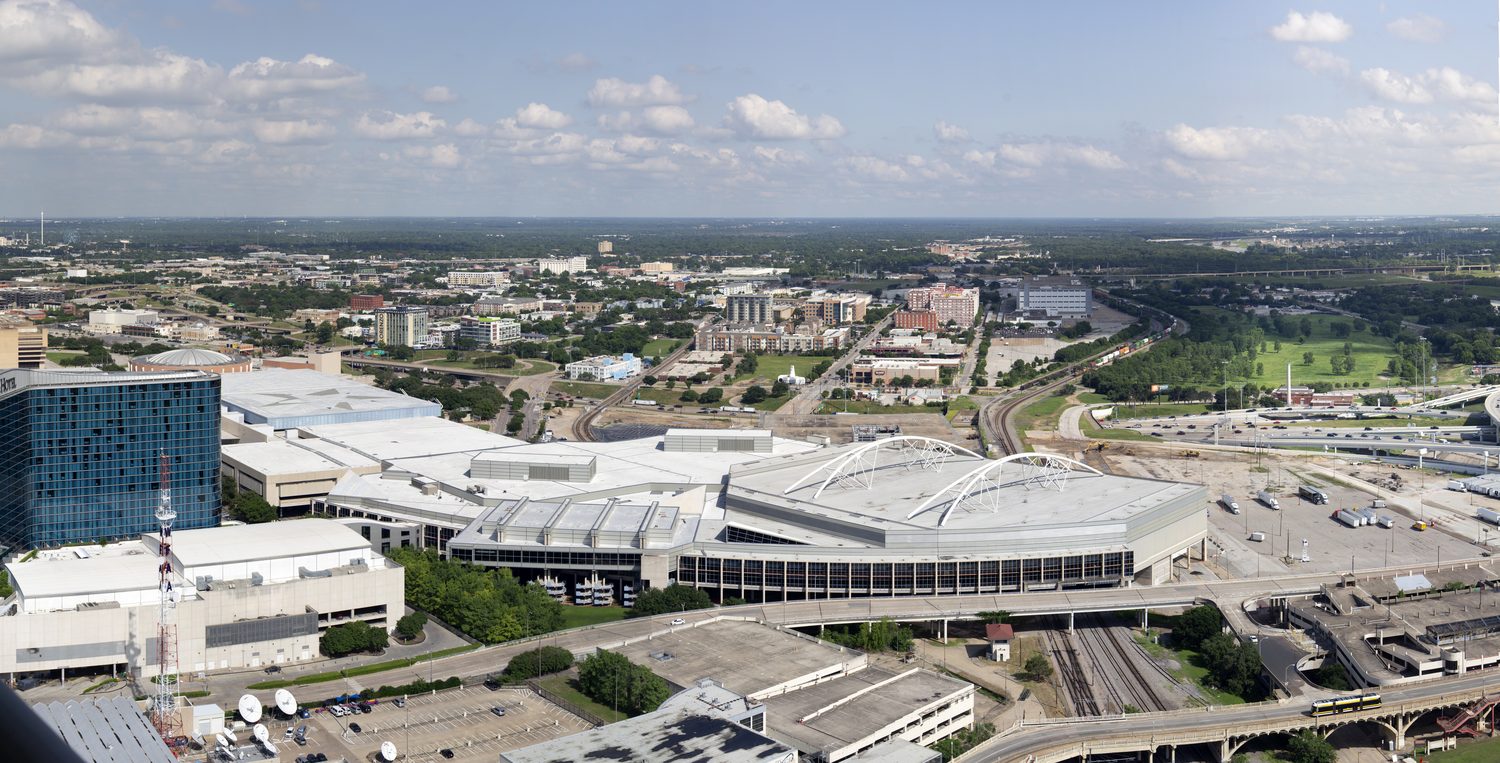
RefCam, and what Lenovo's AI does to it
The other officiating-side camera sits on the referee's head, and Lenovo's AI now works on its picture. A head-mounted camera on a running referee produces a violently shaky image, and Lenovo's stabilization layer, branded "Referee View," cleans it up. The spec is up to 50 percent jitter reduction in high-motion scenes, with resolution held above 1K, handing the host broadcast an extra stream with no loss in visual quality Lenovo StoryHub, 12 Jun 2026. The layer stabilizes motion; it does not generate imagery.
Referee View earned its first moment on 11 June. It captured the first goal of the 2026 World Cup, Julián Quiñones for Mexico against South Africa at the Estadio Azteca, from referee Wilton Sampaio's point of view Lenovo StoryHub, 12 Jun 2026. verified
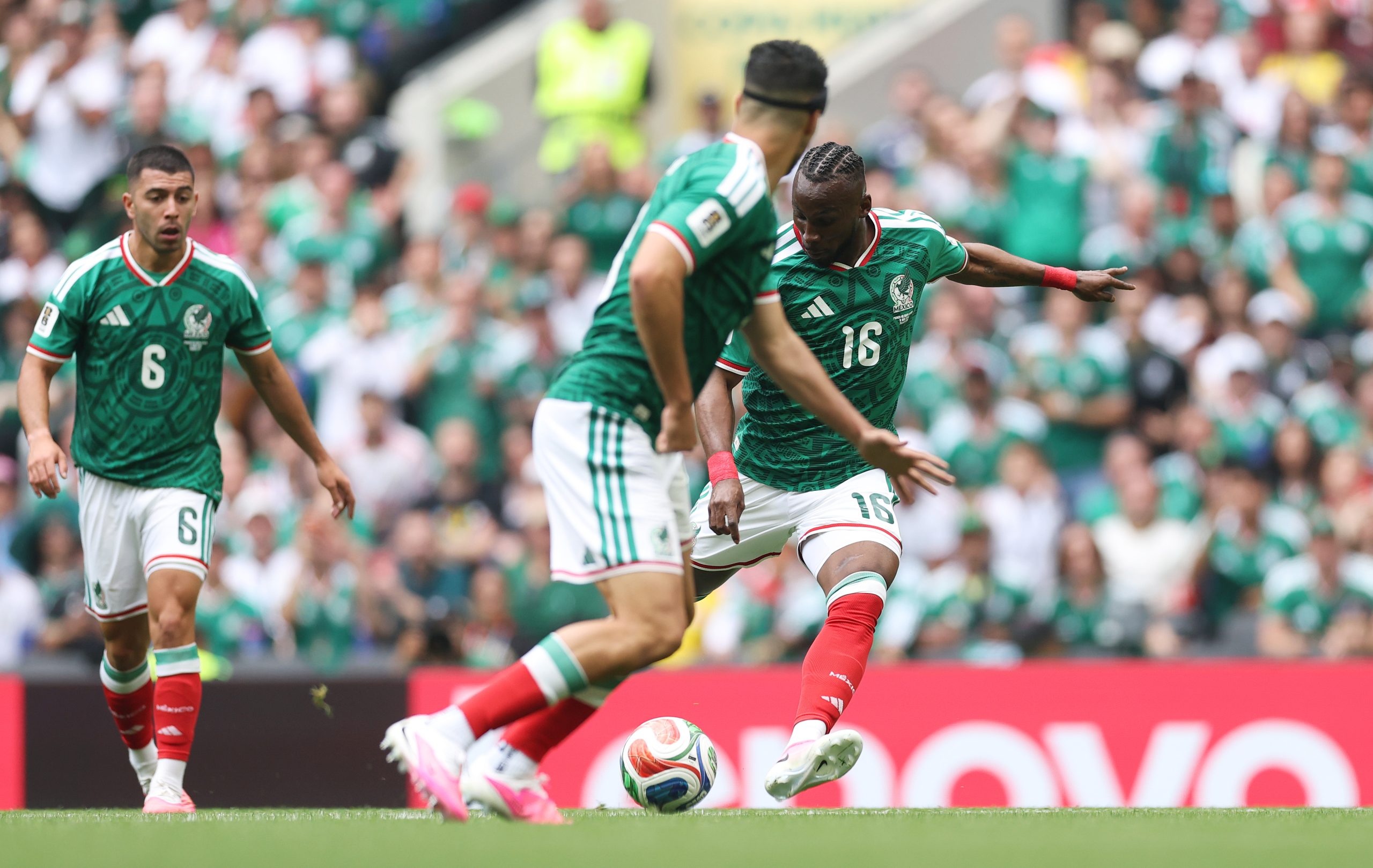
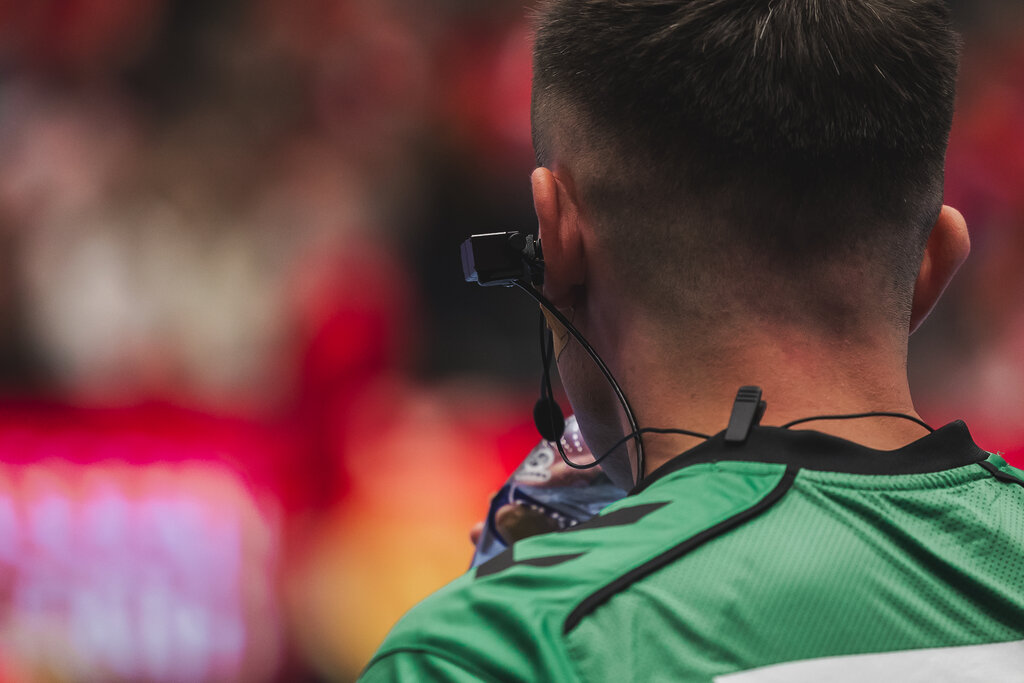
The camera itself is RefCam, a 14-gram point-of-view unit mounted on the side of the referee's head. The full worn kit is a customized earpiece on the right side, two thin wires (one for the camera, one for a microphone clipped at the collar), and a bodypack transmitter tucked into the shorts pocket. FIFA tried chest mounts and found the head mount gave the most natural perspective. The feed is reported at 1080i USA TODAY. The camera was developed by FIFA's own football technology and innovation team, not by the host broadcaster, which is why it ships inside the world feed rather than as a separate feed SVGEurope Football Summit 2026. The transport, Riedel's dedicated Easy5G private-5G slice, belongs to the previous section (§4). verified
RefCam is one piece of a small wearable kit the match officials now carry. The public got its clearest look at the whole set from a crowd-annotated broadcast still, corroborated in the replies by a self-described referee @denbersus on Threads. The consensus kit, matched against the known hardware, is four items. strong-secondary
View the referee-equipment post by @denbersus on Threads
| Item | What it does |
|---|---|
| Wrist watch | Timekeeping plus the goal-line-technology buzz on a goal; large screen |
| Head-worn camera + mic + earpiece | RefCam point-of-view feed and the live comms line to the crew and VAR |
| Upper-arm pack | Battery and receiver feeding the head unit |
| Second arm box | Receiver for the assistant referees' flag buttons; vibrates when an AR signals |

How good is the optical offside system, really
The marketing says the optical offside system beats human officiating, and for once there is independent evidence. A peer-reviewed study presented at ICSTPA 2025, drawing on official offside data from the top European leagues from 2020 to 2024 plus the 2022 World Cup, found that more cameras correlate with sharper centimeter-level offside precision (p < 0.01), the real-world backing for the 16-camera upgrade Yan, ICSTPA 2025 (ACM). The same work flagged the failure modes: player speeds above 30 km/h raise the misjudgment rate, and body-posture ambiguity plus camera blind spots are the standing limits. That matches FIFA's own caveats, that the system cannot resolve the tightest calls and struggles when players are grounded or clustered. The data is from leagues and 2022, not 2026, so read it as evidence about the technique, not a measurement of this tournament. verified (peer-reviewed)
- The 10 cm alert tolerance is strong-secondary, not FIFA-primary. FIFA's 2026 page prints no centimeter figure; the 50-to-10 cm tightening is well-sourced press consensus from the Club World Cup 2025 baseline. disputed-as-primary
- Whether the alert audio is synthesized speech or a tone. FIFA says "audio alerts"; "synthesized" is press wording, and "earpiece" is secondary, not FIFA's word. open
- What carries the alert, and whether that channel is authenticated or encrypted. No public source names the comms product (Riedel RefComms and VOKKERO are both plausible) or describes its security. The right word is undisclosed, not unprotected. open
- Where the SAOT fusion computation physically runs (venue edge versus the Dallas IBC versus Hawk-Eye's cloud). The VAR operation is centralized at Dallas (verified); the fusion-compute building is not. inference
- The per-venue VOR offside failsafe and its exact failover. On-site replay crews are confirmed as a connectivity backup; whether that covers offside adjudication is not spelled out. inference
- The end-to-end 2026 decision latency (kick to audio in the ear, in milliseconds). Only the 2022 "about half a second behind live" proxy and the under-30-second wall-clock target are public. open
- The RefCam 2026 broadcast format. Reported as 1080i in World Cup coverage and 1080p50 from earlier Riedel demos; the exact tournament format is the residual unknown (carried from §4). open
That is the officiating story end to end: sense, sync, decide, signal. But the same tracking stream that settles one offside call also becomes thousands of measurements about everything else on the pitch, and those run through a firehose with a human hand on the valve. §6 and §7.
The data format on the wire

The short version
Once a position exists, it becomes a row of bytes in an open format FIFA publishes in plain text. Each exchange is two files: a flat text file holding every player and ball position, one line per frame, plus a separate file that explains how to read it. Each line carries a frame number rather than a clock time, and the real time is calculated from the frame rate.
The system now has a position. The fusion engine holds a kick instant and a pitch full of skeletons on one clock, enough to settle an offside call. The next question is what that position looks like once it stops being physics and becomes a row of bytes. The format is open. FIFA publishes the tracking-data spec in plain text, and the worked example is a real file anyone can download and parse.
The spec is public, and fully readable
The specification is plain text, not a sealed binary. Point
pdftotext -layout at FIFA's own
Standard Data Transfer Format documentation and the whole grammar reads out cleanly:
the element tree, the delimiter rules, the field types, the enums. Everything below is read straight off that primary document
rather than inferred from third-party parsers. corrected
The standard is the EPTS Standard Data Format, written jointly by FIFA and FC Barcelona's innovation group after the 2015 IFAB rule change let electronic performance and tracking systems onto the pitch in competition. The PDF calls itself a "first version," a fair label for a small, vendor-neutral interchange format. It exists because every tracker speaks its own proprietary dialect. A club or league needs one shape it can read no matter who produced the feed. A KINEXON ball feed, a Hawk-Eye optical feed, and a Catapult vest export all collapse into the same text grammar, with no per-vendor parser. verified
Two files, and the raw data is deliberately not XML
An exchange is always two files, and the bulk payload stays out of XML to keep it compact. The provider hands over a flat text file, one line per frame, plus a separate XML file that explains how to read it. The text is the data; the XML is the key that decodes it.
Raw data (.txt)
Flat text, one frame per line, parsed left to right. Three delimiters,
:, ; and ,, pack the frame number, every player's channel
values, and the ball position onto one line. verified
Metadata (.xml)
An XSD-validated envelope: GlobalConfig (frame rate,
field size, tracking type), the team and player roster, the Devices and Sensors tree, and the
DataFormatSpecification that maps each delimited slot to a named, typed channel.
verified
The metadata is built for more than one kind of sensor. A Device holds Sensor entries, and FIFA's
schema names the wearable types: GPS, accelerometer, magnetometer, gyroscope. For an optical setup a
"sensor" is a virtual source rather than a physical chip. Each sensor lists its Channels (XPosition,
YPosition and the rest), and PlayerChannels tie a channel to a player by id. The key field
is TrackingType, an enum with three allowed values: Optical, GPS, and RF. That one field records whether a
position came from a camera, a satellite, or a radio inside the ball, and nothing downstream is supposed to care which.
verified
The spec lays the whole grammar out as a single element tree. The root, FIFADataTransferFormatEPTS,
splits into exactly two children that match the two-file split above: a Metadata branch and a
DataFormatSpecifications branch. The Metadata side holds the boxes already named here, from
GlobalConfig through Devices with their Sensors and Channels, drawn out below straight from the PDF. verified
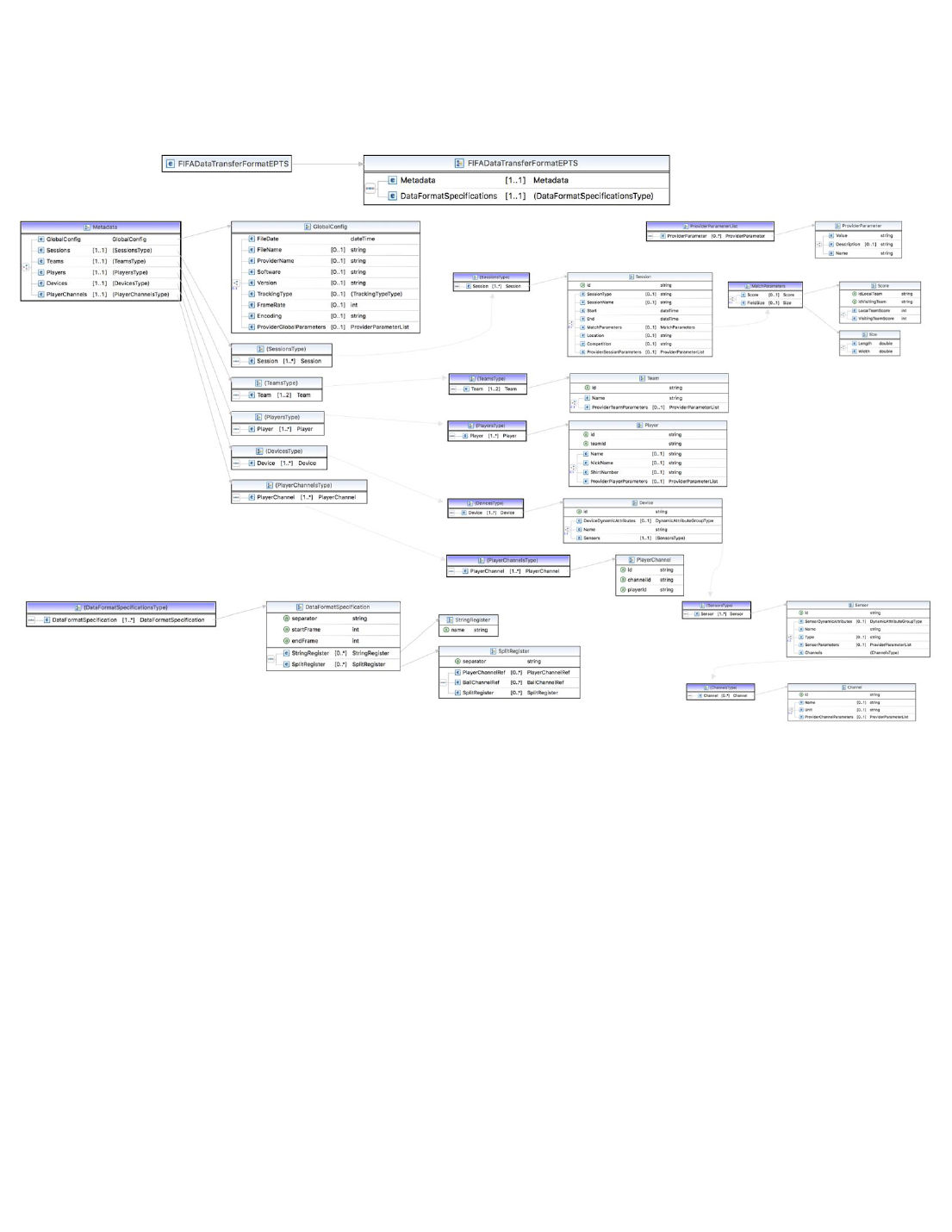
FIFADataTransferFormatEPTS down to every channel and separator field.Metadata and DataFormatSpecifications; every box below is a named, typed element the consumer parses
against. The format is public and fully documented, so this is read off the primary source rather than inferred. Source backlink:
FIFA, Standard Data Transfer Format documentation. verifiedOne real frame, copied verbatim
Below are two consecutive lines from FIFA's distributed example file, untouched, then decoded. The delimiters carry the entire structure. A colon splits the frame number from the player block from the ball block, a semicolon ends one player and starts the next, and a comma separates the channel values inside a single player.
# RAW DATA (.txt): FIFA's own example, two consecutive frames, verbatim
# shape:  frameCount : player1 ; player2 ; player3 ; : ballX,ballY,ballZ :
1779143:-769,-2013,-500,100,9.63,9.80,4,5,177,182;-461,-615,-120,99,900,9.10,4,5,170,179;-2638,3478,120,110,1.15,5.20,3,4,170,175;:-2656,367,100:
1779144:-770,-2010,-500,100,9.63,9.80,4,5,177,182;-462,-616,-120,99,900,9.10,4,5,170,179;-2638,3479,120,110,1.15,5.20,3,4,170,175;:-2656,368,100:

# decoding frame 1779143 (channel order is whatever the metadata declares; this read is illustrative):
#   frameCount = 1779143
#   player 1 : x=-769  y=-2013  z=-500  ... then speed / acceleration / heart-rate channels   (integers, cm scale, pitch-center origin)
#   player 2 : x=-461  y=-615   z=-120  ...  the lone "900" here is a wart in FIFA's example, see below
#   player 3 : x=-2638 y=3478   z=120   ...
#   ball     : x=-2656 y=367    z=100
The coordinates are plain integers on a centimeter scale, with the origin at the center of the pitch. A player on the
halfway line reads near zero. The four corners of a standard 105 by 68 meter pitch land around plus or minus 5,250 along its length and plus or minus 3,400
across it. None of that is mandated. The XSD leaves origin and units to the
provider, declared per file in FieldSize, which the spec documents as "meters or pixels." The
centimeter, pitch-center layout in the example is the optical convention, not a rule of the format.
TRACAB is the optical product often cited as the textbook example of this convention. It came out of ChyronHego. It is now an Electronic Arts product, not a Stats Perform product: EA agreed to acquire TRACAB Technologies in February 2025 (SVG, 4 Feb 2025). verified inference (the example's units) corrected
That line is kept exactly as FIFA ships it, wart and all. Player 2's fifth channel reads 900 in
FIFA's own published example file, far out of
range next to the 9.63 and 1.15 in the same column for its neighbors. An open-source parser built to
reproduce FIFA's reference data flags it: the example "is misspecified," because the raw file carries frames the
specification does not fully define. Trust the metadata blindly and you would misparse FIFA's own sample.
verified

The frame counter is the clock
There is no wall-clock timestamp on the
line. The frame carries nothing but an integer frameCount that increments from the start of
the period. A timestamp is computed, never stored.
timestamp = frameCount / FrameRate # seconds, relative to the period start recorded in the metadataA time-of-day stamp written into each frame can round, drift, or quietly disagree between two machines that both think their clocks are fine. An integer counter cannot drift. Frame 1779143 is frame 1779143 on every consumer that opens the file, to the digit.
Lining up two EPTS feeds, or an EPTS feed against the live officiating pipeline, then needs only two things: the
FrameRate agreed once in the metadata, and the shared PTP clock the
capture systems were synchronized to (Section 4). The counter answers which tick; the shared
clock answers when that tick happened in the world. That keeps the shared clock as the single source of truth for
real-world time, the same clock the cameras and the ball edge already use. verified
The messy reality of a live match is handled by the DataFormatSpecification itself. Each one carries a
startFrame and an endFrame, so a single file can change parsing rules partway through. That is how
it survives a half-time break or a mid-session change in which channels are present: a consumer picks the
spec whose frame range covers the current line and parses to those rules. verified
About 25 Hz, and that figure is derived
This format carries derived variables, not raw sensor signal. The spec's own example of the cadence is traveled distance reported "25 times per second." The frequency field is flexible, not pinned. So the working number is roughly 25 Hz, a documentation example for the interchange feed rather than a guarantee stamped on every export. It sits well under the 50 Hz optical capture and the 100 Hz ball-position rate quoted in earlier sections, one step down from the raw sensing layer. inference (25 Hz is documented as illustrative, not fixed)
- Whether the WC2026 officiating feed travels in this public interchange format or in a richer internal one. FIFA's PDF calls this the "first version" interchange standard, and the live tracking transport FIFA tests against is a separate matter, a RabbitMQ queue into Google Cloud, covered in Section 4. This is the documented public face of the feed layer; the production officiating wire format is almost certainly internal and unpublished. open
- Whether the feed is delivered live as a stream or only after the match, and which spec version the 2026 tournament ran. The FIFA landing pages were last updated 1 April 2026 but state neither the delivery mode nor a version number. open
- Whether the 29-point skeletal data from the optical system rides inside this format or only in a separate skeletal-tracking standard. FIFA publishes a distinct Skeletal Tracking test manual, which hints the body-point data lives elsewhere, but the boundary is not stated. open
So that is one tick of tracking data: a frame number, a row of per-player channels, a ball triple, three nested delimiters, and a clock kept deliberately somewhere else. Run that single line about 25 times a second for a whole match, and the result is the firehose the rest of the system drinks from. The next question is where all of it goes, through what gate, and who is allowed in.
Redistribution: the Data Hub and the gate

The short version
The same tracking stream becomes more than two thousand football measurements, computed by software and human analysts and stored in one central place FIFA controls. From there the numbers fan out to broadcasters, teams, apps, and licensed data sellers. The last step before any stat reaches a screen is two analysts deciding the moment it appears.
The same tracking stream that settles one offside call also becomes more than two thousand measurements about everything else on the pitch. The machine computes a stat in under two seconds. The last step before it reaches a screen is two people deciding the moment it appears. The data fans out from there to broadcasters, teams, apps, and licensed data sellers, and one of those consumers ends up on a different tap from everyone else.
The Data Hub is the central store, and the FTC engine feeds it
Everything downstream of the fusion engine passes through one place. FIFA calls it the FIFA Data Hub. The Hub "centralises all the tournament and match data collected by and for FIFA" (FIFA, Player App). The same FTC AG / Hawk-Eye engine that draws the offside line also generates the automated event data and pushes it here. There is no separate "team feed" and "broadcast feed" at the sensing layer. One engine and one Hub feed everyone, and consumers differ only in how the same source is later packaged. verified (engine identity) inference (single source, then fork)
EFI: the layer that turns positions into football
On top of the Hub sits the metric system, Enhanced Football Intelligence. EFI is a
layer, not a product you log into. It is "a series of algorithms and models that operate live to integrate event and tracking
data," all captured against a controlled vocabulary FIFA calls the FIFA Football Language, and built by FIFA's own
Football Performance Analysis & Insights team
(FIFA, EFI play-offs). Raw tracking gives you coordinates; EFI reads those coordinates back as the language coaches actually
use. A defensive line did not just sit at x = 41.2 m; it broke, or held, or got played through.
verified
The metric families are mostly spatial, the point of having skeletons rather than a scoreline. Line breaks count a ball played past a defensive line and record how many players it bypassed, how many lines it broke, and whether it went through the middle, around the side, or over the top (FIFA High Performance, SSAC 2023). Team shape assigns every player a role from their position relative to teammates and aggregates the last three minutes of play into a true shape, often nothing like the 4-3-3 on the team sheet. Phases of play bucket time into build-up, progression, press, counter-press, and the rest. The remaining families cover pressure, receptions and offers, forced turnovers, ball-recovery time, final-third entries, and a summarising FIFA Power Index.
The headline figure FIFA and Lenovo both quote is more than 2,000 metrics drawn from hundreds of millions of data points a match (FIFA, football data solutions). verified (metric existence and headline names)
The granular definitions are no longer a matter of inference. FIFA published a public, non-login Enhanced Football Intelligence explanation document for the 2023 Women's World Cup that spells out how each metric is calculated. Because EFI is the same metric layer FIFA carries into 2026, the methodology travels with it (FIFA, EFI Explanation Document v1.1, 11 July 2023). verified (FIFA-primary)
The two possession figures you see on TV, Team A and Team B adding to a hundred, are a flattened view. FIFA's own model splits a match into four states: possession by Team A, possession by Team B, out of play, and a third in-play state FIFA calls In Contest, the loose-ball moments when neither team controls the ball. An aerial duel is In Contest, and so is the instant a defender blocks a pass. The four percentages are computed from the sequence of ball-control events on the pitch, and they sum to the whole match rather than to a hundred percent of "active" time. The loose-ball slice is the one the on-screen graphic usually leaves out (FIFA, EFI Explanation Document v1.1, 11 July 2023). verified
Phases of play are computed per frame, then stitched into time. The algorithm classifies each frame from where the players and ball are and how they are moving; a phase that holds across enough frames becomes a sequence, and the sequences aggregate into a fraction of in- or out-of-possession time. The taxonomy is larger than the broadcast shorthand suggests: 7 in-possession phases (build-up, progression, counter-attack, and more), 9 out-of-possession (presses, blocks, counter-press, recovery, defensive transition), and 4 set-play, each with a plain FIFA definition. A low block, for instance, is a compact defensive shape held near a team's own penalty area. The on-screen "Phases of Play" bars are the aggregated output of this per-frame classifier (FIFA, EFI Explanation Document v1.1, 11 July 2023). verified
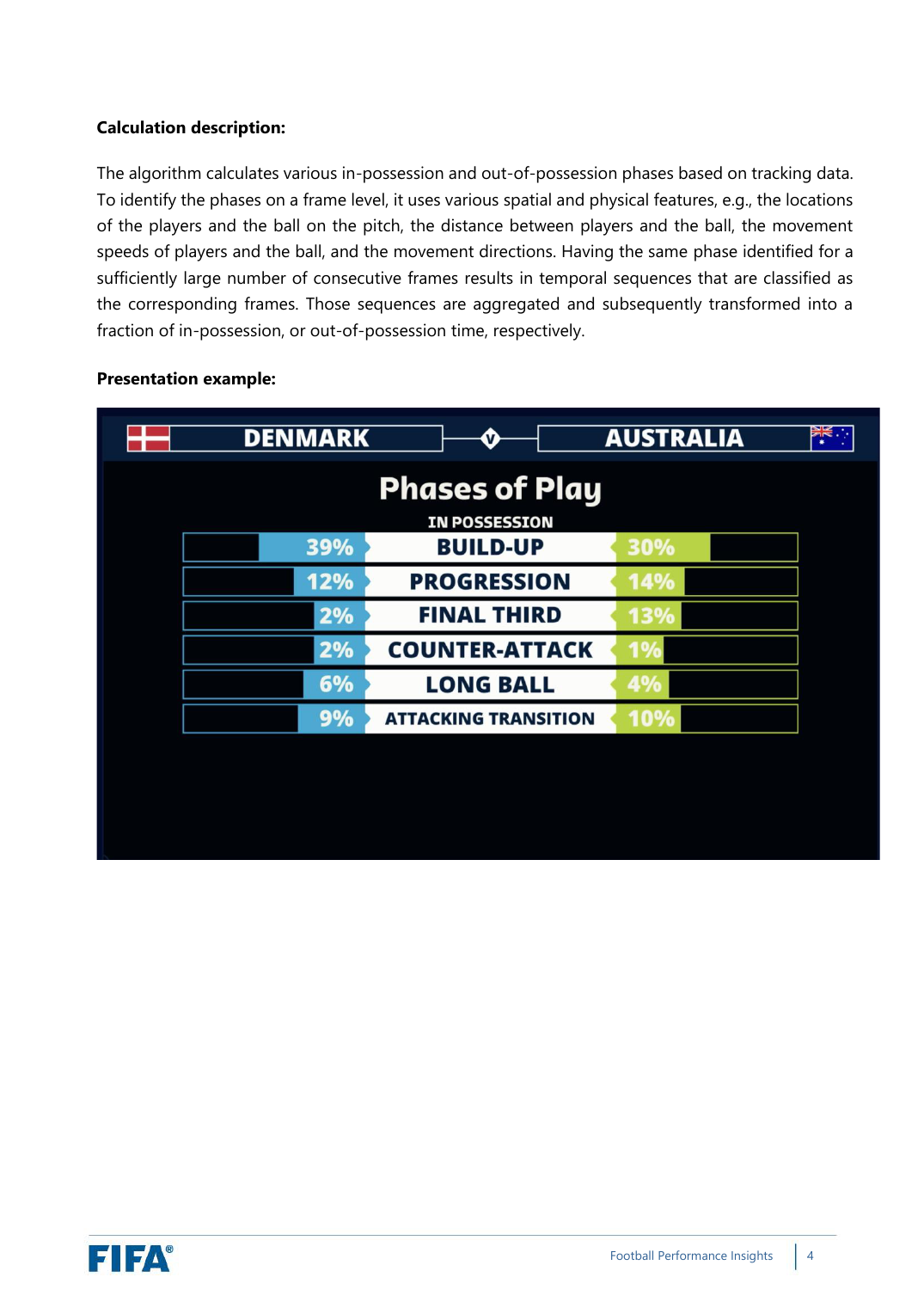
The same document also pins down the other two metrics this section leans on. A line break counts how many opponent units a pass, cross, or ball-carry bypasses, a unit being the defenders, the midfielders, or the attackers as a group. It also records the route (through, around, or over), whether the action was attempted or completed, and where the ball was received relative to the opponent's team shape. Ball recovery time is the time between a team's last ball-control event in one possession sequence and its first ball-control event in the next, that is, how long a side goes without the ball before winning it back (FIFA, EFI Explanation Document v1.1, 11 July 2023). verified

How the metrics actually get made: 22 analysts, frame-accurate, on Airflow
The pipeline behind EFI is more hand-built than the "2,000 metrics" headline implies, and its mechanics are public: two members of FIFA's High Performance team described them on stage at the 2023 Sloan conference. It starts with people. A data-collection unit puts 22 football analysts on a match, one per player, each annotating their player's events, on the ball and off it, for the full ninety (FIFA High Performance, SSAC 2023). That human event stream is then synced against the optical tracking stream. The tagging is frame-accurate on purpose, so that "we know exactly where all players were at each moment that there was an event tagged." Event data answers what happened, tracking answers where everyone was, and the frame-accurate join lets EFI compute a line break or a press as a spatial fact rather than a guess. verified
The metric algorithms run on Apache Airflow (an open-source tool for scheduling data-processing jobs), FIFA's own choice of orchestrator, with "as many algorithms as we want in parallel." When one breaks mid-match, say a pressure job throwing red errors, the team drops into "investigation mode" and debugs it live. During a match they sit in one room: data scientists, engineers, and football analysts alongside the data providers, all watching dashboards. When they spot a trend worth surfacing, they push it out to the broadcasters and the stadium screens. verified
Pitch to screen in under 30 seconds, with a human hand on the valve
FIFA states the complete live path, pitch through external providers to the screens, at under 30 seconds for event-based metrics, of which the metric processing itself runs under two seconds on average (FIFA, EFI play-offs). With computation at two seconds and the ceiling at thirty, most of that budget is not machine time. It is the human step: two qualified analysts decide when each metric is revealed, "in accordance with the events taking place on the pitch." They surface the right insight at the right moment rather than dumping every number the engine produces. That is editorial control as much as engineering, the cleanest example in the stack of a person sitting deliberately between the data and the audience. verified
Two caveats keep that precise. First, this is the EFI-metrics-to-screens path, not the real-time officiating signal that bypasses the Hub for the assistant referee's earpiece, and not the 30-to-100 second buffering on consumer streaming services, a separate artifact for unrelated reasons. Second, the figure is FIFA-documented for the 2022 cycle and its intercontinental play-off trials; no 2026 page restates the thirty seconds verbatim. It most likely holds, since the architecture has not changed, but that is an inference, not a fresh quote. verified (2022-stated) inference (2026 persistence)
Where it fans out
From the Hub, the data goes to six kinds of consumer. Broadcast graphics get the 3-D offside replays built from the player avatars, the match-center event timeline with real pitch coordinates, and the EFI dashboards, all behind the timing gate. The two FIFA apps, the fan-facing one and the players' own, both draw the same family of EFI data but through deliberately opposite front doors, a contrast treated two sections on. Officials get the offside signal on the fast path that skips the Hub. The 48 teams reach the analytics through a brand-new tool, the subject of the next section. And the licensed distributors take a commercial cut of the data out to a separate world entirely. verified

The distributors, and what FIFA actually sold
FIFA's commercial-data tier is three companies with three different relationships, and they are easy to lump together. Stats Perform is the new one: FIFA's "first-ever official worldwide betting data and betting streaming rights distributor," with exclusive rights covering all 104 matches of the 2026 tournament, announced on 12 January 2026 (FIFA media release; Stats Perform). It is the single licensed pipe that resells FIFA's official data and video to sportsbooks, through brands you may know: Opta for the stats, RunningBall for the ultrafast betting tick, and Bet LiveStreams for the video. verified
Sportradar is the older, complementary relationship: FIFA's integrity partner, running bet-monitoring across all 211 member associations, extended through 2031 in an announcement dated 2 March 2026 (Sportradar; GlobeNewswire). Its Universal Fraud Detection system watches the betting markets for matches that look fixed; it never touches the on-pitch tracking data. Stats Perform sells the data, Sportradar polices the markets the data feeds, which is why FIFA can hold both deals at once without conflict.
Genius Sports, often assumed to belong here, has no FIFA-central deal for 2026. Its
FIFA footprint is the free-to-play games tier on play.fifa.com, and its tracking pedigree (Second Spectrum, bought
for USD 200 million in 2021) belongs to the 2022 optical generation, not the 2026 engine
(Sportico). For scale: the 2026 tournament is expected to
draw on the order of a 50 billion-dollar betting handle, with Brazil entering as a freshly regulated market.
verified verified (context)
| Distributor | FIFA role for 2026 | Touches tracking data? |
|---|---|---|
| Stats Perform | Official worldwide betting-data + stream distributor (exclusive) | Commercial data/video only |
| Sportradar | Integrity / bet-monitoring partner (to 2031) | No, watches betting markets |
| Genius Sports | No FIFA-central deal; free-to-play games tier | No |
The betting tick is not the tracking tick
The sub-second feed that reaches a sportsbook's in-play odds is not the KINEXON in-ball or Hawk-Eye optical tracking stream, a structural point that headlines about "official FIFA data on betting markets" gloss over. It is RunningBall data, collected by humans. Stats Perform's own product page says it plainly: "RunningBall scouts will be in-venue for every World Cup match," connected to "secure, ultrafast stadium Wi-Fi," delivering data "from the venue in under one second" (Stats Perform, RunningBall). A scout watches the match and taps in what happens. The "tracking-derived" content that does reach betting is Opta-modeled event data, not raw positional coordinates from the officiating sensors. The betting world runs its own fast observation path, parallel to the officiating pipeline and never crossing it. The "under one second" and "100% reliability" claims are Stats Perform's own marketing, not an independent benchmark. verified (scout-collected, parallel path)
One small public artifact shows that the fan-facing slice of all this has been live for a while. The
Internet Archive's index shows FIFA's data-hub per-match stats endpoints returning ordinary 200 OK responses back
in 2022, and it has captured a new 2026 route at /v1/powerranking/match/{id}, the public surface behind the
Power Index, recorded without anyone probing a live server
(Wayback Machine / CDX). That route is part of the fan-feed story two sections on. verified (index)
- Whether the under-30-second, two-analyst rule persists verbatim for 2026. FIFA documented it for 2022 and the intercontinental play-offs; no 2026 page restates the number. inference
- The granular EFI sub-definitions are now FIFA-primary. FIFA's public EFI Explanation Document (v1.1, Women's World Cup 2023) defines how possession, phases of play, line breaks and ball-recovery time are calculated; EFI is the same metric layer carried into 2026, so the methodology travels across tournaments. What stays inferred is only that the exact thresholds are unchanged for 2026, not the method. verified (FIFA-primary)
- The wire protocol and authentication on the Hub-to-distributor leg. The fan-out to Stats Perform and the rest is confirmed to exist, but how the data physically reaches them, the format, the push or pull, the authentication method, appears in no public source. open
- FIFA Data Hub internals: which cloud and region host it, its schema, and whether it consumes the EPTS Standard Data Format. No public API or developer docs for the Hub exist. open
The Data Hub, then, is a firehose with a human valve. One of the biggest consumers hanging off it is brand-new for 2026, and it does more than display the data: a coach types a question in plain language and gets back video, charts, and 3-D scenes. That is the next stop, and the one detail FIFA has not disclosed is which model is doing the talking.
The AI layer: Football AI Pro and the foundation-model question

The short version
On top of all the tracking, FIFA and Lenovo built a tool a coach can question in plain words and get back clips, charts, and 3-D scenes. All 48 teams reach it through a login-protected web page. Which language model answers those questions has never been disclosed, leaving an evidence-weighted guess.
On top of every tracking stream the stack produces, 2026 adds a layer a coach can talk to: ask the data a question in plain words and get back video, charts, and 3-D scenes. FIFA has not disclosed which model is doing the talking.
What the tool actually is
Football AI Pro is the team-facing assistant FIFA and Lenovo built together, unveiled on 7 January 2026 at Lenovo Tech World during CES in Las Vegas, with FIFA's president sharing the stage with Lenovo's chief executive (FIFA media release). A user types a football question, in one of many languages, and it replies in seconds with prose, video clips, graphs, and 3-D visualizations. It is more than a chatbot. FIFA and Lenovo both describe a multi-agent system that "orchestrates a team of intelligent agents." The agents query FIFA's structured match data, the human-tagged event stream and the optical player tracking, alongside the Football Language Model and the video archive. A generative model reasons over the results (Computer Weekly). At bottom, it is a retrieval system grounded on FIFA's own data, with a language model on top. verified
The agents reason over more than 2,000 metrics from the Enhanced Football Intelligence layer described in the previous section. All 48 teams get it on identical terms. It is licensed for use before and after matches only, not during live play (FIFA media release; Fox Business, 26 May 2026).
The framing FIFA chose was equality. Infantino's pitch was to "democratise access to data by providing the most complete set of football analytics to all competing teams," and reported users sit at both ends of the seeding table, Spain and Cape Verde among them. verified
Before 2026, a team's match analysis arrived as a written report of 50 or 60 pages. Football AI Pro turns that into a conversation, so a coach pulls "their build-up under pressure" with a question instead of leafing through a binder (FIFA innovation).
FIFA owns the data, the Data Hub it lives in, and the Football Language Model. Lenovo supplies the computing power and the agent and application layer that runs over them. This ownership split drives everything later in this section. verified
How teams reach it: a login-gated web portal
The tool is a web portal. FIFA's pages and a dozen press write-ups all called it
an "enterprise knowledge assistant" or a "platform" and stopped there, the longest-standing blank in the AI layer. FIFA runs two
purpose-built, FIFA-owned web addresses for
it: aipro.fifa.org, whose public page title reads "FIFA AI Pro," and fbai.fifa.org, titled "Football
FIFA AI Pro." Both sit behind the Akamai edge, both serve a small
login page, and both are indexed by search engines as FIFA sign-in pages
(aipro.fifa.org). The two addresses return an
identical page, down to the same caching fingerprints, so they are two names for one application, not two
products. verified (the portal channel)
Everything above comes from the
public response a browser receives before any login screen draws: the page title and the response headers,
read once, plus public registration records. Those headers mark this as a running application gated behind a login.
The Cache-Control: no-store and
X-Frame-Options: DENY headers are the standard fingerprint of logged-in content, served over a roughly 1,280-byte stub that
loads its real interface in the browser. No credential was submitted, no login attempted, and nothing behind the login
touched. verified
Teams open that portal in a browser on Lenovo hardware at their base camps. Lenovo's June 2026 operations release puts more
than 17,000 Lenovo and Motorola devices and over 200 engineers across venues and Team Base Camp training sites, with ThinkPad
laptops and workstations on the list for analysts and staff at those sites
(Businesswire, 2 Jun 2026). The portal and the base-camp browsers are each verified; that teams
open aipro.fifa.org on those ThinkPads is a strong inference, not a quoted line.
It is neither a public app-store download nor an open programming interface: no FIFA app carries a "Football AI Pro" string, and there is no developer documentation or public access point. verified (web portal, not an app, not an API) inference (portal on the base-camp device)
Is it ChatGPT, Claude, or AWS?
This is the question people actually ask, and it has not been disclosed. No public source names the foundation model under the Football Language Model or Football AI Pro: not the FIFA media release, not its innovation page, not Lenovo's StoryHub releases, not any of roughly a dozen press and analyst pieces. Every one of them stops at "FIFA's Football Language Model" plus "Lenovo's full-stack AI." The identity is held as proprietary, so the non-disclosure is itself the verifiable fact (InformationWeek). verified that it is undisclosed
No single source names the model, so the verdict breaks into pieces at different confidence levels. The breakdown below is the whole verdict, an inference, not a fact.
| Claim about the foundation model | Confidence |
|---|---|
| The base model is publicly undisclosed; no source names it | HIGH |
| The generative layer runs on Lenovo's own AI-Factory / Hybrid-AI infrastructure, on-prem and at the edge, rather than on a hyperscaler's managed inference | HIGH |
| It is an open-weight, Llama-class model served through NVIDIA NIM, fine-tuned or grounded on FIFA data | MEDIUM |
| Any one named vendor; the model is most likely swappable behind the agents | LOW |
The two high-confidence rungs rest on Lenovo's own statements. Lenovo runs the tournament's AI on its own machines at the venue, described as the place "where cloud-only solutions failed to meet broadcast requirements," with the servers named and placed at the International Broadcast Centre in Dallas (Businesswire, 2 Jun 2026). Running on-site cuts against a managed cloud home such as Amazon's or Microsoft's hosted AI. Lenovo's platform guide describes a self-hosted system that can serve many models through NVIDIA NIM, with a Meta-Llama 8B model as its sizing reference (Lenovo Press lp2311).
That is the basis for the medium-confidence "open-weight, Llama-class, via NIM" read, and the load-bearing word is class. Llama-8B is a hardware-sizing yardstick, not a sign that FIFA runs Llama-8B, and NIM serves dozens of model families. The inference reaches "the kind of model Lenovo's platform is built to serve" and no further. verified (infrastructure and platform) inference (that the FIFA model runs there, and is Llama-class)
The low-confidence rung, that no single vendor is the answer, comes from the one Lenovo executive who addressed it head-on. At the World Economic Forum in January 2026, Lenovo's chief financial officer Winston Cheng said on the record, "we're not doing our own LLM" and "we're taking an orchestrator approach," partnering with region-appropriate models, Mistral, Humain, Alibaba, DeepSeek, depending on jurisdiction (Business Today, 23 Jan 2026). Cheng was describing Lenovo's corporate, device-level AI strategy, not FIFA, so reading it onto the FIFA tool is a reasonable bridge, not a stated link.
If the model is chosen by region, "which one model" may have no single global answer for FIFA at all. So of the candidates people keep naming, ChatGPT, Claude, and AWS Bedrock are each individually unevidenced for FIFA's team tool. A closed model served through NIM cannot be fully ruled out either, which keeps the Llama-class rung at medium. best-supported inference
Signals often mistaken for the answer
One tempting shortcut to the model question is wrong. Several companies in this ecosystem publish public records that link their domains to Anthropic and OpenAI, a marker proving ownership to an AI vendor. The data distributors all carry them: Stats Perform, Sportradar, and Genius Sports each publish both an Anthropic and an OpenAI marker; Catapult and Riedel each carry OpenAI. All those markers prove is that those companies use those models somewhere in their own tooling. They say nothing about Football AI Pro, which sits on a different layer. verified (the tokens exist) inference (what they imply)
Then there is who carries nothing. Hawk-Eye, whose optical engine draws the offside line, publishes neither an Anthropic nor an OpenAI marker; its domain points to security and data tools instead. That is the footprint of a self-built computer-vision shop with no language model in its tracking engine. FIFA's own tool appears nowhere in this picture at all. verified
The other thing mistaken for the FIFA model is a separate AI that some teams brought themselves: Google Gemini, bought at the team level. Argentina's technical staff describe using Gemini for tactical, injury, and decision analysis, announced as an Argentine FA sponsorship in March 2026. France's Google deal is team communications and Pixel as the official phone, not tactical work (TechTimes, 10 Jun 2026).
Two football ties get misread as Gemini. Brazil's Google football tie is DeepMind's TacticAI, a different product. The wider Gemini deals around the USA, Türkiye, Iraq, and Morocco are fan-facing sponsorships rather than team tools. Team Gemini is a parallel, team-bought track, not the engine inside FIFA's tool. verified (team-procured, separate)
The apps carry no model
Taking the four FIFA apps apart turns up no foundation-model vendor on the phone. The Official app, the Tournament and ticketing app, the Player app, and the Media app carry no trace of one: no OpenAI, no Anthropic, no Amazon, Microsoft, or Google AI service, no Cohere, Mistral, or Hugging Face, no vendor addresses, no model names, no AI keys. That is a clean result, not a worrying one. On-device machine learning amounts to barcode scanning in the ticketing app and nothing more. verified
The only generative-AI feature shipped to any app is a third-party support chatbot, ServiceNow "Now Assist" in the
Tournament app, a help-desk agent running on FIFA's servers at football.service-now.com. Its backing
model is not named in the app: Now Assist can run ServiceNow's own model, Microsoft's hosted AI, or others, depending on how the
account is set up. The app only tags answers as LLM versus NLU for analytics, naming no vendor.
The Official, Player, and Media apps carry zero ServiceNow code. verified
// the single AI-bearing endpoint across all four FIFA apps (Tournament/ticketing only)
host:   football.service-now.com
sdk:    ServiceNow NowChat / Now Assist  (server-side generative virtual agent)
auth:   OAuth client 9dfb...ba8d
model:  UNNAMED in the binary  (ServiceNow "Now LLM" vs Azure OpenAI vs other = tenant config)

// foundation-model vendor signatures across all 4 apps: 0 hits
//   openai / anthropic / claude / bedrock / azure-openai / vertex / gemini / cohere / mistral / huggingface
// model-ids gpt-* / claude-* / llama / titan: 0 hits. No LLM API key embedded anywhere.The closest public look at the analytics output
Football AI Pro's own interface has never been shown publicly. Two adjacent surfaces are the nearest public artifacts, and the caveats have to travel with them. The first is Lenovo's Intelligent Command Center dashboard, published as a press image on Lenovo's StoryHub on 8 June 2026 in a pre-tournament demo state, every group standing reading 0-0-0. That dashboard is the operations layer, the big-screen view at the Miami Tournament Operation Center showing host cities, fixtures, and weather, not the on-pitch tracking and not the team analytics tool. verified
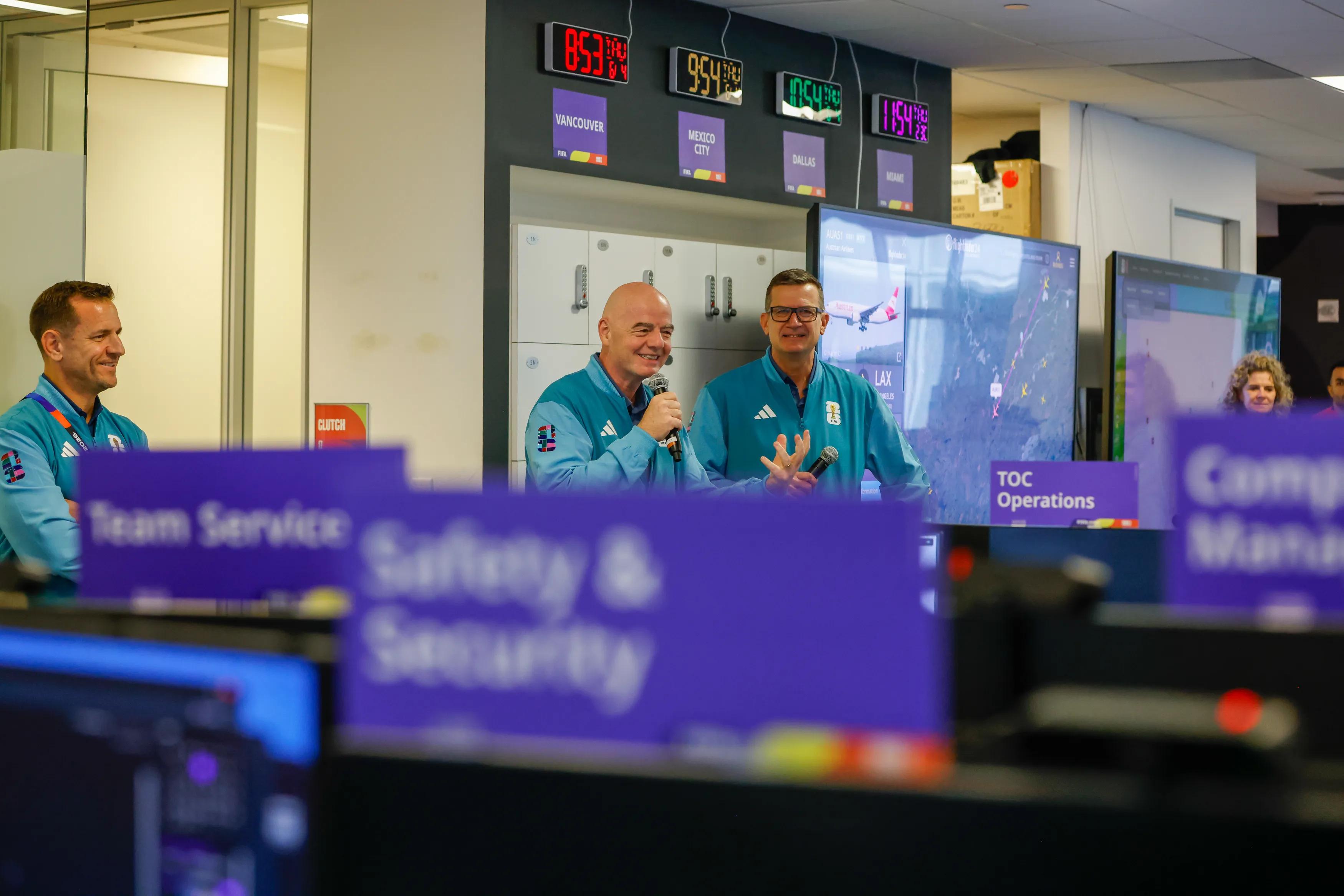
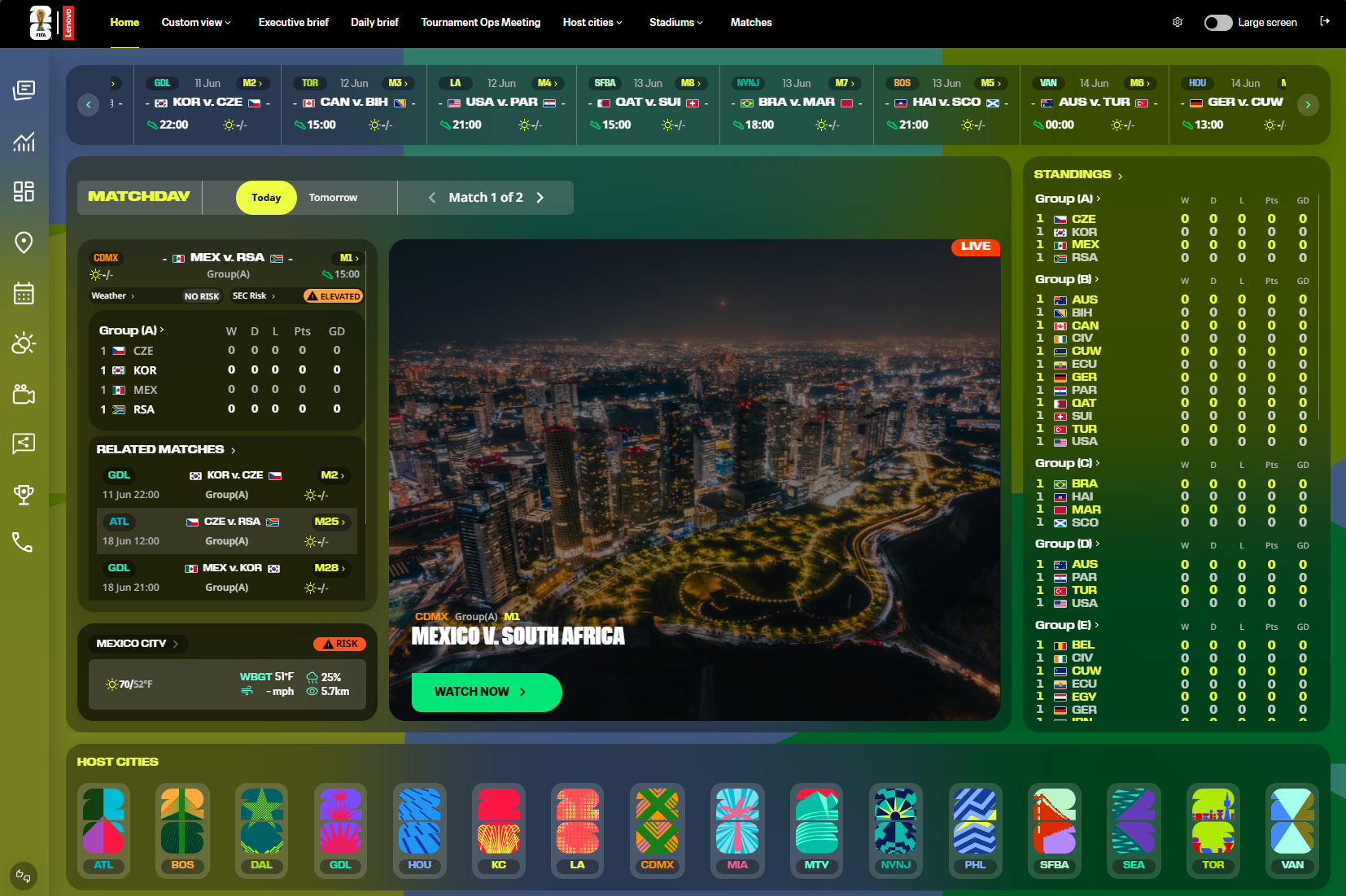
The second is a pair of KINEXON webinars that show the vendor's analytics platform running: a statistics view with per-player tactical tables, a 2-D and 3-D replayer, post-match report templates, and a pitch-control map. It is an honest look at what ball-and-position analytics produce. It is also a 2022 vendor demo on anonymized sample data: the on-screen refresh dates read 12 April and 8 August 2022, and it is not the FIFA officiating screen. The same KINEXON product family grew into the connected-ball system, but these frames predate the World Cup (KINEXON, 1 Sep 2022). verified (2022 vendor exemplar)
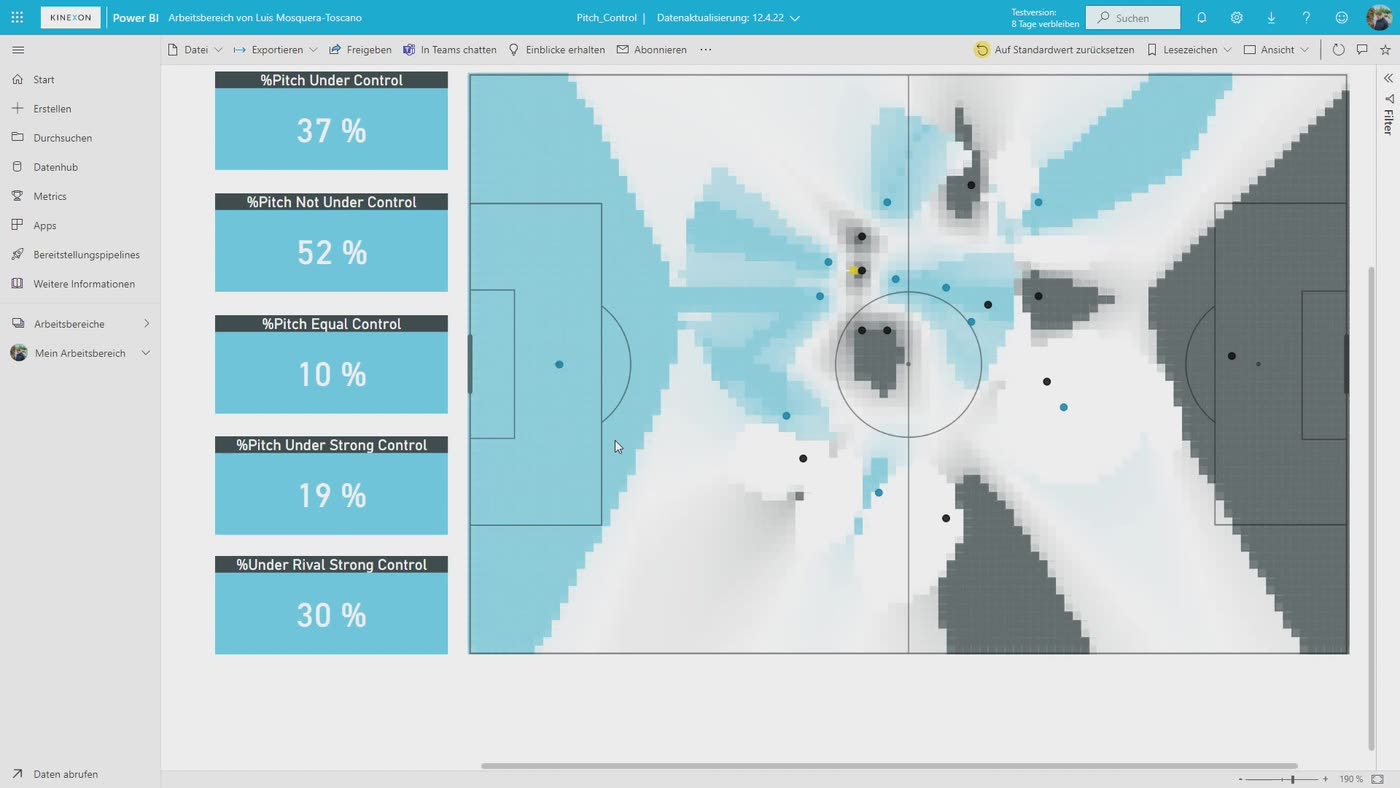
- The foundation model behind the Football Language Model and Football AI Pro: its vendor, family, open-versus-closed status, and size are named in no public source. Best-supported read is a self-hosted open-weight, Llama-class model served via NVIDIA NIM, swappable by region. Resolves with a Lenovo solution brief, a FIFA technical-regulations annex, or a future model name. open
- Whether any FIFA AI work ever touches a major cloud provider despite the on-site framing. Disfavored by the stated on-site setup, but not excluded. open
- How the portal handles login and keeps each team's data separate: login-gated is verified; the rest is not exposed in the public page and was not probed. open
- The model behind ServiceNow Now Assist in FIFA's account: not in the app; needs disclosure from FIFA's ServiceNow setup. open
The intelligence works and every team gets the same access. The engine behind it stays a blank. All of it, the verdict on the pitch, the 2,000 metrics, the team AI, is built for professionals at the base camps. That leaves the closest-to-home question: how does your app get any of this?
How the public FIFA app gets its data

The short version
The same family of stats reaches the public fan app through a feed with no lock. The players' own app reaches its data behind a personal login. The apps' published code shows the fan app requesting public match numbers, and a fleet of FIFA apps built on different tools with no shared sign-in.
The same family of stats reaches the public fan app through a front door with no lock. It reaches the players' own app through a per-user login. Same data, two opposite designs. The rest of this section works it out from the code, then steps back to the five-app fleet behind it.
Everything here was read statically. The sources are the public Android binaries pulled apart with apktool and jadx, plus public app-store labels and public DNS. Nothing was logged into, no endpoint was called, no credential was submitted. Any feed authentication described below is read from the client's config and network code, not probed on the live server. Secret values are shown as a name plus the first and last four characters. This ground rule shapes every claim that follows. verified
The two data-hub feeds, side by side
FIFA serves its Enhanced Football Intelligence stats to fans and to players
through two separate backends. The names look almost identical, so they are easy to confuse. The fan app calls
fdh-api.fifa.com, the Football Data Hub. The players' app calls fdp.fifa.org, the FIFA Data
Platform. Both carry the same numbers, the EFI metrics built off the tracking pipeline traced so far. They share no
login at all. verified

Feed one: the fan app pulls stats through a door with no lock
The FIFA Official app is the one that shows match data (com.fifa.player is the player app, this one is
com.fifa.fifaapp.android, v6.5.4). It is built on Kotlin
Multiplatform with Ktor as the HTTP client. The jadx decompile kept
FIFA's own package and source-file names, so the API calls read almost like source. The live stats come from
the Football Data Hub at base https://fdh-api.fifa.com/v1, through an interface named IFDHAPI
(the implementation is the obfuscated class FDHAPI, pb0/C34634d). Four methods, all keyed by a
match "IFES id":
// FIFA Official app · Ktor FDHAPI client (com.fifa.legacy.network.FDHAPI)
// base = ke.a.d = "https://fdh-api.fifa.com/v1"
GET /stats/match/{matchIfesId}/players.json     // live per-player EFI metric arrays
GET /stats/match/{matchIfesId}/teams.json       // live per-team EFI metric arrays
GET /stats/season/{seasonId}.json
GET /stats/season/{seasonId}/teams.json

// the client config installs JSON + a response validator + exception logging only.
// NO Authorization header. NO Ocp-Apim-Subscription-Key. NO api-key.   (static-inferred; not probed)
The response is a compact table of numbers, Map<String, List<List<JsonPrimitive>>>,
keyed by player or team id, each pointing to rows of bare values. The metric names live in the app, not on the wire.
The .json file-style paths, plus a sibling AWS CloudFront
match-data CDN at d1pm0fe67fpjw8.cloudfront.net/fifa-matches-wc, are the shape of cacheable static JSON.
The Ktor client that fetches it attaches no Authorization header and no API-key header at all.
So as far as the code shows, anyone who knows a match's IFES id can fetch the live EFI feed.
verified
The app reads it on a 20-second poll (tickFlowInterval = 20000). That makes it a near-live reader of an
already-curated feed, one that sits downstream of the human gate from
the previous-but-one section. It is not a real-time stream or a way around it.
One hedge travels with that claim. The zero-auth read is from the per-client config. A global Ktor
DefaultRequest or Auth plugin, somewhere the static read did not reach, could in principle add a
header, and the no-probe rule meant the endpoint was not called to settle it. So the precise wording is "no
client auth header in the decompiled client," not "confirmed open on the wire." An independent verifier reproduced
the same zero-header read from IFDHAPI and pb0/C34634d.java, as far as static analysis can
take it. static inference, not live-probed
Feed two: the players' app pulls the same family of data behind a personal token
Now the other door. The FIFA Player app (com.fifa.player, v3.0.10) is where a player reviews
their own match. It is a thin skin on the Imgzine/Triple "androidcore" white-label platform, with the FIFA-specific
logic in a bundled fifa-player module. Its data backend is the FIFA Data Platform at base
https://fdp.fifa.org/api/v2.0/, through a Retrofit interface named DataService.
Every call carries a per-user bearer token. An OkHttp interceptor named
PlatformRequestInterceptor attaches Authorization: Bearer <accessToken> to every request.
One request is the exception, flagged isNotAuthorizable: true and used only by the
downloadPdf call. Login is mandatory (APP_LOGIN_METHOD = "required").
verified
// FIFA Player app · OkHttp PlatformRequestInterceptor, on every call:
GET https://fdp.fifa.org/api/v2.0/FifaPlayerApp/GetMatchInfo?RegistrationKey={…}&playerKey={…}
   Authorization: Bearer eyJh…<redacted per-user access token>…_sig

// the DataService surface (base = /api/v2.0/, per-user Bearer):
//   FifaPlayerApp/GetPersonAppInfo            own (or ?playerKey=) profile + role
//   FifaPlayerApp/GetMatchInfo                the per-match EFI / heatmap dossier
//   FifaPlayerApp/GetSelectedTeamPlayers      ?SelectionEditionKey=
//   FifaPlayerApp/GetTeamsForCompetition      ?competitionEditionKey=
//   FifaPlayerApp/GetPersonImagesForMatch     ?MatchKey=
//   PlayerAppResourceHub/GetResources | GetLanguages
//   downloadPdf -> GET {url}   header isNotAuthorizable:true   (the lone unauthenticated call)
The token is minted by a Duende/IdentityServer-style login server on
fdp.fifa.org itself, with a public client client_id="OAuth", no client secret, and
PKCE doing the protecting. (The identity machinery behind that, and the fact that fdp.fifa.org also federates to a
Microsoft Entra tenant, is the next subsection.)
The bearer unlocks a rich personal dossier in the GetMatchInfo payload: a 20×14
heatmap encoded as a 280-character digit string (with a finer 7,245-cell variant, about
one cell per meter on the pitch), five speed zones each split into in-possession, out-of-possession and dead-ball
distance, distance covered, average and top speed, sprints over 20 km/h, a pass matrix, line breaks, final-third entries,
goal attempts with xy coordinates, aerial and ground challenges, a radar, goalkeeper saves, the FIFA Power
Index, and team-level EFI, all aligned to four camera angles by a per-event
syncOffsetInMs. It is a post-match review tool (matchDataStatusType:"Finished") that loads once
the game is over. verified
fdh-api.fifa.com/v1 (fan app,
near-live, no client auth header) and fdp.fifa.org/api/v2.0/ (players' app, post-match, per-user
bearer token) are two different FIFA data-hub backends. They carry the same metric family for different audiences,
with opposite logins. That is how the public app gets its data: an unauthenticated GET against a
public stats feed. verifiedThe open feed tracks the sensitivity of the data. The numbers on fdh-api are the same broadcast
stats FIFA already pushes to scoreboards, apps and TV, so an unauthenticated public feed is a normal choice. The
players' personal dossier, which links a named individual to their own physical-performance telemetry, sits behind
a mandatory login instead. verified
The content API in one line, and the fleet behind it
The fan app also pulls its richer match and content data from a third backend, api.fifa.com/api/v3
(internally "FDCP", the Match Data Platform): fixtures, live scores, event timelines including VAR
notifications, squads, standings. That is roughly 55 endpoints, consumed largely as an unauthenticated guest behind an Azure API
Management key (Ocp-Apim-Subscription-Key, value 2b1a…58bf). It is content plumbing, separate
from the EFI stats feed. The full route list lives in the endpoint appendix.
verified
FIFA ships a fleet, around fifteen apps across the two stores. Five were pulled apart binary by binary for this report, and below the logo they share almost nothing: four engineering stacks wired to three identity vendors, with no single sign-on bridging them.
| App · package | Stack | Identity |
|---|---|---|
Official / FIFA+com.fifa.fifaapp.android | Kotlin Multiplatform + Ktor | PingOne + DaVinci (EU) |
Tournament (ticketing)com.fifa.tournament | Flutter + native + Compose | PingOne + DaVinci (same EU tenant) |
Player (performance)com.fifa.player | Imgzine / Triple "androidcore" | Microsoft Entra + Duende on fdp.fifa.org |
Media (accredited press)com.fifa.mediahub | React Native / Expo / Hermes | Microsoft Entra (second tenant, runtime-injected) |
| Mobile Tickets (wallet) Apple id6532603739 | binary not obtained | (likely PingOne) |
Two package names are easy to get wrong: the Google Play listings confirm the player and press apps are
com.fifa.player and com.fifa.mediahub, not the older
com.fifa.fifaapp.player / com.fifa.media. corrected
Two identity regimes run across the five, with no federation between them. The two consumer apps (Official,
Tournament) share one Ping Identity tenant, environment 3f85e2e1-…, home region EU. The two workforce
apps (Player, Media) live in Microsoft Entra, on different tenants (Player's e8b93319-… is named in
the binary, Media's is supplied at runtime and never appears in the package). Add the tracking vendor Catapult's
own Auth0 tenant, and that is three identity vendors and at least three FIFA-side tenants for one tournament.
verified
Certificate pinning across the fleet is light and uneven. It is applied
to exactly one host, the login endpoint auth.fifa.com (a single pin shared by the two consumer apps). Every
other host, the EFI feeds included, is checked against the device's built-in list of trusted authorities.
The players' and press apps pin nothing at all. verified
The fleet's other details belong to the appendix, not to the question of how the app gets its data: the Tournament app's NFC ticketing on SECUTIX's TixnGo and its ServiceNow "Now Assist" support chatbot, the Media app's staff "view-as" impersonation header and its PairIP-wrapped Hermes bundle.
Independent teardowns reached the same picture
Two third parties analyzed the same FIFA apps with no contact with this project, and the outside record lines up. NowSecure, a mobile-security firm, published a free risk report for the Official app and independently reproduced the host map drawn here. It found the same connections to Akamai, AWS, Cloudflare and Google across the US, Frankfurt and Toronto, the same light dangerous-permission set (camera, biometric, notifications, no location, microphone or contacts), and the same collection of the device build fingerprint (NowSecure MARC). verified
Exodus Privacy, a French non-profit tracker auditor, counted the embedded trackers and permissions: 10 trackers and 21 permissions on the Official app, and 6 trackers and 28 permissions on the Tournament app, in line with this report's SDK inventory (Exodus, Official app; Exodus, Tournament app). The exact tracker names could not be pulled, the report-detail pages were unreachable, so the counts are confirmed and the named list is not. verified (counts) tracker names not retrievable
One trap surfaces whenever people search for "FIFA app privacy." Two widely-cited
exposés are about the Qatar-2022 government apps, Hayya and Ehteraz, the contact-scraping, call-history-reading
state apps analyzed by CNIL and Promon, not the FIFA-published com.fifa.* apps studied here
(Cybernews;
Private Internet Access). A different set of apps, a different tournament. verified (do not merge)
- Whether
fdh-api.fifa.com/v1's stats are served without any auth header end to end, or whether a shared KtorDefaultRequest/Authplugin (not reached in the static read) adds one. The endpoint was deliberately not probed. - Whether match IFES ids can be enumerated from
/timelinesor the in-stadium geofence responses, and the human-readable EFI metric names behindfdh-api's number arrays (in a client-side schema not fully recovered here). - Whether
fdp.fifa.orgissues opaque or JWT access tokens, and the exact Azure region of thefdporigin (Azure App Service is header-confirmed, the precise region is not). - The Media app's Entra tenant GUID, injected at runtime and absent from the binary, and the fifth app, FWC2026 Mobile Tickets, which was not obtained, so its stack, identity provider and pinning are unknown.
That is how the public app gets its data. The next section shows where those feeds physically live, and the one after that maps the companies behind every box in the diagram.
Cloud and infrastructure footprint

The short version
The two systems run on separate clouds, by design. The offside and tracking side answers on Amazon, with most of its addresses off the public internet. The fan side rides an Akamai edge into Microsoft and Google. The two never meet, the same locked-versus-open split seen at the apps, one layer down in the addresses.
Two systems decide a match, and they run on different clouds by design. The officiating side, which settles offside, answers on Amazon. The fan side, which fills your phone, rides an Akamai edge into Microsoft and Google. It is the same split you met at the apps' front doors, one layer down in the IP addresses.
The officiating plane is on AWS
The tracking pipeline's backends sit in one autonomous system, the block of
addresses one organization announces to the internet: AS16509, Amazon's main commercial network. Two vendors,
one address space. Hawk-Eye's broadcast-data layer answers on
hawkeyeinnovations.com, an Amazon address by authoritative RDAP
(RDAP 13.248.177.213).
KINEXON's FIFA tracking host, fifa.kinexon.com, resolves to a
single server in Amazon's us-east-1 region, RDAP Amazon again
(RDAP 34.232.89.6). The ball's
position stream and the optical engine that draws the offside line both terminate on the same network.
verified (the cloud the hostnames sit in)
Resolving a hostname and looking up who owns the address tells you which cloud the host lives in. It does not tell you how the deployment is wired on match day: zones, hot failover, a per-venue fallback box, the instance counts behind the one address that answers. All reasonable for a tournament that cannot drop a frame, but no public source enumerates it. The cloud is a fact; the match-day topology is an inference. inference (match-day redundancy, HA, failover)
Most officiating hosts will not resolve for you
Most of KINEXON's officiating hosts do not resolve from the public internet:
engage-officiating.kinexon.com, the dedicated offside-alert surface; the GNSS pipeline; the
real-time mesh. Each returns NXDOMAIN, the DNS answer for "no such name." They are not firewalled; they do not exist
in public DNS at all. KINEXON runs split-horizon DNS, so those names resolve only inside its own network. The lone
host that answers publicly, fifa.kinexon.com in us-east-1, pins the cloud.
verified
Their existence is still knowable through Certificate Transparency. Every security certificate a vendor issues is logged to
public, append-only CT logs, hostnames included. So the officiating names appear there even though they never resolve. The same
logs draw Hawk-Eye's per-camera fingerprint: thousands of entries shaped like
<N>.{dev,ctf-dev}.broadcast.data.hawkeyeinnovations.com, numeric labels consistent with roughly sixteen
cameras across sixteen venues, all under AWS, none with a public address. The names are public record; the addresses
behind them are not. verified (CT entries)
inference (the per-camera reading of the numbers)
The fan plane is a different stack
The other system, the one that ends on your phone, runs on a different cloud. Every *.fifa.com
host the fan and player apps reach sits behind an Akamai edge, where the secure connection terminates and Akamai's bot
defense runs (RDAP 23.196.3.189).
The origins behind it are picked per job. The FIFA-operated API and identity tier runs on Microsoft Azure.
cxm-api.fifa.com fronts an Azure app server, and the player-data host fdp.fifa.org and media host
api-media.fifa.com both carry Azure signatures in their live response headers. Google Cloud / Firebase handles the mobile plumbing: push
notifications, crash reporting, and remote config, split into three projects, one per app family
(fifa-fta, fifa-player-app, fifa-media-hub-app), from the decompiled app
resources. verified
Small enough to hold in your head: one edge and a few function-specific origins.
| Plane | Cloud | What runs there |
|---|---|---|
| Officiating & optical | AWS (AS16509) | Hawk-Eye broadcast data on Global Accelerator; KINEXON ball and position ingest in us-east-1 |
| Fan & player edge | Akamai | every *.fifa.com host; TLS termination; Bot Manager |
| App & identity API | Azure | cxm-api, fdp.fifa.org, api-media on App Service plus APIM, behind Akamai |
| Mobile plumbing | GCP / Firebase | push, crash, remote config; three projects, one per app |

The split is the finding
The two traces never cross. The data that settles offside never touches the Akamai edge your phone hits. The open stats feed your phone pulls never reaches the AWS network where the offside engine runs. The boundary lines up with the auth contrast at the app layer, the locked door for officiating and the open one for fan data. verified (the planes are physically separate)
One slice of this infrastructure does double duty as evidence elsewhere. The vendors in the redistribution chain publish
DNS verification tokens, the small records that prove domain ownership to a SaaS or an AI provider. Across the
chain, the data distributors carry both Anthropic and OpenAI tokens while the optical vendor carries neither
(CT, hawkeyeinnovations.com;
the TXT records are observable directly with dig TXT). That pattern feeds the
foundation-model question. The AI layer (Section 8) works out what it does and does not imply. The conclusion there: the tokens describe the vendors' own toolchains, not the model behind FIFA's tool.
verified (public DNS TXT records)
- The match-day topology of the officiating plane, redundancy, hot failover, any per-venue fallback box, the instance counts behind the one host that answers publicly. RDAP proves the cloud; it does not enumerate the deployment.
- The IP space behind KINEXON's split-horizon officiating, GNSS and mesh hosts, and behind Hawk-Eye's per-camera
broadcast.dataSANs. Enumerable from CT logs; no public A record. - The exact Azure regions actually serving production traffic for
fdpandapi-media. The Azure stack is header-confirmed; the region is read from host-name conventions.
The IP addresses draw the same boundary the auth headers did. One question is left: who owns the companies behind every box in the diagram? Section 11.
Corporate and the shell game

The short version
Several vendors that look independent trace back to a few owners: Sony holds both the optical engine that draws the offside line and one of the big vest makers, and the offside algorithm lives in a tiny Swiss company jointly owned by FIFA and that engine's maker. The recurring blank is price, because FIFA publishes no contract values.
Hawk-Eye, the optical engine that draws the offside line, and STATSports, one of the two big training-vest makers, share a parent: Sony. Sony has assembled most of a sports-tracking portfolio, so several vendors that look independent trace back to one owner. The two tiers stay apart in use. Officiating runs on Hawk-Eye through a FIFA joint venture; the vests are the teams' own kit. A large electronics company owning sports-tech firms is ordinary, but worth knowing when the branding makes them look separate. This section maps who owns each box, who builds it, and the one figure none of them publishes: the price.
Sony owns both ways of seeing
The two tracking subsystems meet at one owner. Hawk-Eye Innovations Ltd, which builds the SAOT optical engine and the SkeleTRACK pose model, is a wholly owned Sony company. The UK register lists Sony Europe Limited as the person with significant control, holding 75% or more of the shares, notified 3 March 2025 verified. The same Sony Europe Limited also controls STATSports Group Ltd, the Newry company behind the Apex wearable pods, the control entry notified on the register 7 October 2025 and announced the next day verified. Sony made the pairing explicit: it bought the wearable maker to build "a comprehensive optical and wearable tracking solution" alongside Hawk-Eye (Sony press 25-037E, 8 Oct 2025).
The register draws Sony's control over STATSports carefully. Sony holds more than half the shares but under 75%, yet more than 75% of the voting rights, plus the right to appoint and remove directors. So the founders, Alan Clarke and Sean O'Connor, kept a real slice of the equity while Sony took control.
The two are not a standalone pair. The same Sony release names the biomechanics firm KinaTrax and the virtual-recreation studio Beyond Sports as group companies, and the sports-platform shop Pulselive sits in the same portfolio. So when the offside graphic draws itself from a dressed avatar, the geometry is Hawk-Eye and the rendering style Beyond Sports built, both under the same Tokyo parent.
The board ties them tighter still. The same two Sony-side directors, Atsuki Matsuzawa and Fumiatsu Hirai, now sit on both the Hawk-Eye and the STATSports boards, having taken their STATSports seats the day Sony's control was notified, 7 October 2025 verified. The two nominally independent vendors share named individuals at board level, not just an ultimate owner.
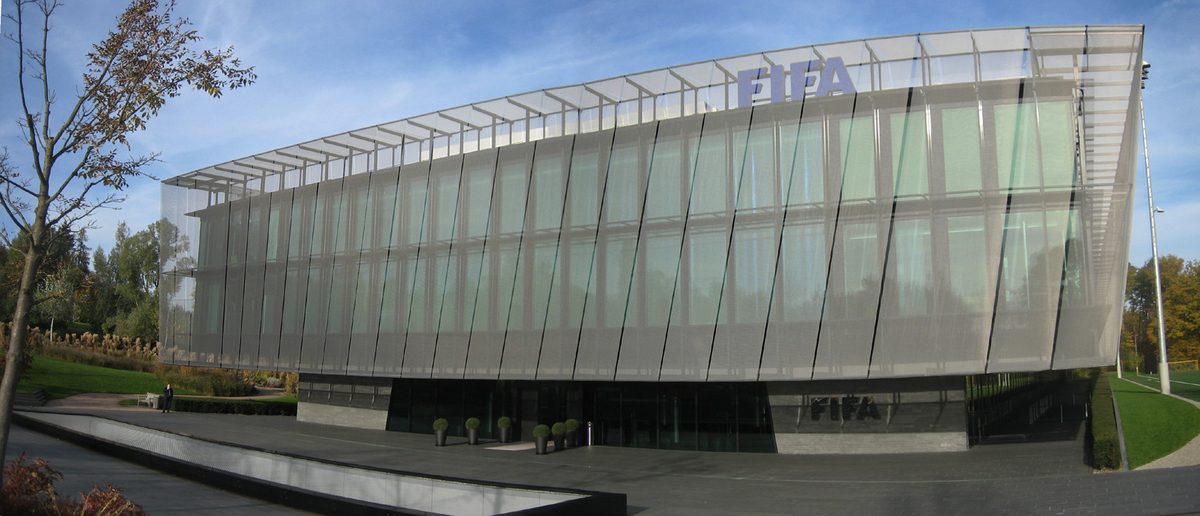

The shells, counted once
The path into Hawk-Eye is a textbook restructuring trail.
Hawk-Eye's control ran for years through a stack of Dutch holding companies, Sony Europe B.V. and two others, all
collapsed and ceased as controllers across a three-day window at the end of October 2024, then replaced by the new UK
holdco Sony Europe Limited (Companies House 15698470, incorporated
1 May 2024)
by March 2025 verified. One intermediate vehicle, named "Newco1
Hive B.V.," appeared and vanished inside a single day. Nine separate legal
layers, live and ceased, were touched between 2018 and 2025 to land Hawk-Eye and STATSports under one Weybridge address.
The timing lines up. That Dutch-to-UK collapse happened in the same fortnight a new Swiss company was incorporated in Zürich, so Sony rebuilt the holding layer for its sports-tech assets as FIFA's offside joint venture was standing up. Both dates are independently verified; their coordination is the reasonable read, not a filed fact. inference (coordination)
FTC AG, the joint venture that owns the offside algorithm
The algorithms that settle an automated offside belong neither to Hawk-Eye nor to FIFA directly, but to a joint
venture. Football Technology Centre AG is a Swiss company limited by shares, register identifier
CHE-427.492.520, domiciled c/o FIFA, FIFA-Strasse 20, 8044 Zürich, its stated purpose to build
"first-class functional algorithms grounded in football logic" for "automated real-time detection of factual on-pitch events"
(Swiss commercial register, FTC AG).
Its parents are FIFA and Hawk-Eye, which is to say FIFA and Sony, and it is the legal home of the productized offside logic
described earlier. verified
It is a small thing to own a World Cup's decision-critical software. The share capital is USD 120,000, fully paid as 100,000 registered shares at USD 1.20, audited by PricewaterhouseCoopers AG, run by a three-person board (Swiss register, FTC AG). The currency is the odd detail. A Zürich company would normally be capitalized in Swiss francs, so the choice of dollars is the one public hint of a non-Swiss, Sony-side hand in the cap table, a hint, not proof inference (USD-denomination hint).
The split itself is sealed. Swiss companies of this kind need not publish a shareholder register, and the FIFA-to-Hawk-Eye ratio appears in no FIFA report, no Sony filing, and no Swiss gazette. Who actually controls the company that owns the offside algorithm is not derivable from public records, and no percentage is guessed here unverifiable (the FIFA-to-Hawk-Eye equity split).
The regulator that approves the technology chairs the venture that builds it. The president of the FTC AG board, Johannes Holzmüller, also heads FIFA's own football-technology and innovation function, the department that commissions, tests, and approves match technology. The Swiss register names him President of the joint venture's board; FIFA's published pages name him its Director of Innovation verified (the interlock).
The overlap is composed from those two sources; no single document states it, and the JV's launch announcement names only the FIFA Secretary General and the Hawk-Eye CEO, not Holzmüller. The longer title "Director of Football Technology and Innovation" that some profiles carry is an aggregator rendering, not FIFA's own. The identity match, same name, same FIFA tech remit, is clean.
What the interlock implies about FIFA's control of the venture stays open. Chair plus department-head is role concurrency, and with the equity split sealed the "FIFA-controlled JV" reading is inference, not fact.
The patents draw a cleaner line. The camera-fusion patent, US 11,514,678 B2, is assigned to Sony and Hawk-Eye, not to FTC AG (US 11,514,678 B2). So the boundary reads: Sony owns the patents, FTC AG owns the productized offside algorithm. That the algorithm IP sits in FTC AG specifically, rather than being licensed from Hawk-Eye, is read off the register's purpose clause, not a filed assignment inference (algorithm-versus-patent boundary).

KINEXON, Lenovo, and the round that was not a BMW round
The sensor inside the ball comes from KINEXON, which is not one company but a
four-entity German group plus a US arm, under the common control of its two founders, Alexander Hüttenbrink and Oliver Trinchera.
The operating parent is KINEXON GmbH (HRB 200097 at the Munich register), which began life in 2012 as
SporTactics GmbH and was renamed by 2013
(German Handelsregister via Northdata)
verified. Below it sit the trading entity KINEXON Sports & Media GmbH, a holding shell,
and an industrial-automation arm, with KINEXON Inc in Chicago as the US entity and the FCC grantee for the radio hardware. The
structure is ordinary. One company supplies both the in-ball sensor and player-tracking, under
FIFA's Preferred Provider designation for Live Player and Ball Tracking, named July 2022.
KINEXON's funding history is widely mis-told, and the correction changes who the company answers to. The April-2022 round reported as "a BMW i Ventures minority stake" was a $130 million Series A led by Thomas H. Lee Partners, the Boston private-equity firm, with BMW i Ventures and Deutsche Telekom's strategic fund as co-investors, not the lead (Business Wire, KINEXON $130M; BMW Group press) corrected. BMW's own release confirms a minority position and discloses no amount. So the larger new shareholder in the maker of the in-ball sensor is a US private-equity firm, not a carmaker. The exact percentages are sealed: the German register gates the shareholder list, so THL's, BMW's and the founders' stakes are not public, though the founders stayed on as co-CEOs and kept executive control unverifiable (KINEXON cap table).
Lenovo is FIFA's Official Technology Partner for 2026 and the 2027 women's tournament, announced 15 October 2024, and the supplier of the compute behind the avatars, the broadcast feeds, the Referee View, and Football AI Pro verified.
Two data-rights deals run alongside, complementary rather than competing. Stats Perform (owned by the private-equity firm Vista Equity Partners) is FIFA's first official worldwide betting-data and stream distributor, exclusive for 2026, announced 12 January 2026; Sportradar is FIFA's integrity and bet-monitoring partner, extended through 2031 verified.
Genius Sports, often named in the same breath, has no FIFA-central deal for 2026; it works at member-association level, and its link to this stack is historical, having bought the 2022-era optical firm Second Spectrum for USD 200 million in 2021, a lineage easily confused with Hawk-Eye.
Adidas through 2030, with the dates fixed
The ball itself is Adidas, FIFA's Official Match Ball supplier through 2030, and the end date is one more thing repeated incorrectly. It does not come from a "2021 renewal," as a wave of July-2021 articles implied; those pieces republished an older Adidas release verbatim. The through-2030 term was announced on 21 November 2013 in Moscow (NBC Sports, Adidas-FIFA extension) corrected (the date). The value, like every other contract here, is undisclosed; press estimates put it north of a billion dollars, which would make it the largest in FIFA history, but that is an estimate, not a filed number unverifiable (value). Adidas's commercial counterparty for the sensor is KINEXON, not FIFA directly, a supplier relationship that runs from Al Rihla in 2022 to the Trionda in 2026.
One corner that changed hands in bankruptcy
One piece of the supply chain moved through a Chapter 11.
The video delivery network behind FIFA's media app, content.uplynk.com, is Uplynk, whose lineage runs Edgecast to
Verizon Digital Media Services to Edgio. Edgio filed for Chapter 11 on
9 September 2024, and the Uplynk business emerged from
bankruptcy wholly owned by the hedge fund Lynrock Lake, so the live FIFA media-video path now sits under a hedge fund
verified. Separately, Akamai, which already
fronts every *.fifa.com hostname as FIFA's edge,
acquired the other Edgio contracts, so two slices of the same
defunct network landed with two of FIFA's own vendors.
The officiating side has a smaller echo: the founder of Riedel, the company behind the RefCam and its private 5G, acquired the Munich camera-and-lighting maker ARRI in full, announced 14 April 2026. Vendors here are bought and sold under the feeds while the feeds keep running.
The money nobody prints
The one thing this map cannot give you is a price. FIFA does not disclose vendor contract values, and its own accounts break out no line for tracking or officiating technology. The published 2023-26 cycle budget puts the 2026 World Cup event investment at USD 3,839 million, "Information Technology" at USD 106 million and "Digital Development Services" at USD 193 million across the cycle, with no line anywhere for SAOT, the Data Hub, or FTC AG (FIFA, 2023-26 cycle budget) verified. The cost of the offside system is absorbed inside those larger numbers.
The firm money lives at the parent-group level, and none of it isolates the FIFA spend: Lenovo's group revenue was about USD 83 billion for its 2026 fiscal year, Catapult's about AUD 116.5 million, and the only precise price tag in the whole space is a comparable, the USD 200 million Genius paid for Second Spectrum in 2021. Every FIFA-facing contract value, and both Sony acquisition prices, is confidential unverifiable (all FIFA vendor contract values).
The shell count is modest per vendor and concentrated in two places. Sony reaches both tracking vendors through five live entities and at least four ceased Dutch and UK shells touched in the 2024-25 restructure; KINEXON is four German entities plus a US arm; and the offside algorithm sits in one Swiss company audited by one firm. Everyone else, Adidas, Lenovo, Riedel, is a single clean entity. The map is a small cast with two dense knots inference (the "knot" framing; the entity counts are register-verified).
- The FTC AG FIFA-to-Hawk-Eye equity split. Swiss companies of this kind do not publish shareholders, and it appears in no FIFA or Sony filing. The USD-denominated capital is a hint of Sony-side structuring, not proof of a ratio. unverifiable
- The KINEXON cap table. The German register gates the shareholder list; the THL-led $130M round and the BMW co-investment are confirmed, the percentages are not. unverifiable
- Every FIFA vendor contract value (Lenovo, Hawk-Eye/FTC AG, KINEXON, Adidas, Stats Perform, Sportradar). FIFA discloses none, and the listed partners do not break out the FIFA line. unverifiable
- Sony's purchase prices for Hawk-Eye (2011) and STATSports (2025), and the STATSports founders' retained equity percentage. All officially undisclosed; the press figures are estimates. open
The receipts
Where every claim came from, what stayed open, and how the report was built.
Confidence ledger
The report's intellectual honesty lives here: every claim is labeled, and the genuinely open / disputed / unverifiable items are cataloged rather than papered over. Across the corpus, five independent verifier passes produced zero core refutations; the changes were corrections (a GNSS chip class, patent assignees, a model-procurement status) and honest "non-public" flags.
| # | Item | State | Why |
|---|---|---|---|
| CL1 | Trionda (2026) UWB transceiver generation / STS support | open | glob-topped, house-marked "V93LA1 2024"; resolvable only by decap/X-ray |
| CL25 | Foundation model under the Football Language Model / Football AI Pro | open | publicly undisclosed; best-inference self-hosted Llama-class via NVIDIA NIM; OpenAI/Claude/Bedrock each unevidenced for FIFA's tool |
| CL2 | Football AI Pro delivery channel | resolved | login-gated web portal aipro.fifa.org / fbai.fifa.org (Akamai-fronted), reached from Lenovo devices at team base camps; residual open edge = the portal's IdP and 48-team tenancy |
| CL8 | FIFA PTP profile / IEEE-1588 Annex-P authentication | open | internals not in public OSINT; decisive for how the timing layer is authenticated |
| CL9 | AR-earpiece alert channel auth/encryption | open | undisclosed; asserted "undisclosed," not "unprotected" |
| CL10 | fdh-api truly unauthenticated vs a global Ktor plugin | med/open | static-only; deliberately NOT live-probed |
| CL6 | STATSports Apex "dual-band RTK GNSS cm-level" | disputed | filed silicon = u-blox NEO-M9N (single-band L1, non-RTK); vendor-marketing |
| CL3 | FTC AG FIFA↔Hawk-Eye equity split | unverifiable | Swiss AGs don't publish shareholders |
| CL5 | All FIFA vendor contract values (Lenovo/Hawk-Eye/KINEXON/…) | unverifiable | confidential; no filing breaks them out |
| CL5b | Exodus tracker names per app (counts stand) | unreachable | host TCP:443 down + no Wayback; counts verified (Official 10, Tournament 6) |
| CL26 | SkeleTRACK neural architecture / framework / training set | open | only "ML / deep pose estimation" public; arch reserved by Hawk-Eye |
| CL27 | Foundation model behind ServiceNow Now Assist (FIFA tenant) | open | not in the binary; the enums label engine-type only, never the vendor |
| CL14 | 2026 30-second / 3-tablet live-delay rule | disputed/inference | no 2026 primary regulation text; 2022 model well-attested (carry-over) |
Corrections applied during verification (not refutations): STATSports APX400 UWB = DW1000; patent ledger re-attributed to primary sources; per-team Gemini upgraded disputed → confirmed.
Glossary
Plain-language definitions for every acronym and term of art in this report. These also power the hover-tooltips on dotted terms throughout.
Endpoint surface (selected)
Key backends from the 22-host estate, with their authentication posture. None were live-probed; these were read statically from decompiled clients and passive DNS/CT. Secret values are redacted throughout.
| Host | Role | Auth | Cloud / notes |
|---|---|---|---|
fdh-api.fifa.com/v1 | near-live EFI fan stats (Official app) | unauthenticated (static-inferred) | Akamai → origin |
fdh-api.fifa.com/v1/powerranking/match/{id} | per-match FIFA Power Index route (fan feed) | unauthenticated (same client, static-inferred) | Akamai → origin; recovered from a 2026 Wayback CDX capture |
fdp.fifa.org/api/v2.0 | per-player post-match EFI (Player app) | per-user Bearer (Duende) | Azure |
api.fifa.com/v3 | match / content (MDP) | APIM subscription key (reused) | Akamai → Azure |
cxm-api.fifa.com | FIFA+ CMS + PingOne broker | OIDC Auth-Code + PKCE | Akamai → Azure App Service (Japan East + Central US) |
api-media.fifa.com | media hub | Bearer + Mediahub-Impersonation-Trigram | Azure |
auth.fifa.com | consumer identity | OIDC; the one TLS-pinned host (LE-E8) | n/a |
engage-officiating.kinexon.com | KINEXON edge (ball track) | internal | AWS us-east-1 |
…broadcast.data.hawkeyeinnovations.com | Hawk-Eye optical/fusion plane | internal | AWS Global Accelerator (AS16509) |
football.service-now.com | ServiceNow Now Assist chatbot (ticketing); the only AI endpoint | OAuth client + WebRTC | ServiceNow; model server-side/unnamed |
content.uplynk.com | media-hub video CDN | commercial | Uplynk (hedge-fund-owned post-Edgio) |
fsdevglhub.servicebus.windows.net | Azure Notification Hubs (push) | DEV Listen-SAS key hardcoded in PROD Official app | Azure |
Sources & method
This dossier is OSINT-only. No live system was probed, no credential or non-public access was used, and no individual was targeted beyond their public professional role. Where a public document was bot-walled (e.g. Cloudflare), it was retrieved through the official primary source or a fingerprint-correct fetch; anything that stayed unreachable is flagged in the ledger.
Primary-source families
- FCC EAS equipment-authorization filings (grantees ZLG-SMCOMB, ZLG-ALRIHLAPRO, 2ALC5, 2APHS, 2ADAL): the device teardowns, RF test reports, and chip photos.
- Patents: USPTO/EPO (US11514678B2 SAOT camera-fusion; US12121776B2 ball suspension; KINEXON US11150321B2). USPTO 10,970,849 is ETH Zürich / Disney landscape, not Hawk-Eye.
- Corporate registries: UK Companies House (Sony Europe, Hawk-Eye, STATSports), Swiss commercial register / SHAB (FTC AG), German HRB (KINEXON entities).
- App artifacts: the four decompiled public APKs (Tournament, Official, Player, Media) + Hermes string tables.
- Passive infra: Certificate Transparency, RDAP, passive DNS, BGP/ASN, DNS-TXT verification tokens.
- Vendor & FIFA primary: FIFA innovation/media releases, Lenovo press + lenovopress product docs, Hawk-Eye SkeleTRACK pages, IFAB Law 4.
Standards & technical references
- IEEE 802.15.4z (UWB HRP PHY) · IEEE 1588 / PTP (precision time): the radio and timing layers.
- FIFA EPTS Standard Data Format + the FIFA Quality Programme test handbooks: the interchange schema.
- Hawk-Eye SkeleTRACK technical pages + the SAOT camera-fusion patent US11514678B2 (no public patent discloses the SkeleTRACK net; USPTO 10,970,849 is ETH Zürich / Disney landscape, not Hawk-Eye).
- Adidas / KINEXON connected-ball patents (incl. the cord-suspension US12121776B2).
- Independent third-party app analyses used as cross-checks: NowSecure, Exodus Privacy.
Per-claim sourcing is kept in the project's private working notes; this public page is the synthesis. Every node and edge in the map carries its own source list, and the appendix lists the primary-source families. Retrieval date for all web sources: 2026-06-16.
Image credits & licenses
Every embedded raster image, with its source and the basis on which it is used. Diagrams and the ecosystem map are purpose-built and carry no license constraint.
- Device teardown photos (the ball, anchors, wearables): U.S. FCC equipment-authorization public filings (grantees ZLG-SMCOMB, ZLG-ALRIHLAPRO, 2ALC5, 2APHS, 2ADAL), retrieved via fcc.report. Public-domain regulatory records.
- FIFA document page screenshots: captures of FIFA's own published PDFs, used for commentary with the source linked on each figure. The EFI pages (efi-*) are from FIFA's Enhanced Football Intelligence Explanation Document v1.1 (11 July 2023); the EPTS pages (epts-*) from FIFA's EPTS Standard Data Format specification; the VOL pages (vol-*) from FIFA's Virtual Offside Line handbook (via the Wayback Machine); the KINEXON page (kinexon-9) from the FIFA EPTS performance test report. © FIFA, editorial use.
- Body-scan booth: Lenovo StoryHub, "Building 3-D player avatars" (news.lenovo.com). Re-hosted with attribution and a source backlink.
- Semi-automated offside workstation: FIFA, "Offside decisions and referee body cams" (inside.fifa.com). © FIFA, editorial use, re-hosted with attribution.
- Riedel RefCam head unit: Riedel / EHF, "RefCam at EHF EURO 2026" (riedel.net). Press image, editorial use, re-hosted with attribution.
- Tournament Operations Center, Miami: FIFA, "Tournament Operation Center, Miami" (inside.fifa.com). Re-hosted with attribution.
- Intelligent Command Center dashboard: Lenovo StoryHub, "Building an Intelligent Command Center for FIFA World Cup 2026" (news.lenovo.com). Illustrative pre-tournament demo, re-hosted with attribution.
- IBC Dallas (exterior, aerial) and Home of FIFA, Zürich: Wikimedia Commons. IBC photos CC0 1.0 (public domain), by Raysonho and IcedCowboyCoffee; the Zürich photo MCaviglia / CC BY-SA 3.0.
- Club World Cup 2025 VAR-review scoreboard (external link in the optical section): Wikimedia Commons, CC BY-SA 4.0.
- All diagrams, charts and the ecosystem map: purpose-built for this report from the verified data (SVG / Cytoscape / Chart.js), selectable text, no licensing constraint.
Embedded images are downsized for web. Where a publisher holds copyright, the image is used for commentary with the source linked on the figure; nothing whose license is unclear is re-hosted without a backlink to the original.
How this was made
What this is
This report is AI-generated and AI-written. A human set the questions, steered the research, pushed for more depth, and independently validated the findings; the searching, cross-checking, drafting, and assembly were done by AI agents. None of it is presented as the human's own writing. The goal was to answer one question, as rigorously as open sources allow: how does the FIFA World Cup 2026 player- and ball-tracking stack actually work, end to end? A second goal: to see how far an AI research process could be pushed, and how well it could bind many independent sources into one coherent map.
The standard throughout is simple. Every load-bearing claim either points to a primary public source or is openly framed as inference. Where sources disagree or run out, the report says so.

1. Seed and scaffold
The work began from public questions and the known vendor set. One literal seed was a public forum thread asking what gadgets the 2026 referees are actually using. The first passes built the scaffold, starting with a vendor and corporate map, the public endpoint and subdomain estate, a correlation index, and an entity graph. Later, narrower questions hung off that frame.
2. The 78-target wave
A challenge agent interrogated the draft the way a relentless child would, asking "why? what is that? how do you know?" of every section, while also acting as a fact-checker. Its questions fanned out to 78 independent research agents, one per question, across the whole stack, from the silicon inside the ball, the pitch-side anchors, the transport network, the optical and semi-automated-offside systems, the AI and data-hub layers, the corporate and contractual chain, the patents, and the radio test filings. Each agent returned a brief in which every claim carried a confidence label (verified, corrected, disputed, inference, unverifiable, or open) and a primary-source link wherever one existed.
3. The social and behind-the-scenes sweep
A second wave widened the aperture from specifications to the human and visual record. Eleven parallel lanes covered YouTube, social posts, trade press, behind-the-scenes imagery, conference talks, public code, procurement tenders, job postings, betting and data feeds, the bench and analyst interface, and infrastructure glimpsed incidentally in general footage. Each lane ran the same shape: fetch widely, then pass every candidate through a classifier that ruled it keep, drop, or review against a strict football-only scope, then synthesize the keepers. Review items were never silently accepted. The orchestrator took a first pass on each borderline find, and the human monitored and overrode in the loop.
4. The browser pass
Much of the best material sits behind bot-walls and JavaScript that a plain fetch cannot read. For those, the orchestrator drove a real browser. That is how the report obtained the Lenovo "how it works" pages (the 3-D avatar pipeline, the Referee View stabilizer, the operations-center dashboard), the original referee-kit thread, a peer-reviewed offside-accuracy paper, and the vendors' own product screens, all of which had returned errors to every automated fetch.
5. The OCR-to-research chain
This is where the pipeline compounded, and it is the part most worth understanding. Collected images were not merely viewed; they were read for their incidental text, and every fragment became a lead. A vendor webinar frame showed an analytics dashboard whose owner was named on screen. Researching that name identified a KINEXON data scientist, which led to a conference speaker page, which pinned the exact event and date where the connected ball was first shown in public. A filename glimpsed on a slide identified the analytics deck behind it. The same loop dated that whole webinar to 2022, which is precisely why it is cited as a vendor exemplar of the analysis output rather than as a 2026 measurement. Image to text to person to document to fact.
6. The passive infrastructure pass
A final pass used only public indexes, drawing on search-engine document queries, certificate-transparency logs, the web archive, and the pre-collected Shodan index. There was no active scanning, probing, or login, in keeping with the report's posture of explaining how the stack works rather than testing it. The pass surfaced public technical PDFs with exact numbers and definitions. One was a FIFA performance test report that listed hard live-data latency figures and, in its own stated test method, named the RabbitMQ-to-Google-Cloud transport that earlier passes had only inferred. Another was the EPTS data-format specification, down to the on-wire frame layout. A third set was FIFA's own video-assistant-referee and virtual-offside test-method handbooks. Anything that looked sensitive would have been flagged to the owner rather than published; nothing of that kind appeared.
7. Keeping it coherent
Every pass wrote to durable files rather than to a chat window, among them per-target briefs, a correlation index and a graph, a classification log of what was kept or dropped and why, a review-resolutions log, a queue of pages that needed a browser, a browser-results log, and a running steering log that recorded each human instruction and the decision taken on it. Findings from different agents were deduplicated and cross-referenced, so a figure that appeared in a patent, a test report, and a conference talk could be triangulated rather than trusted once.
8. Mapping it back into a report
Integration re-authored every section to the cite-or-infer standard, folded in all of the above, rebuilt the original "how it works" diagrams and animations from the verified findings, and embedded the public imagery with its attribution. The whole page then passed through a final quality gate that renders the actual output and inspects it: prose and readability, citation and link integrity, acronym-to-glossary coverage, table fit, image legibility and licensing, animation legibility, and build integrity, looping fix-and-recheck until nothing serious remained.
9. On hallucination
The honest answer to "how do you know none of this is made up?" is not that it was prevented. It is that the process is built to catch it: confidence labels on every claim, primary-source citation as the default, cross-agent corroboration so that no single agent's word is load-bearing, adversarial checking that tries to refute findings, and plain open and disputed tags where the evidence is thin. As a live reminder of why that matters, the sweep turned up a polished "inside the Trionda factory" video that was itself entirely AI-fabricated, inventing chip details and viewer figures; it was caught and dropped, and it stands here as the cautionary case. The labels are the contract: trust the verified claims, weigh the inferences, and treat the open questions as open.